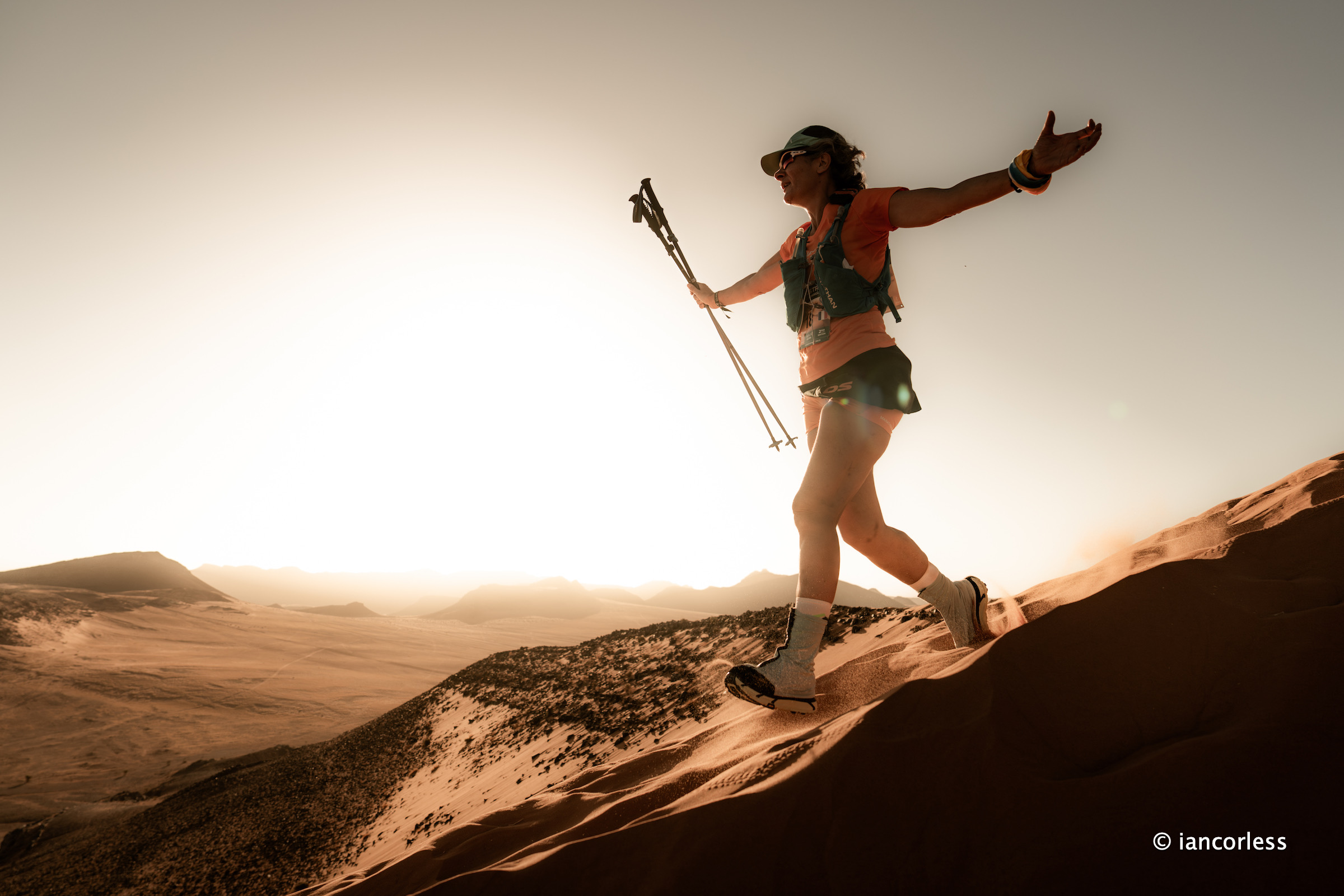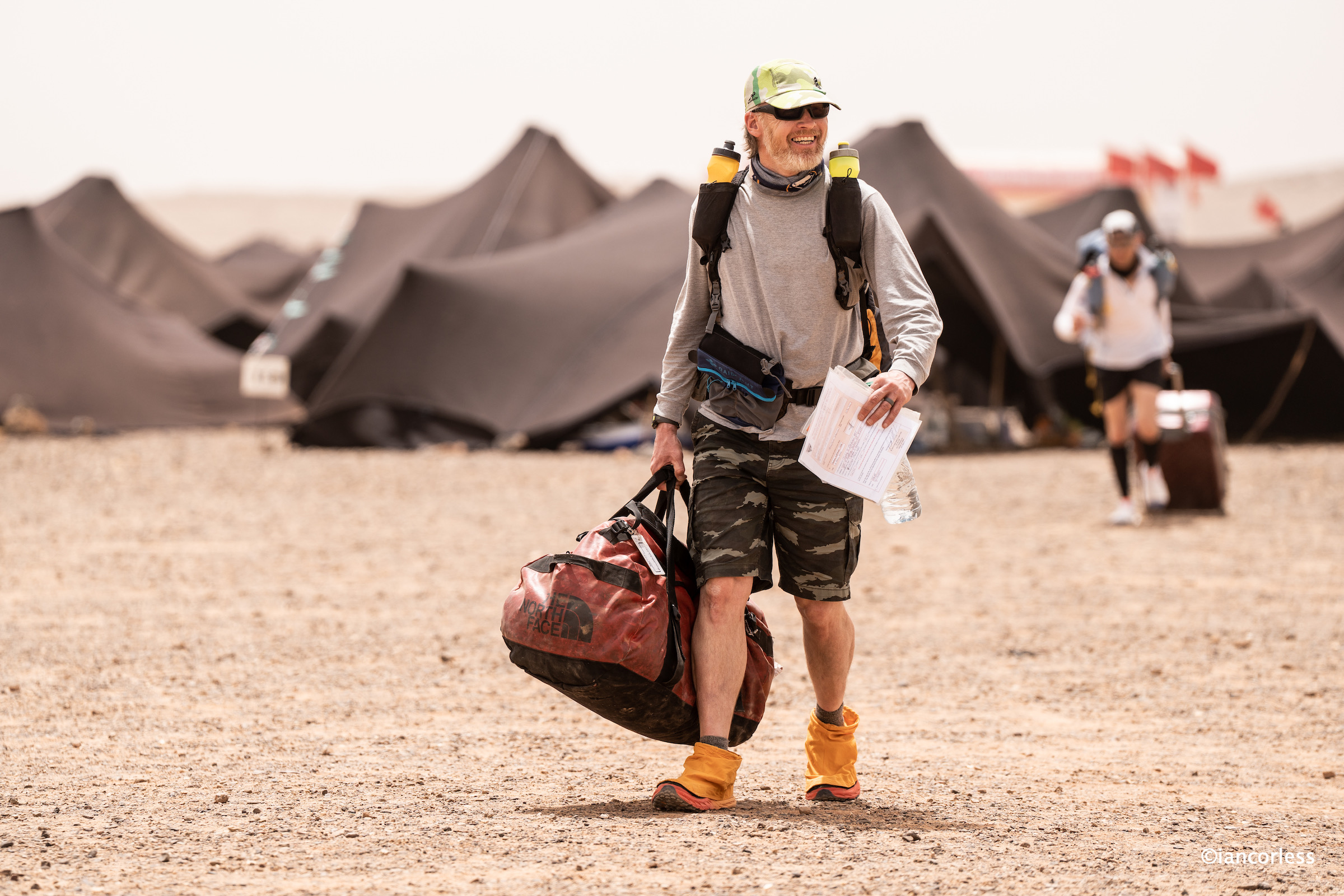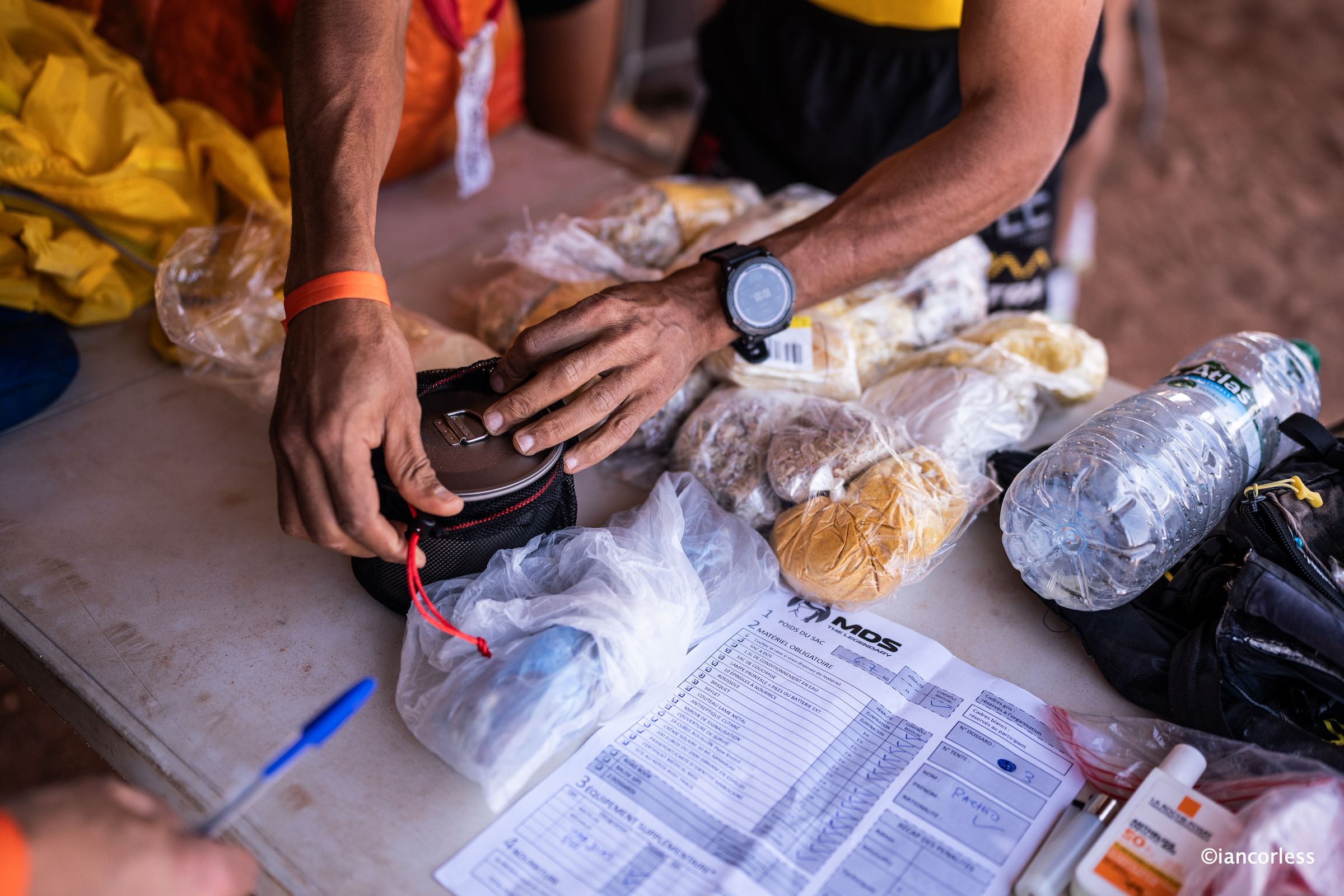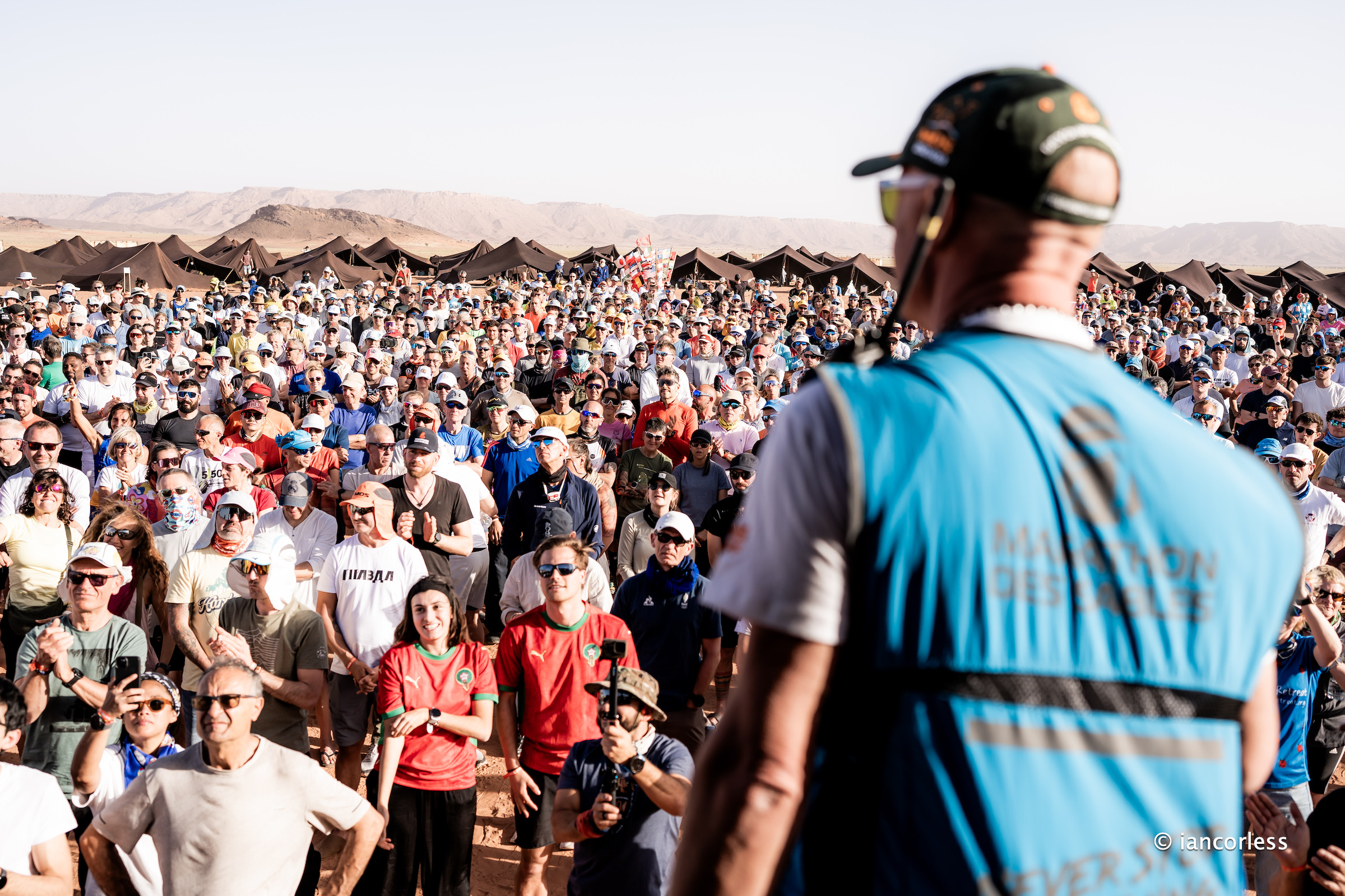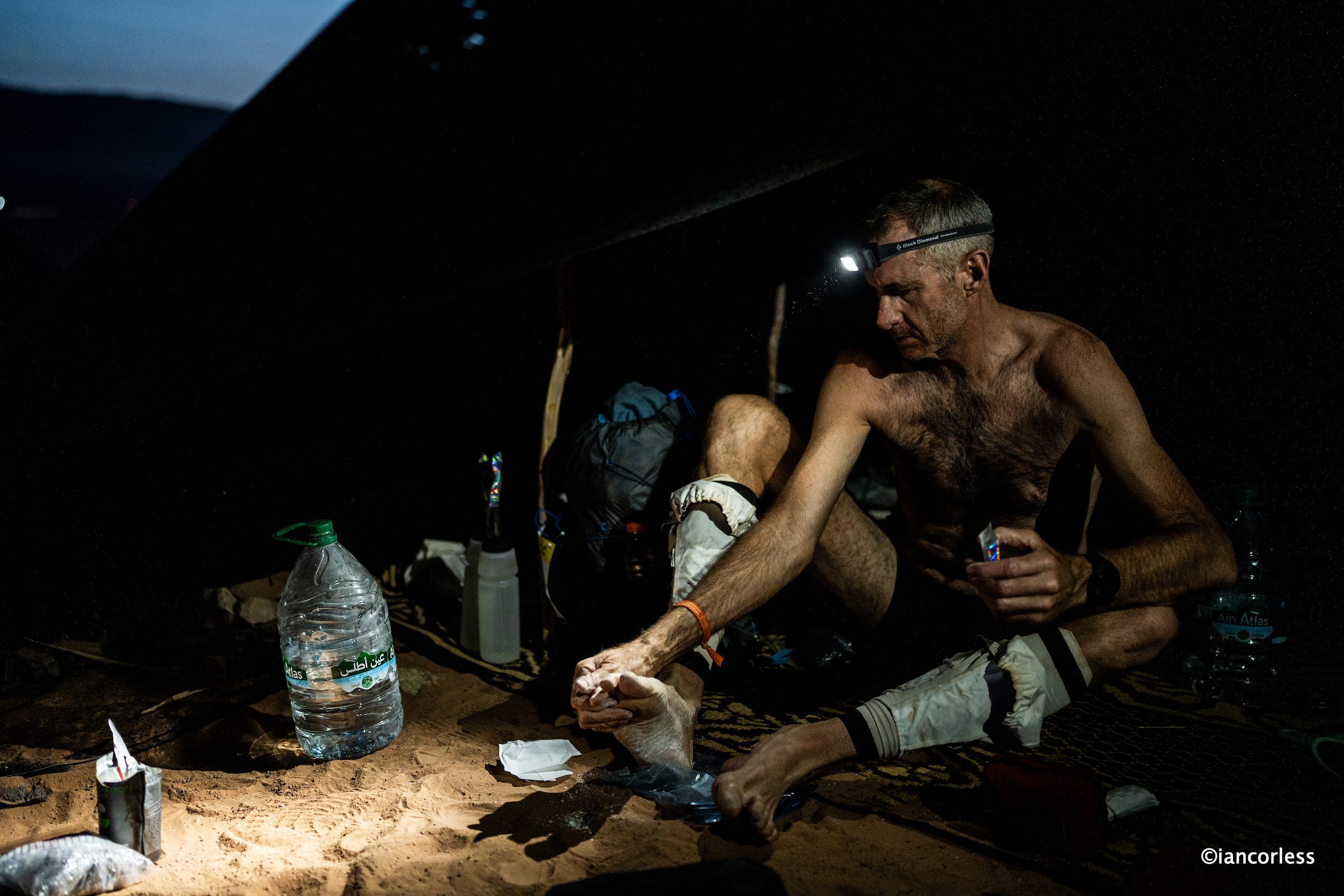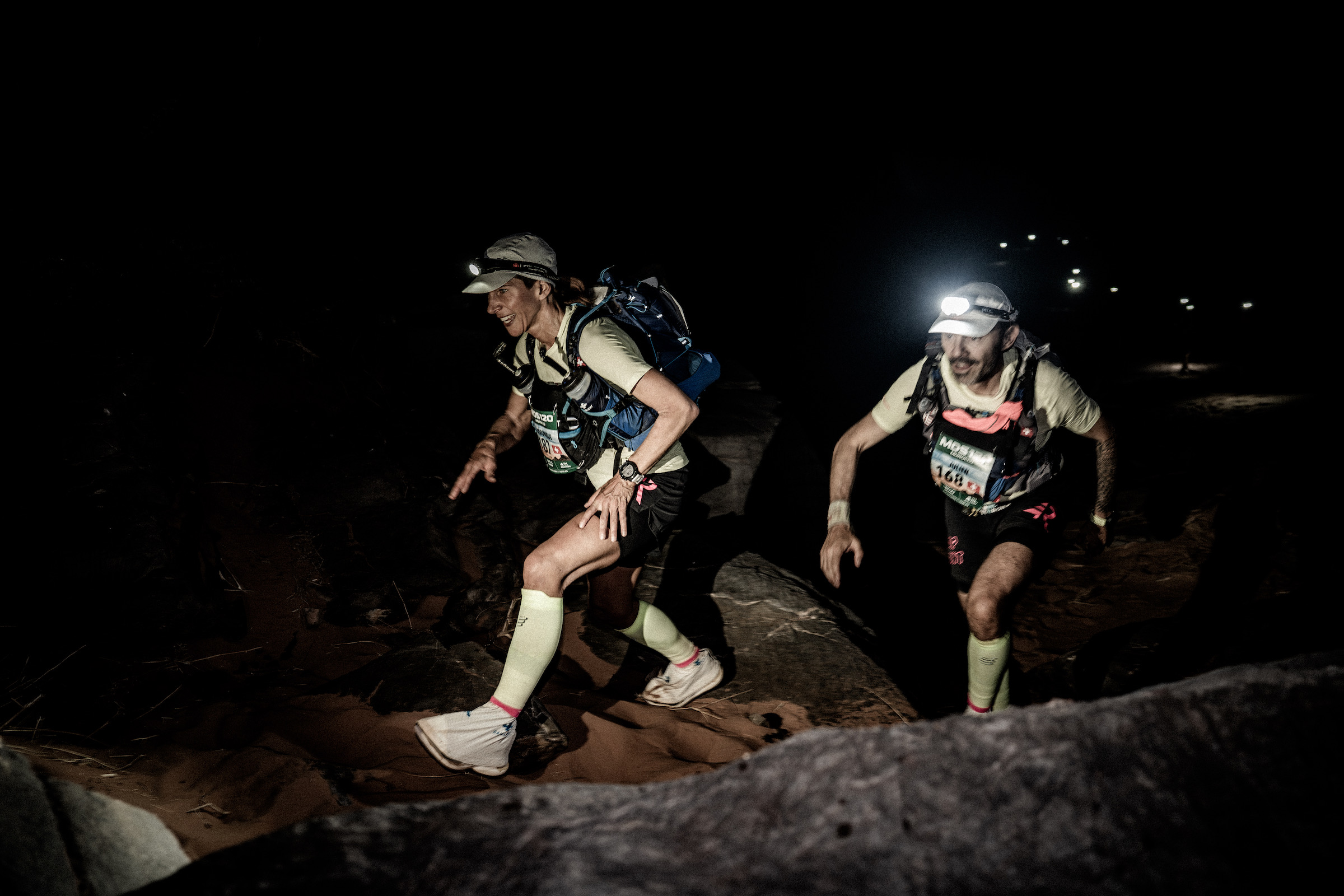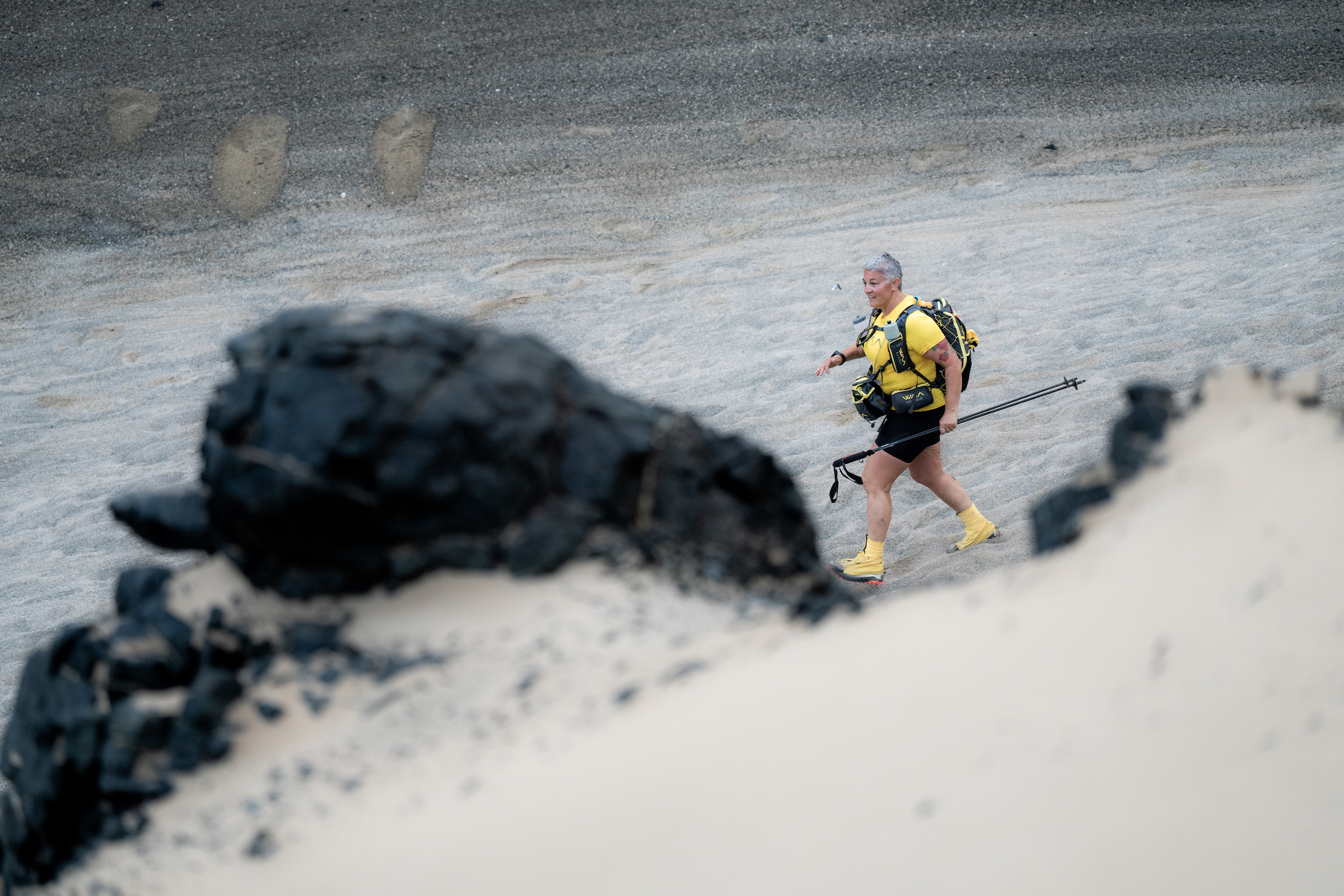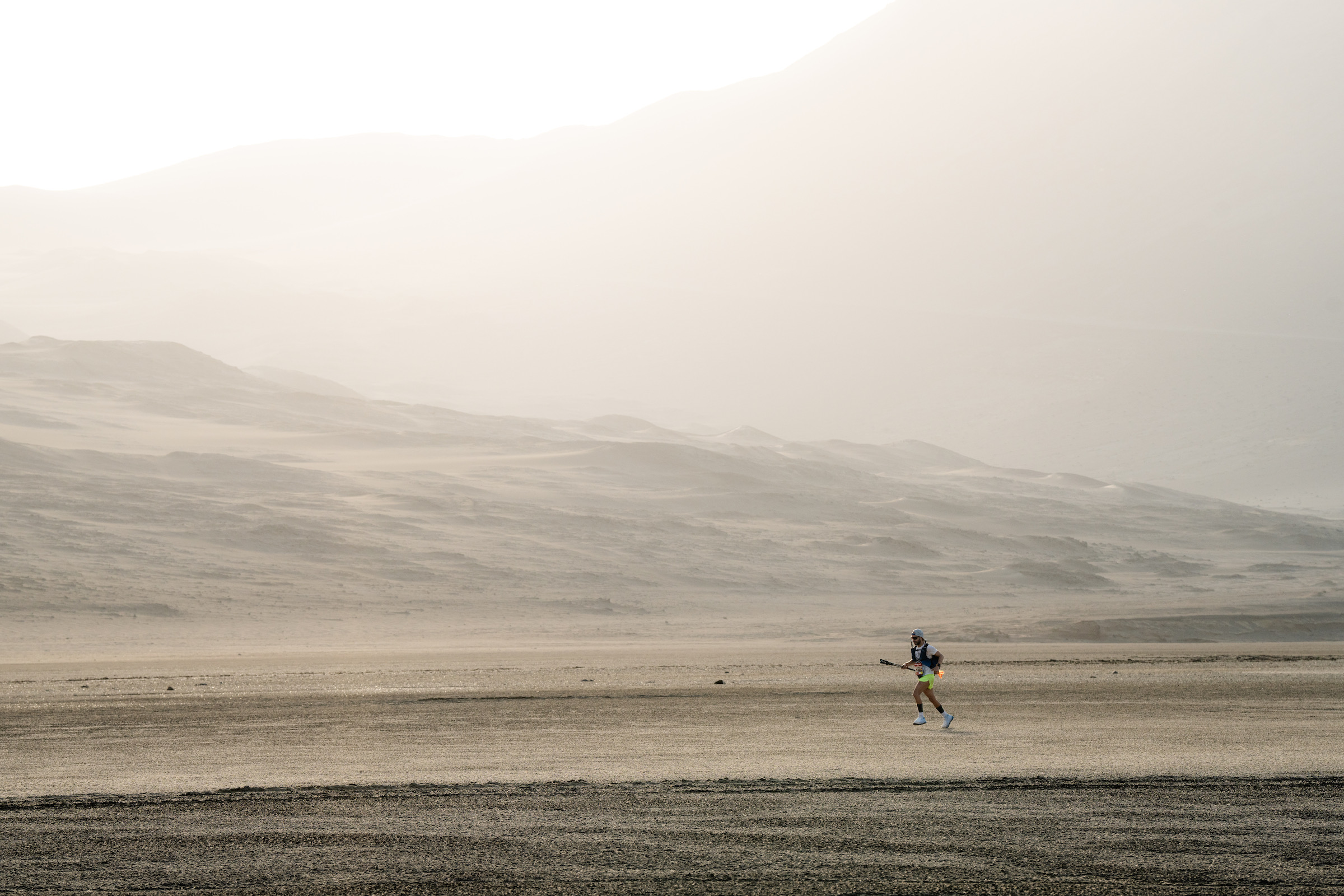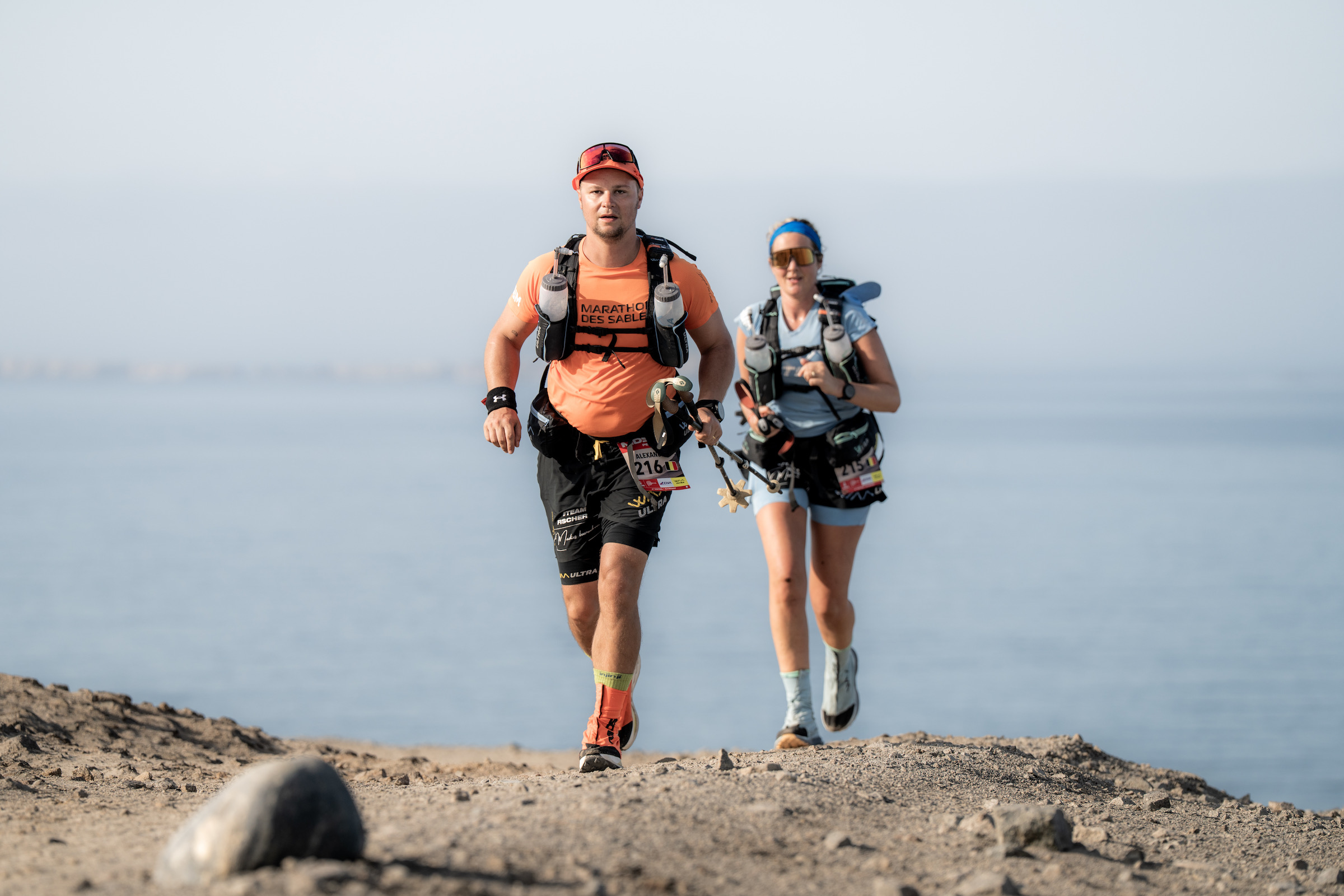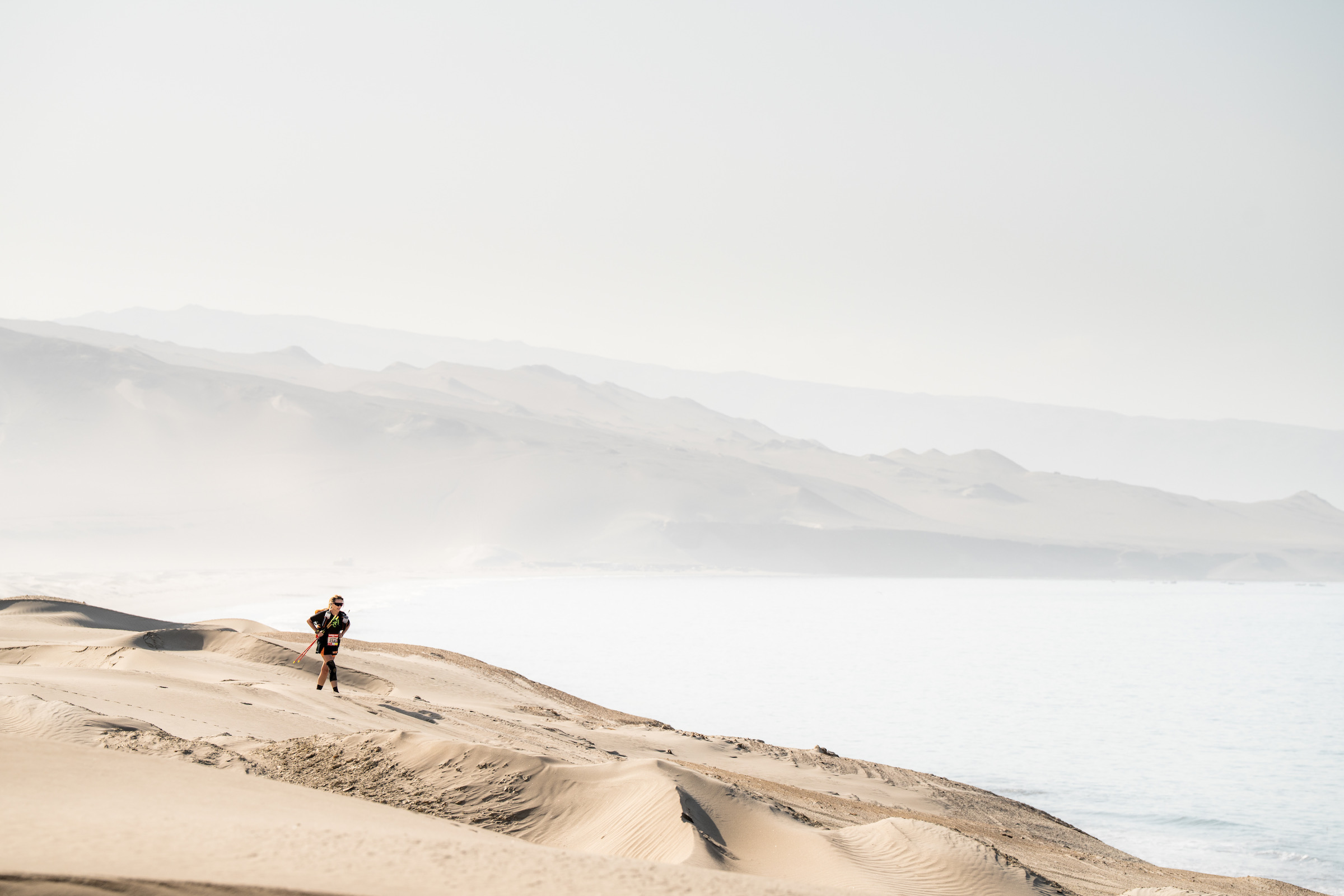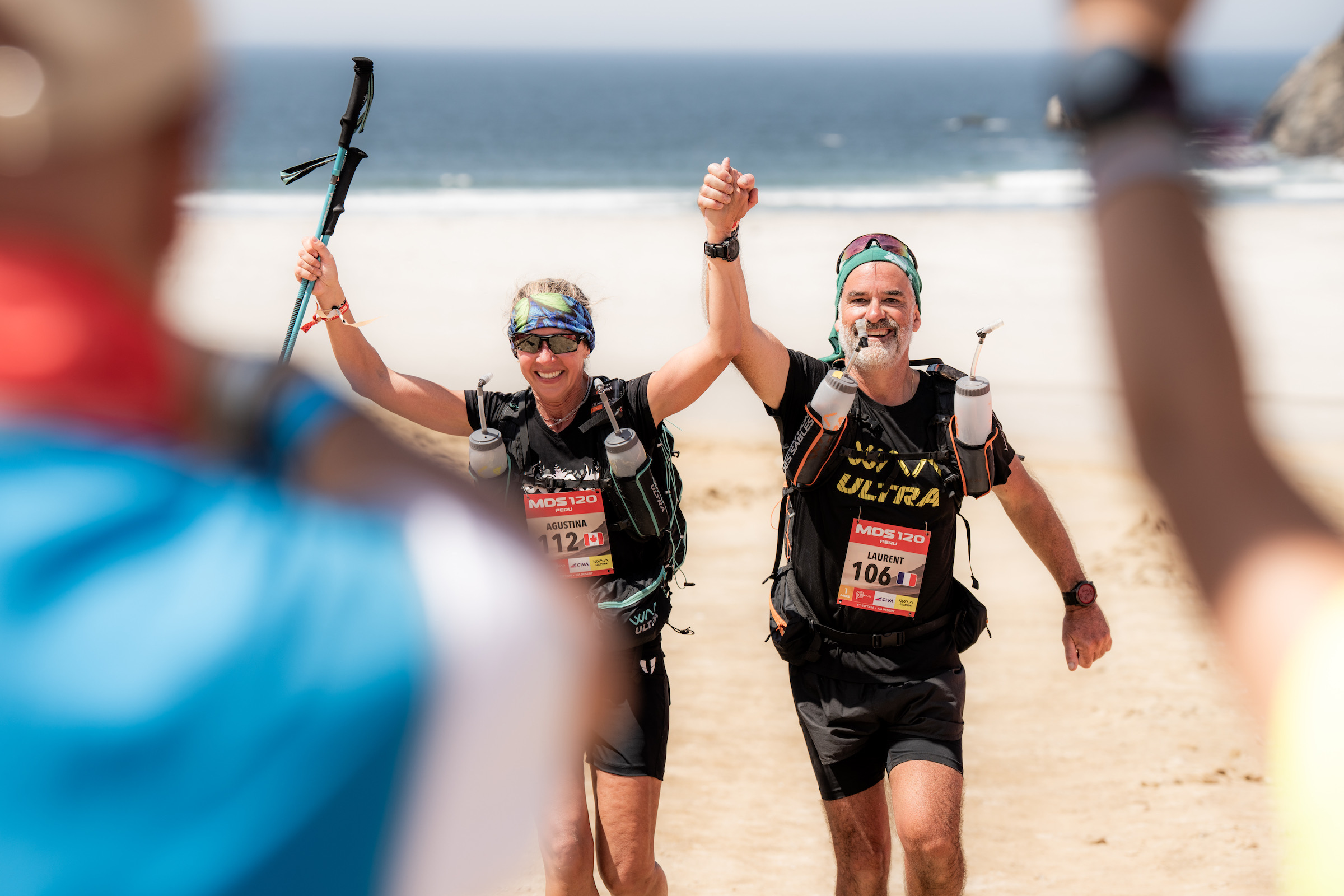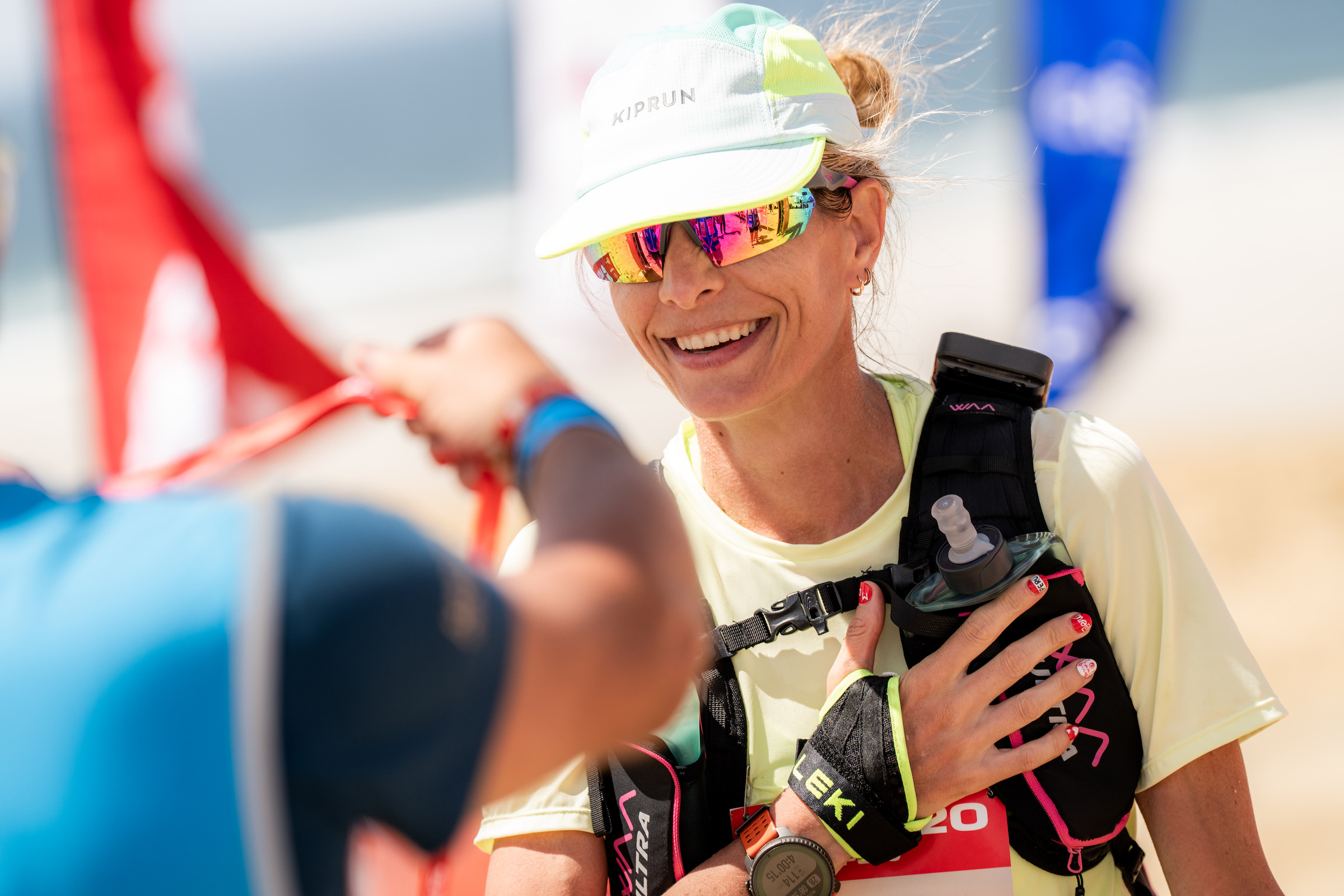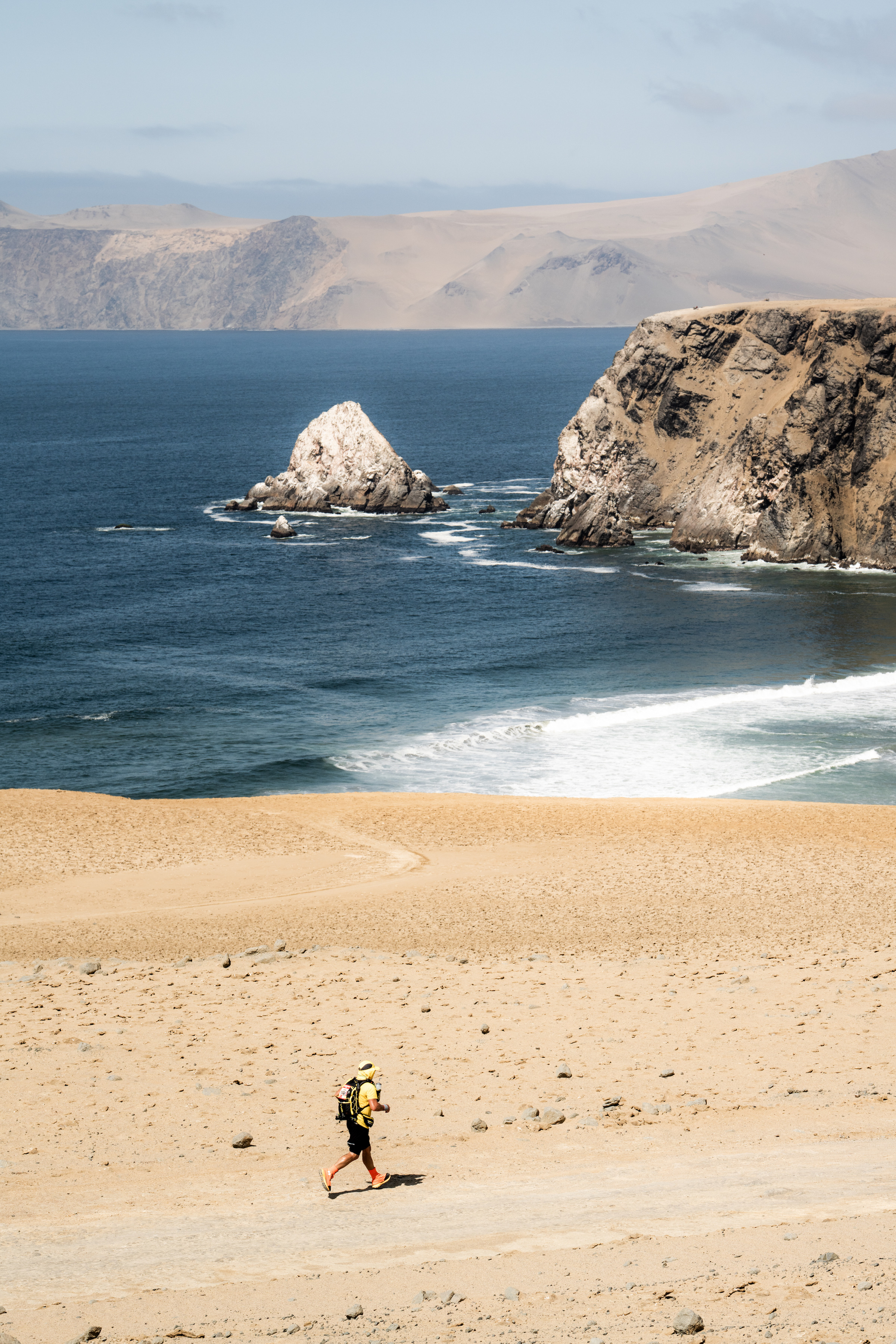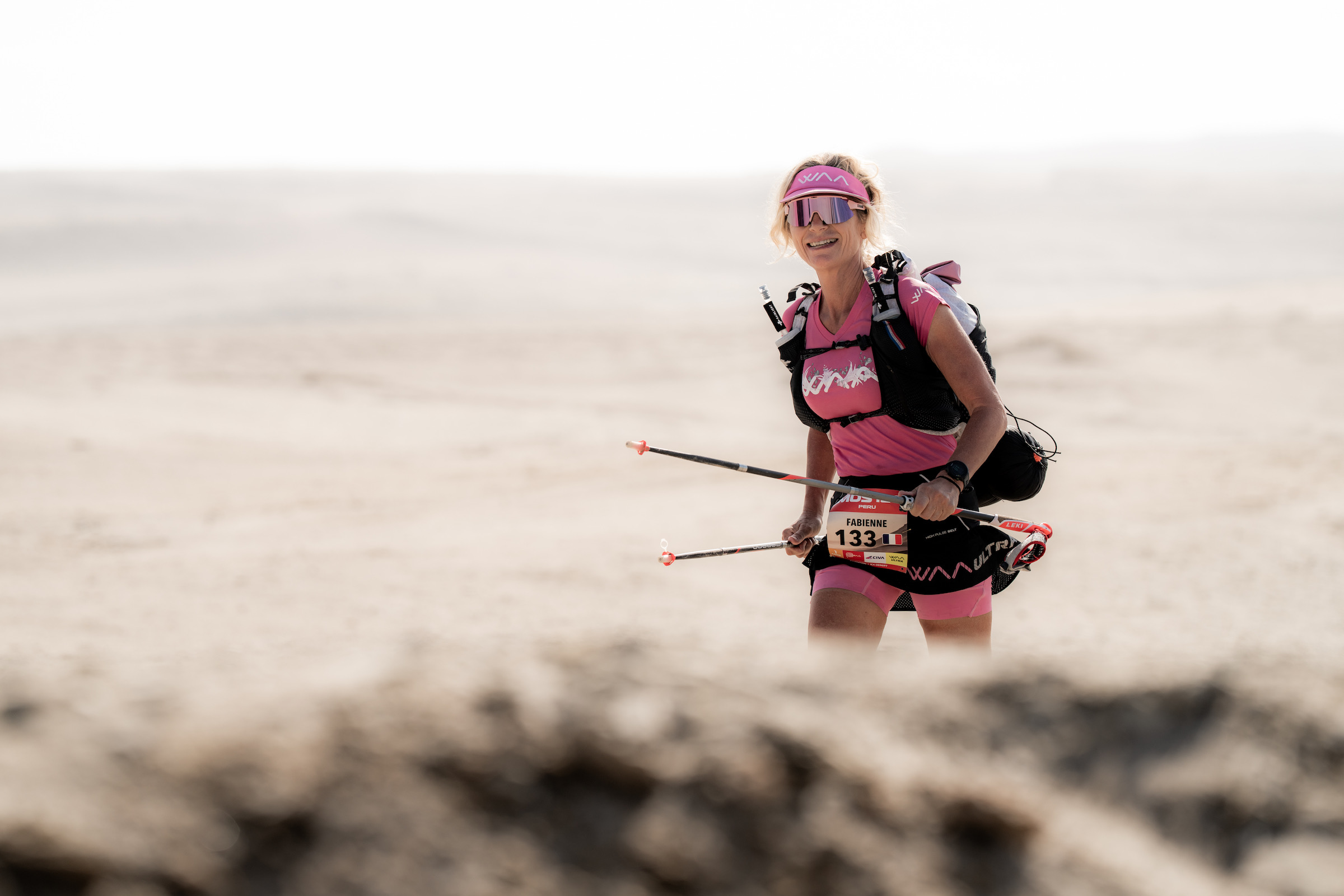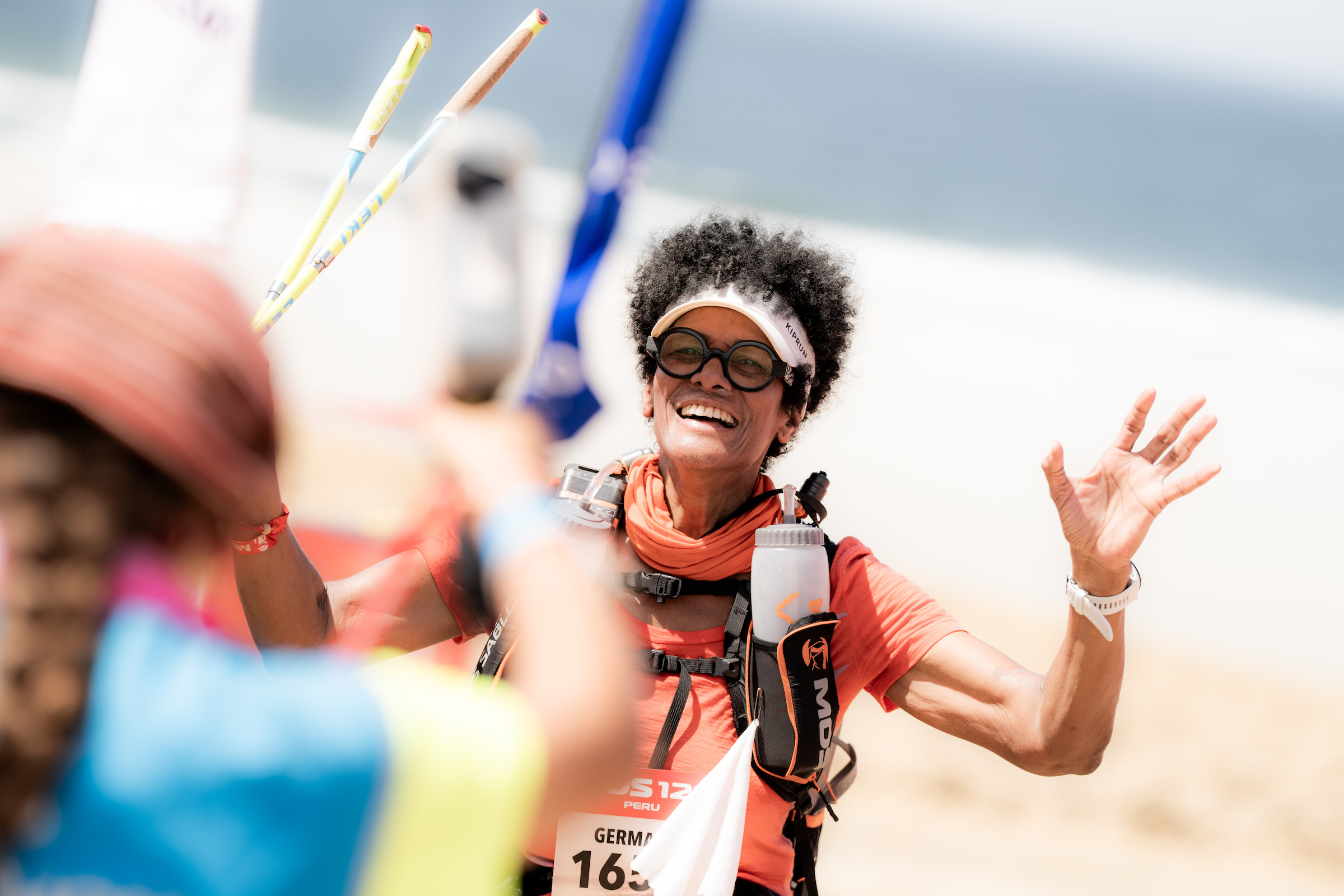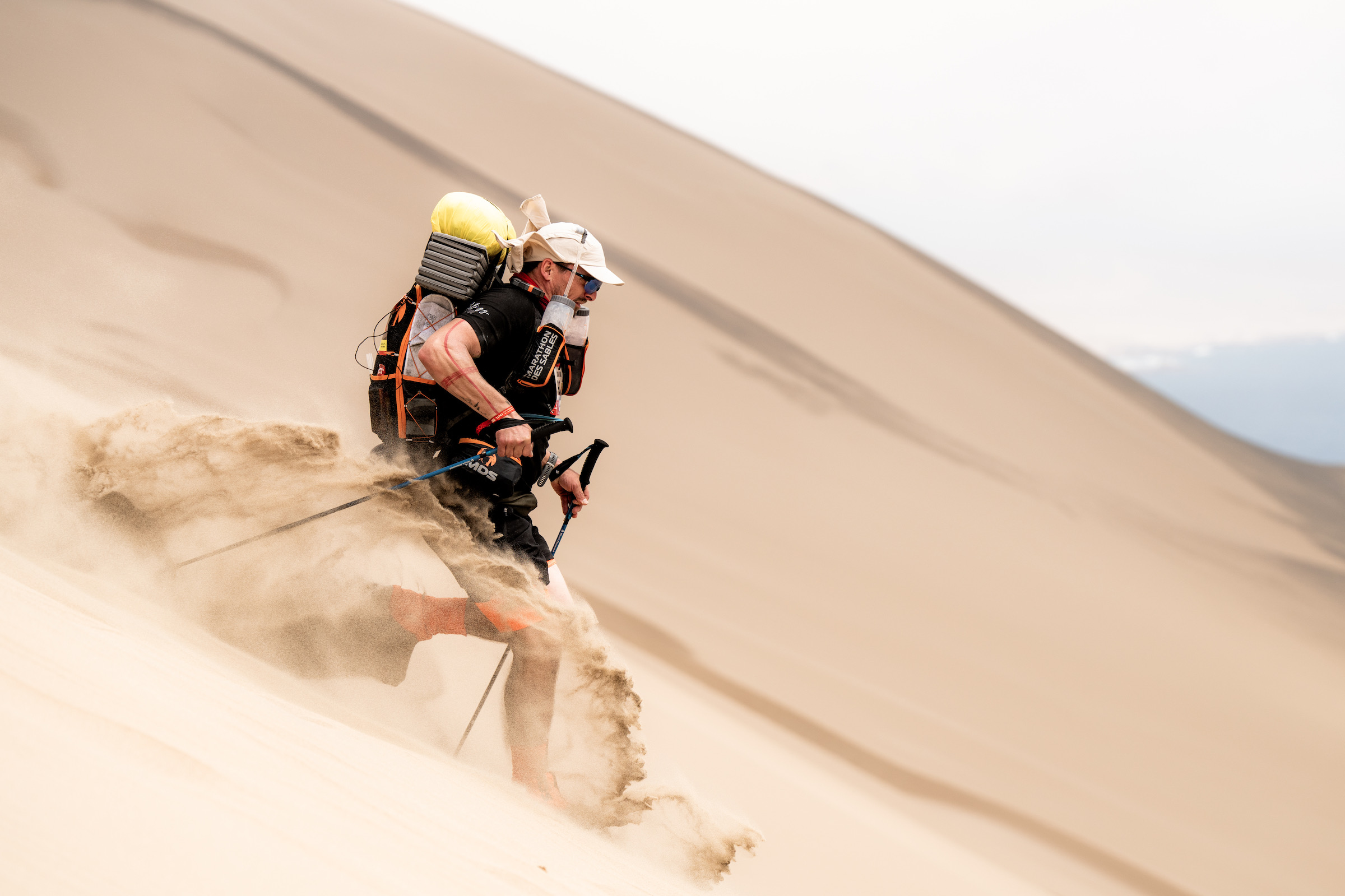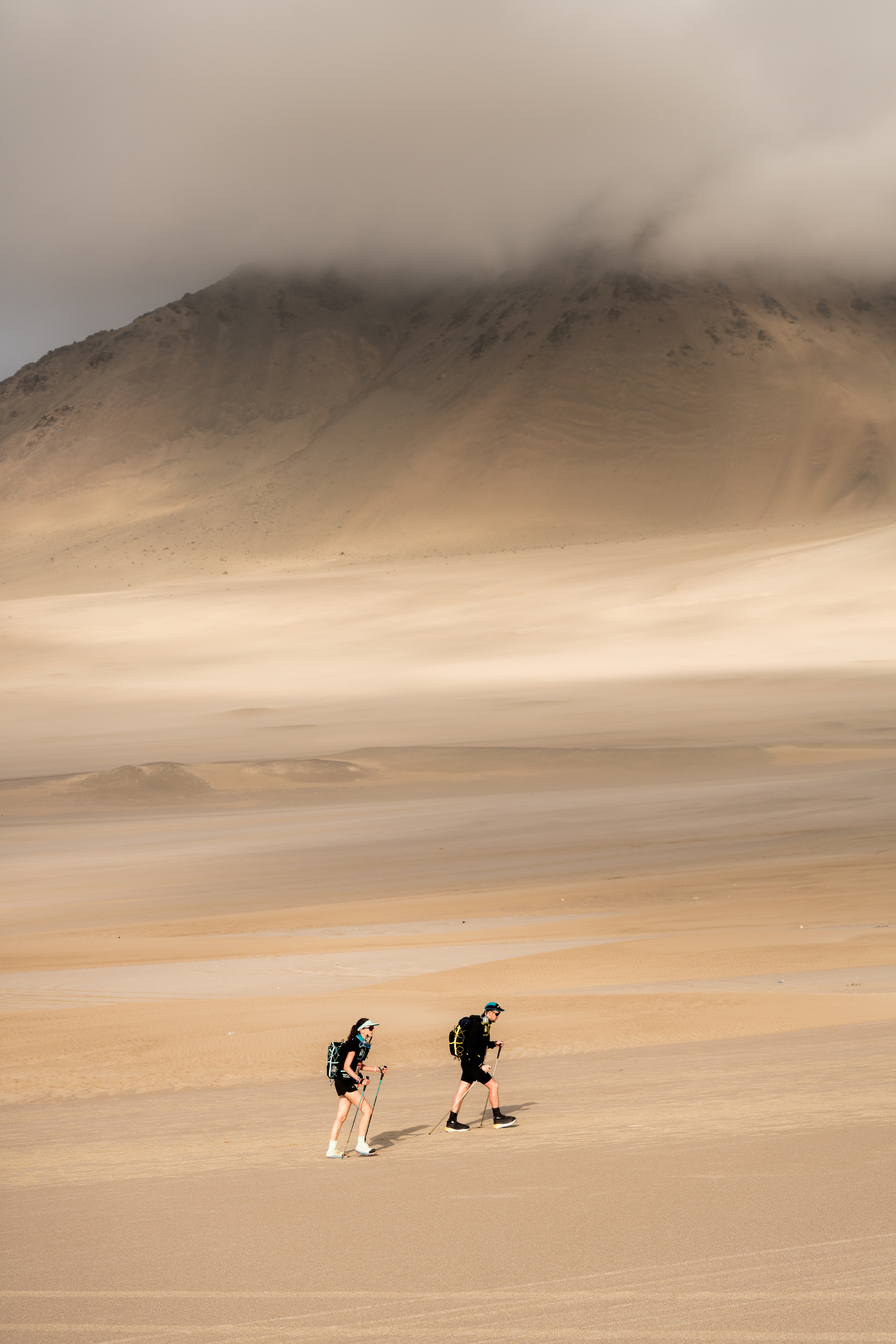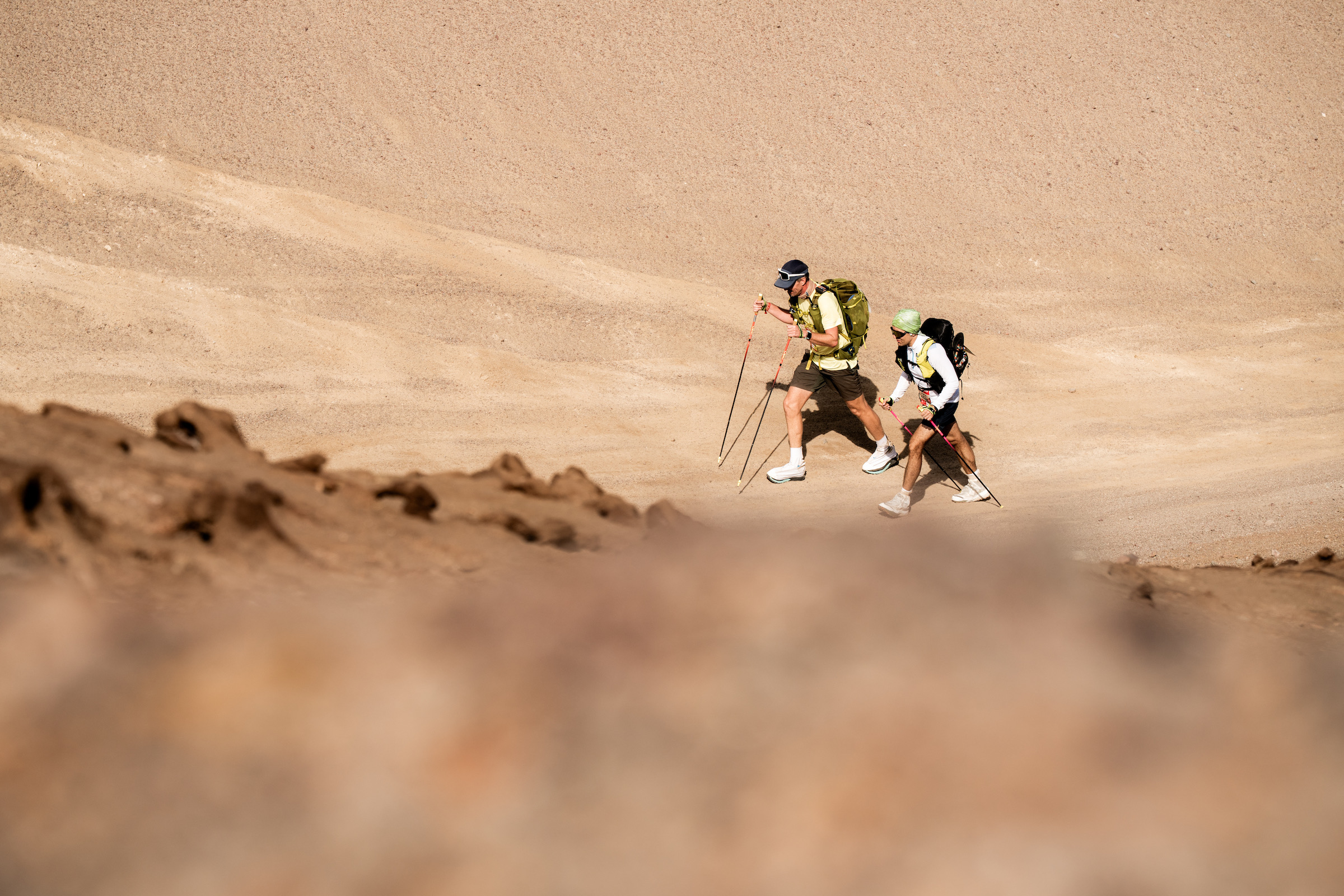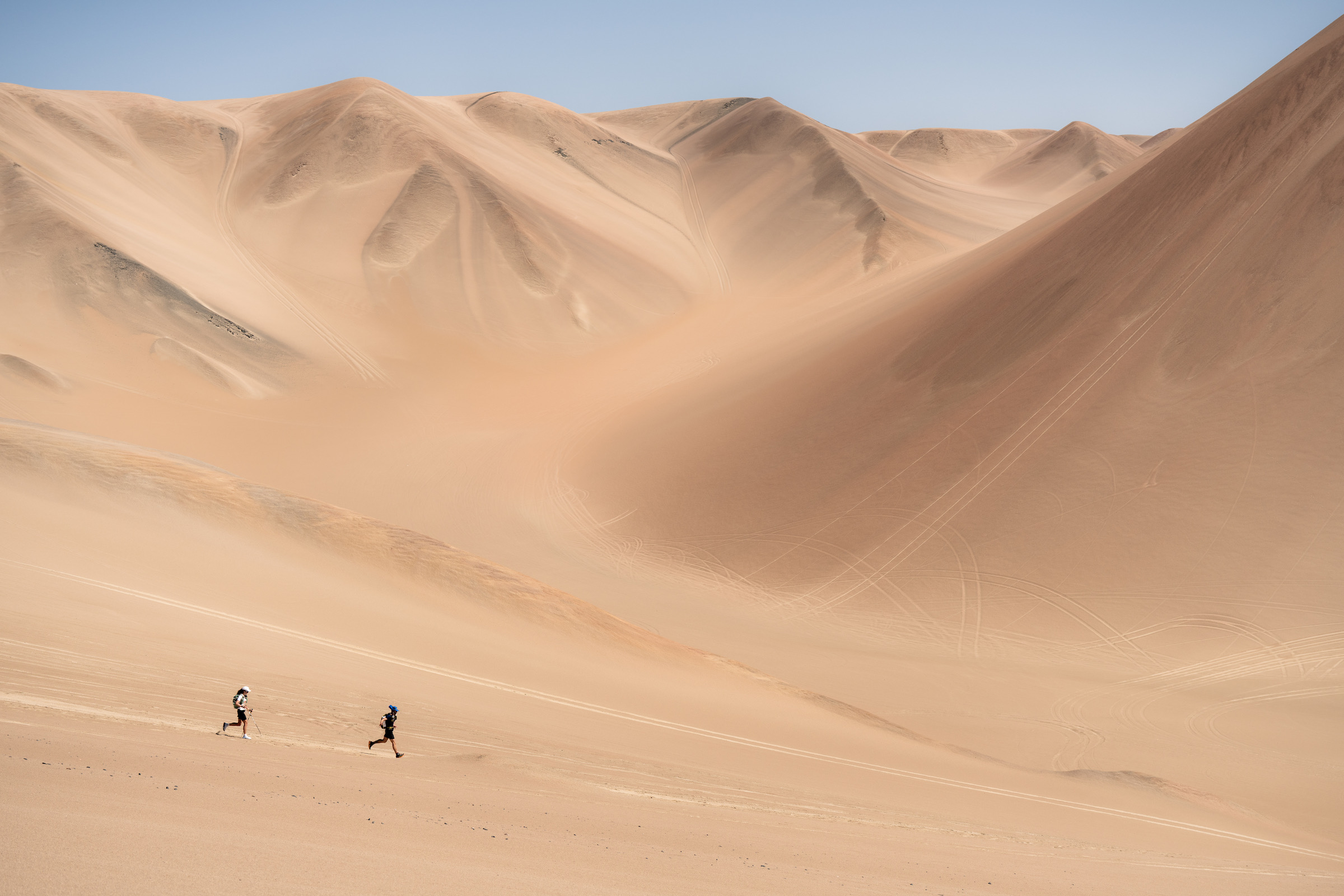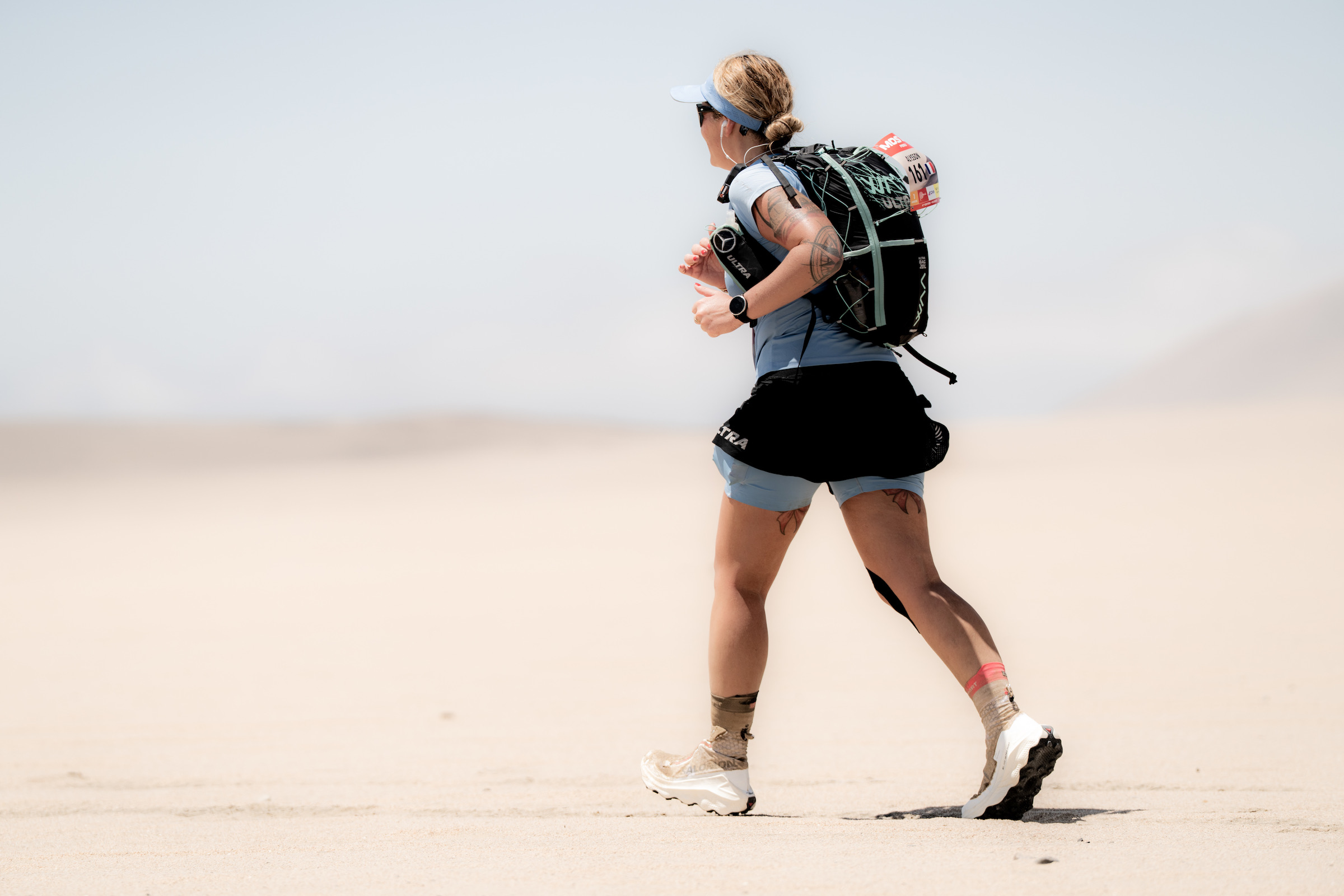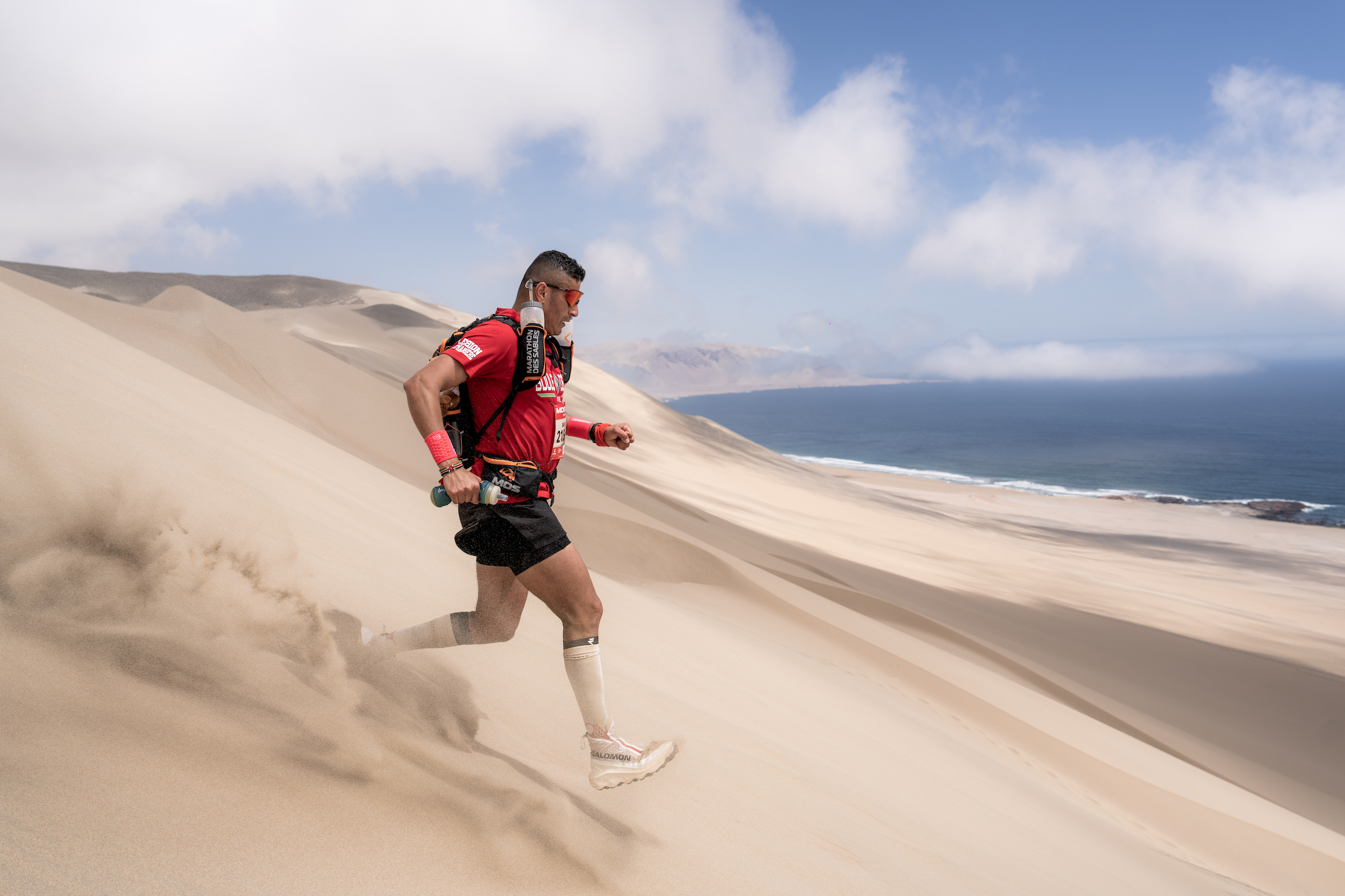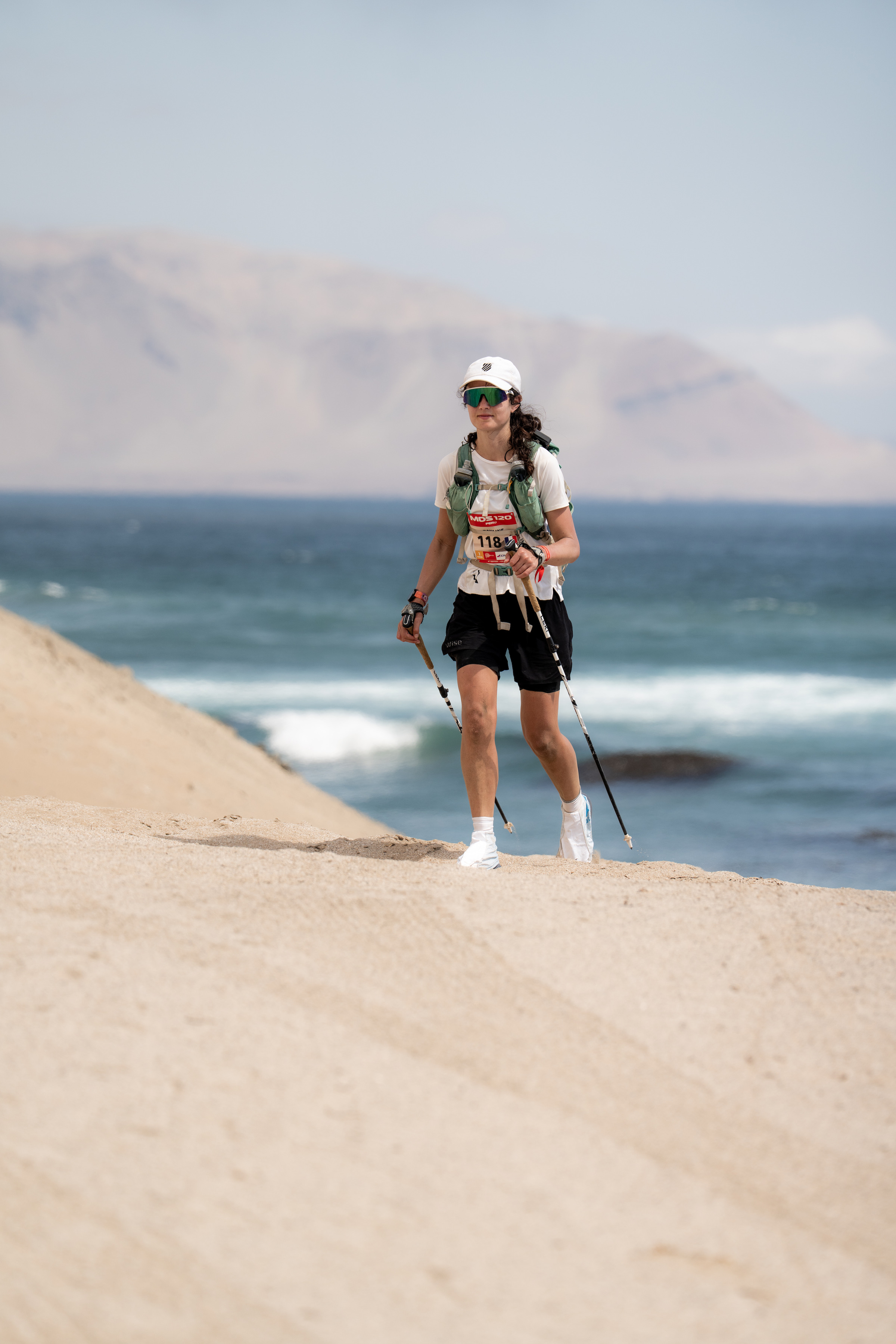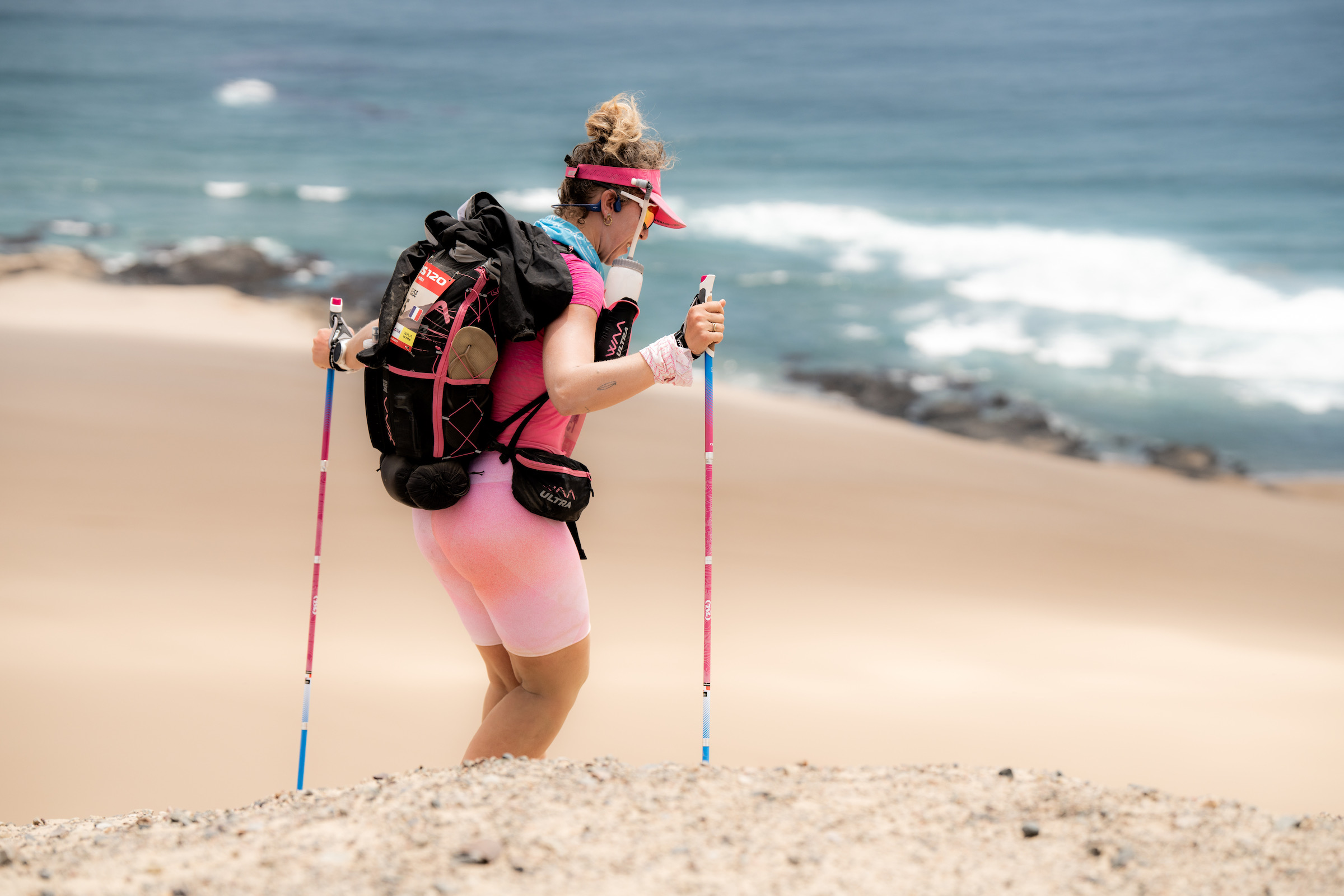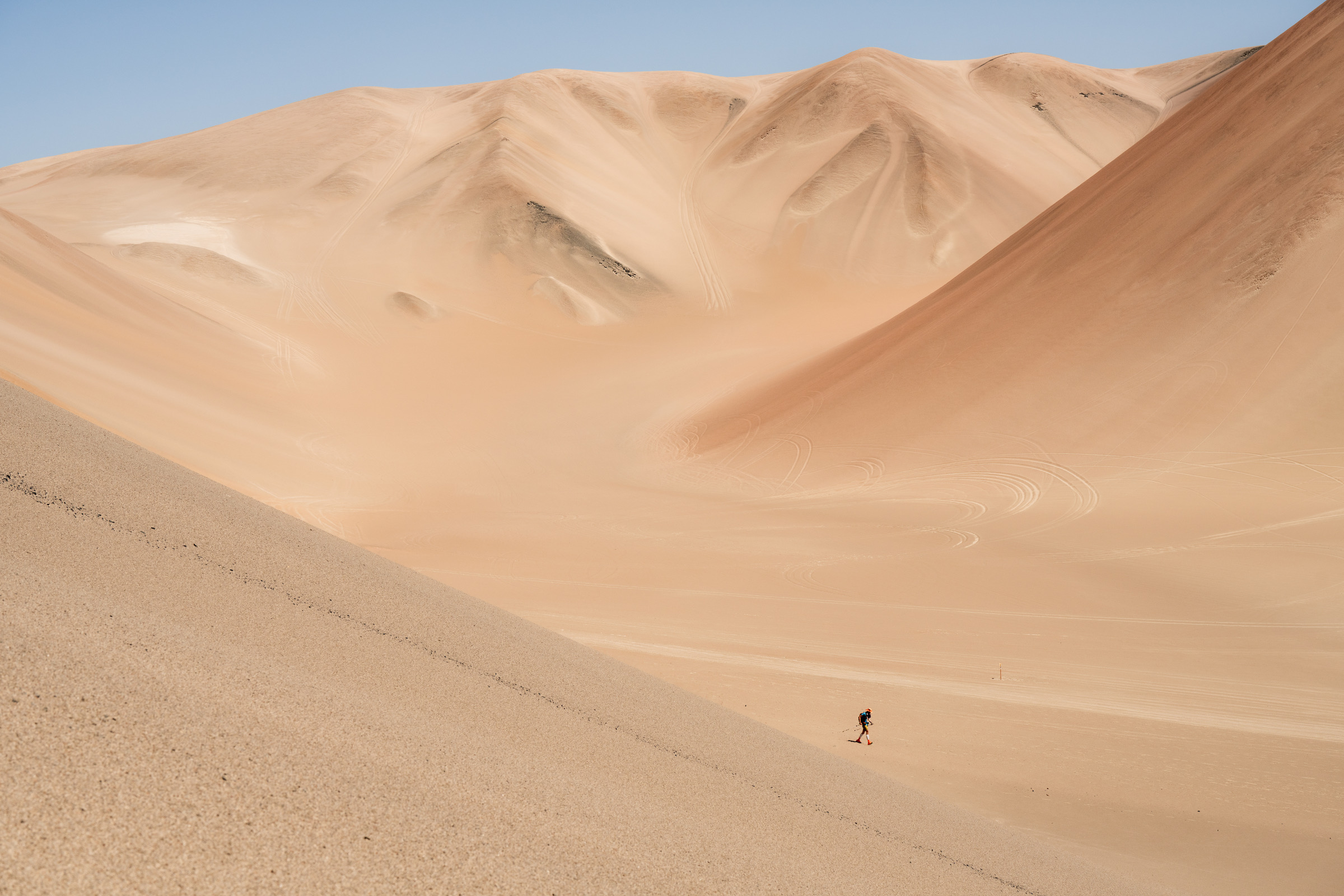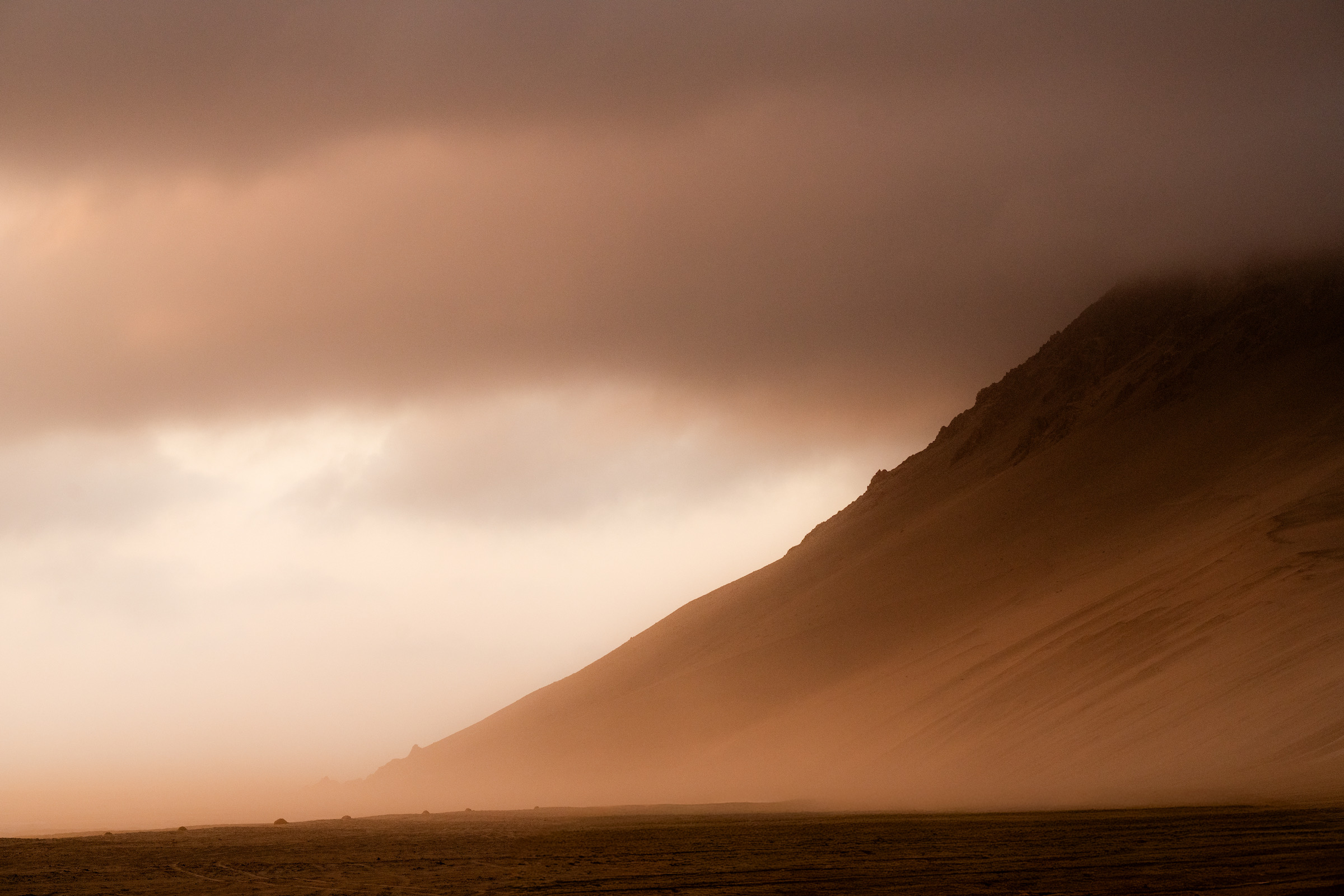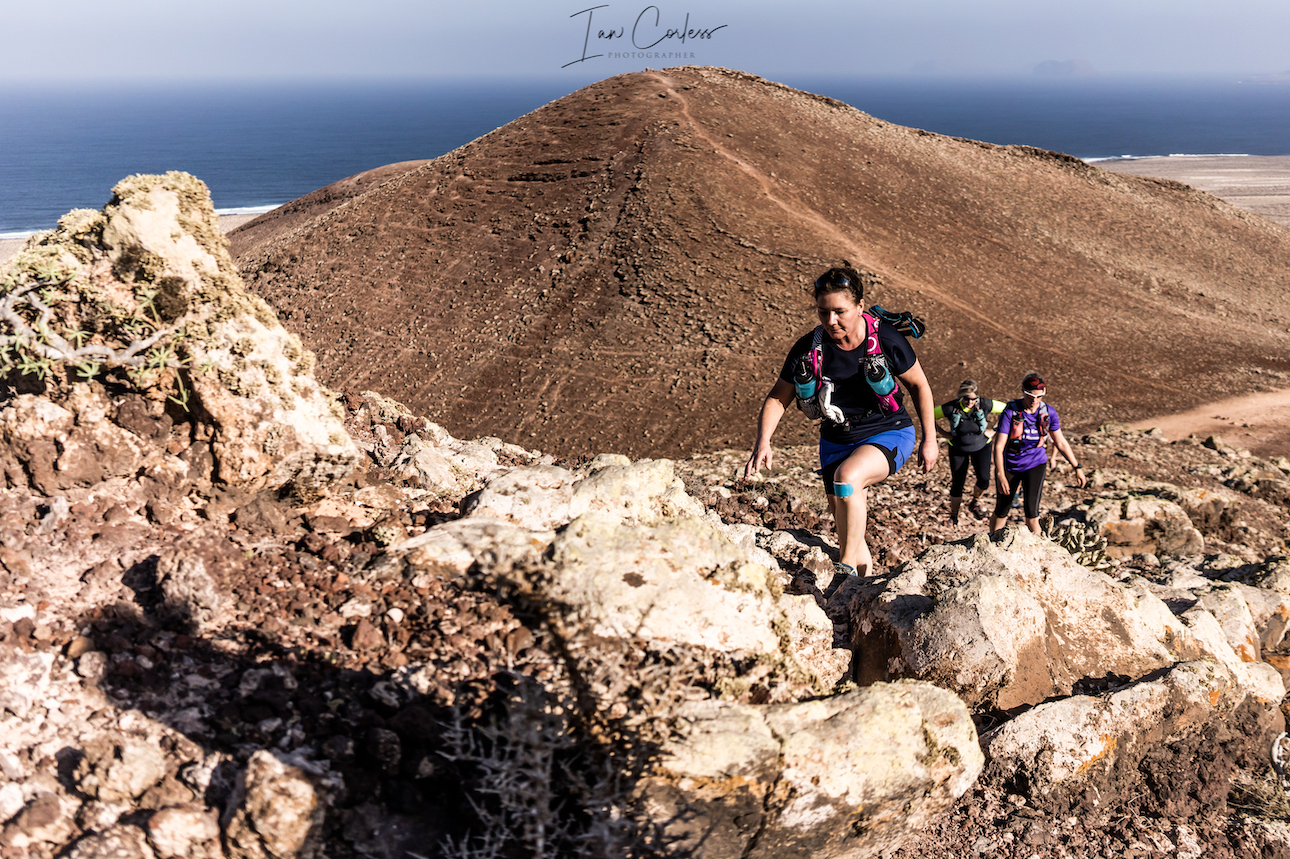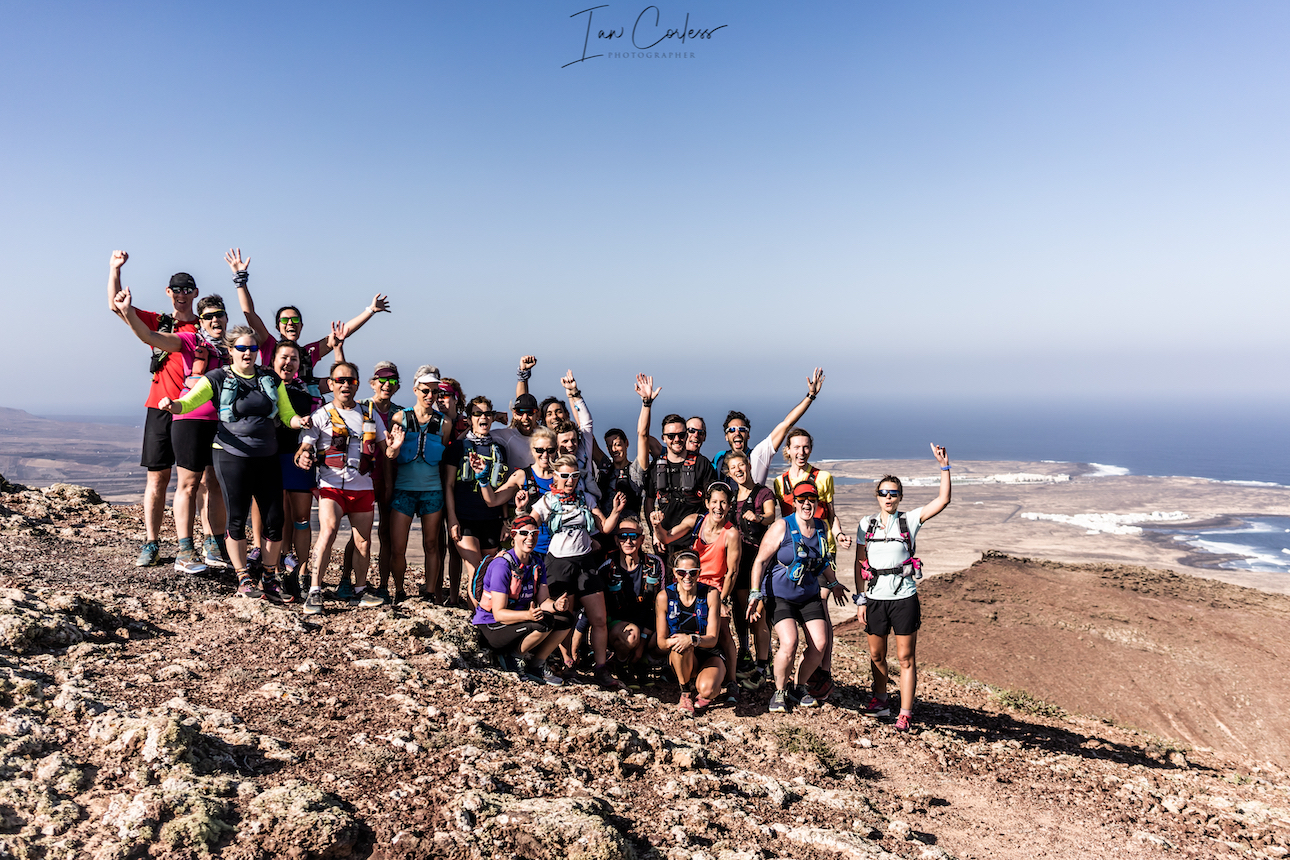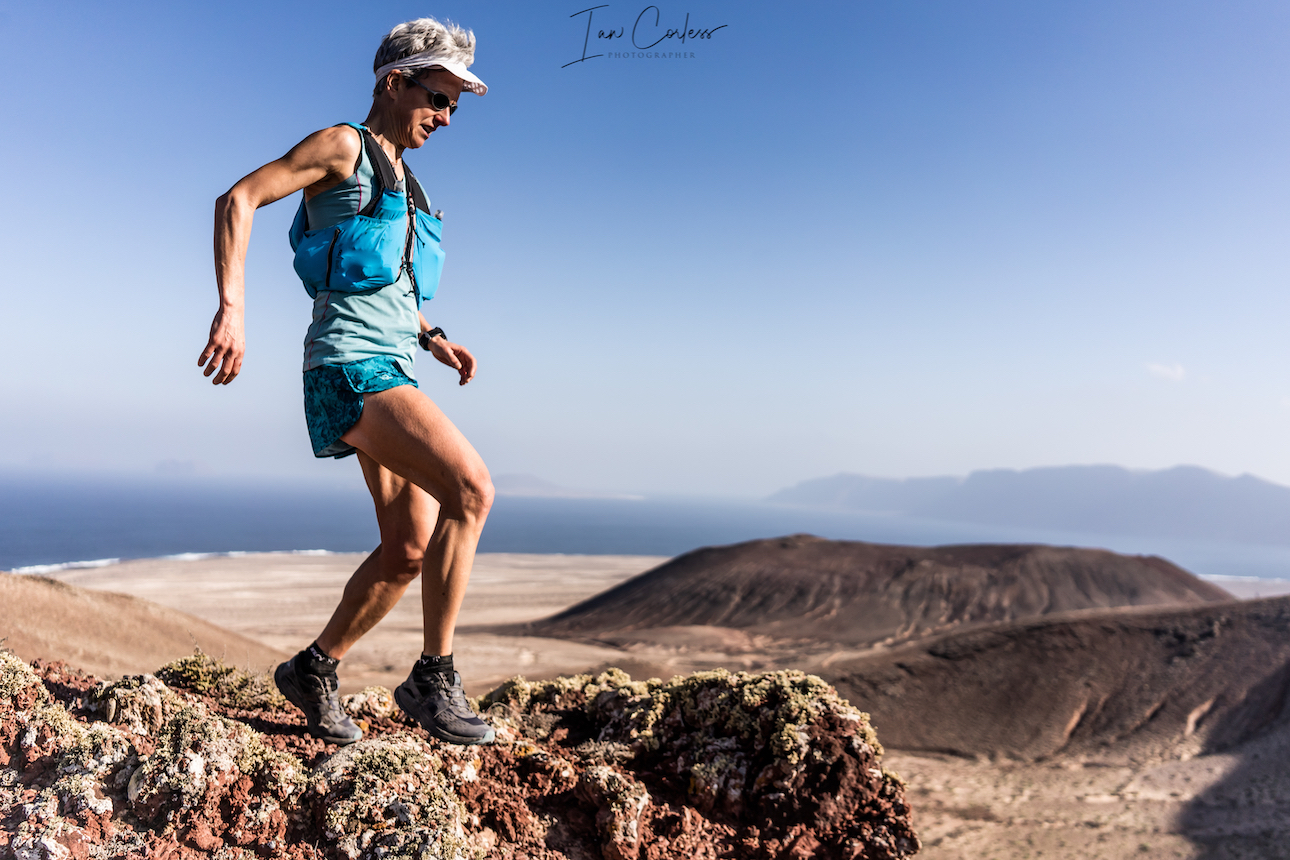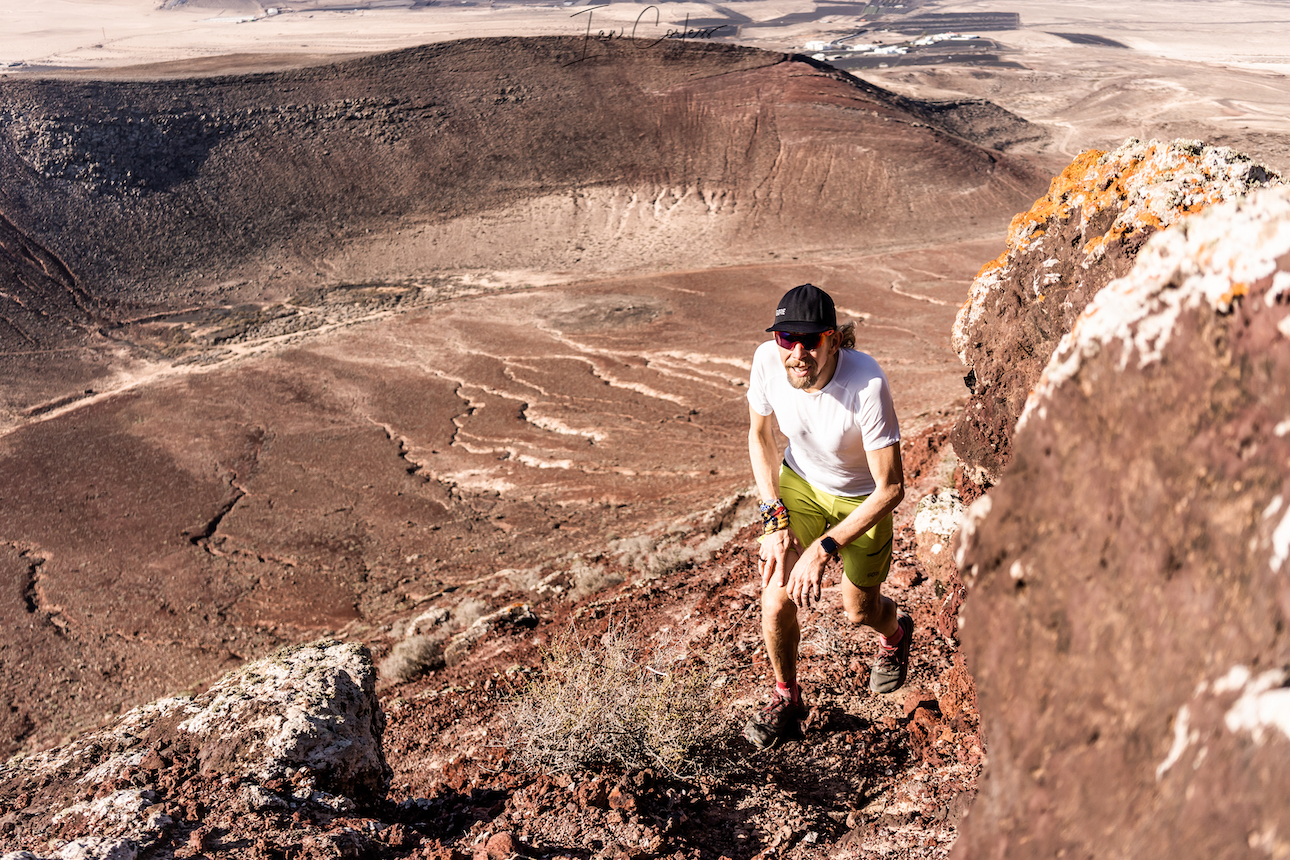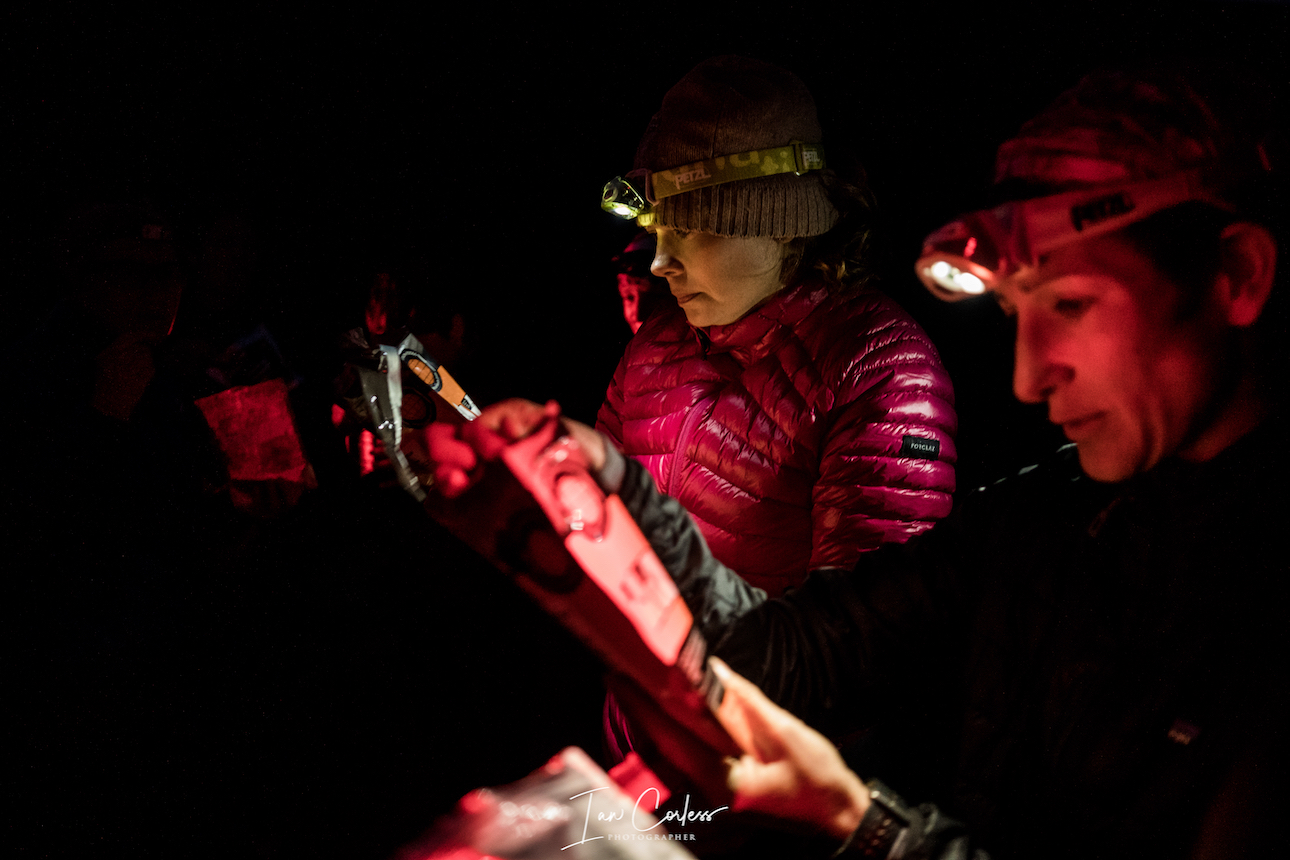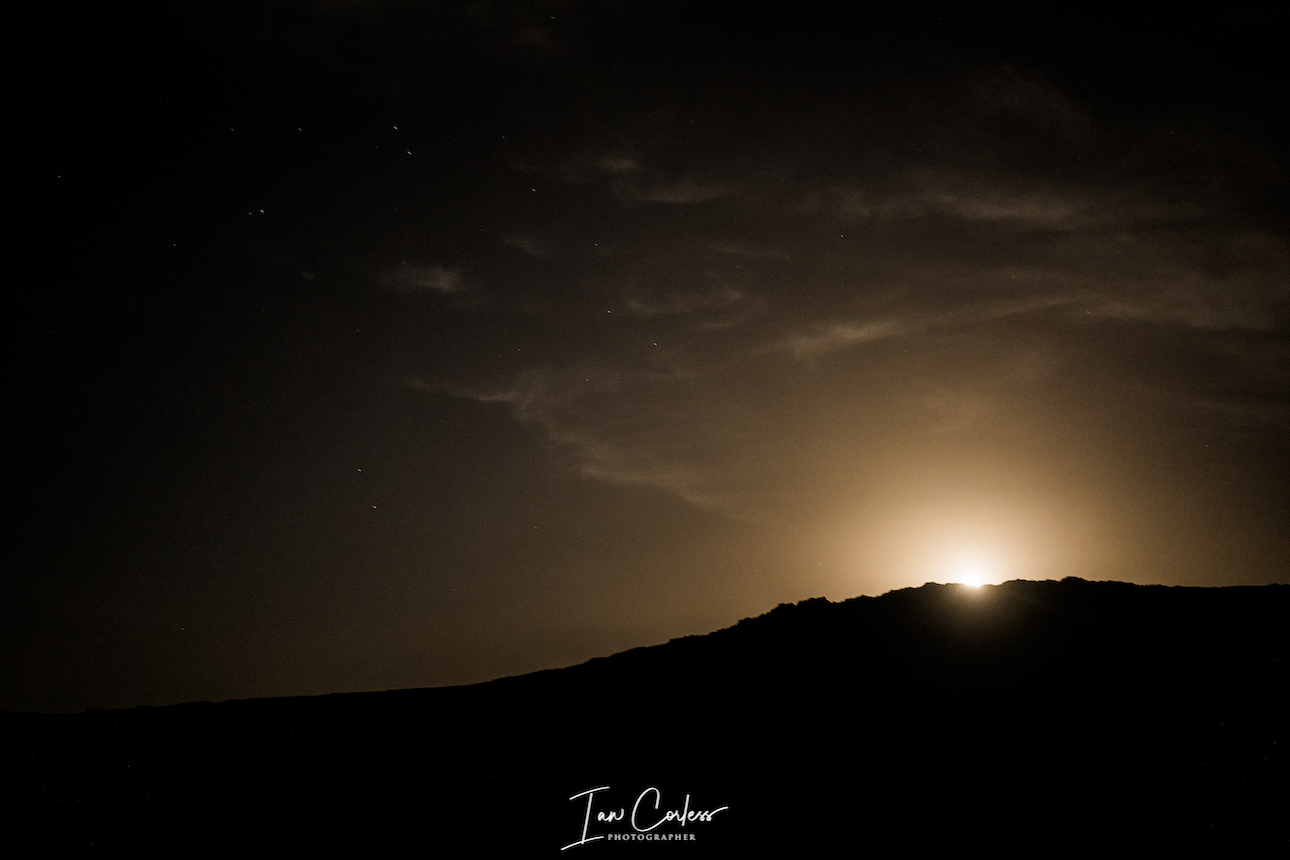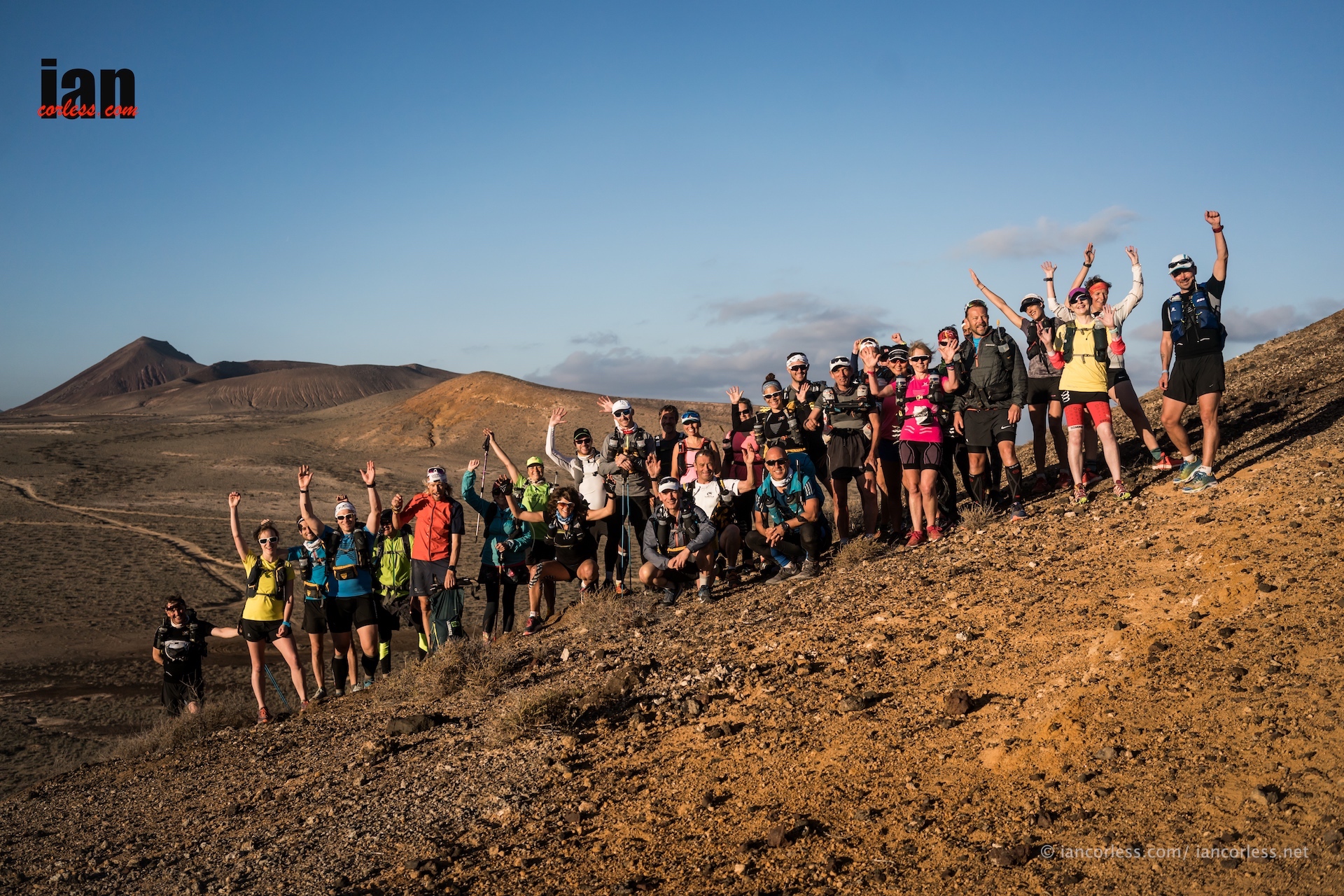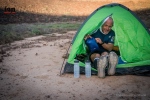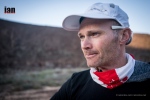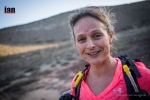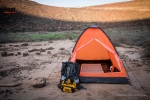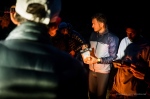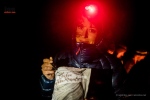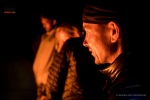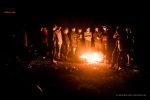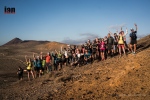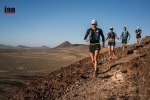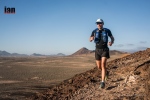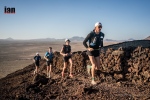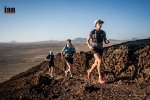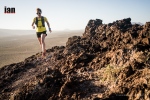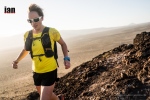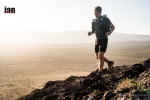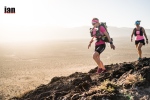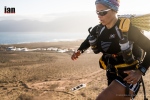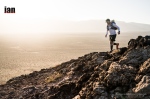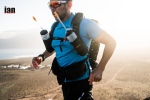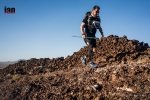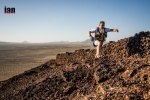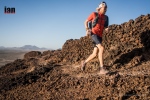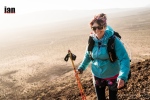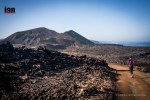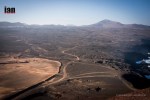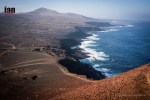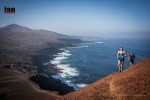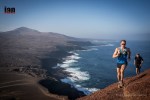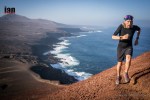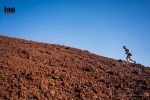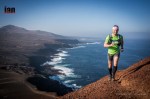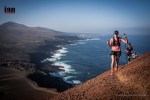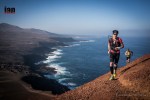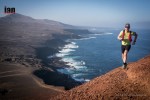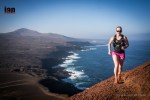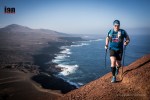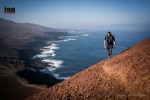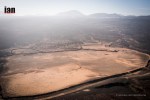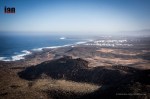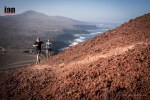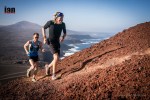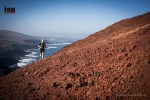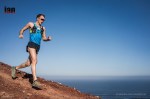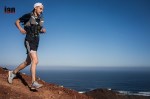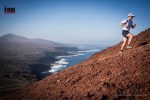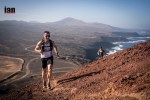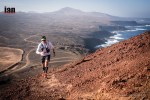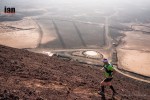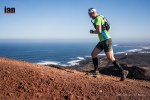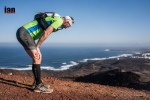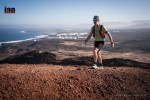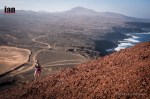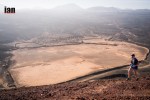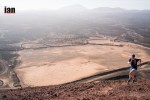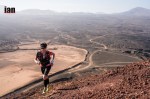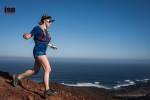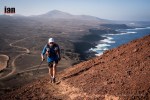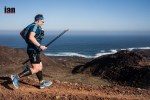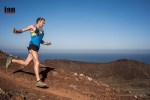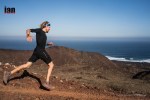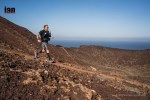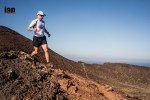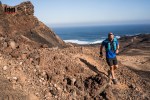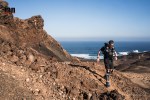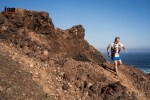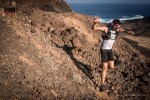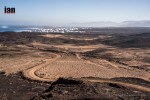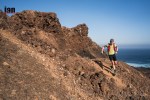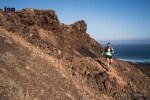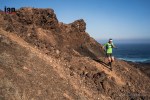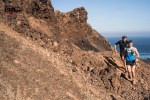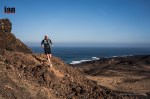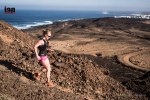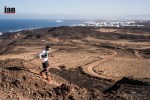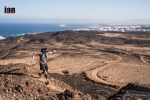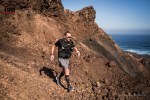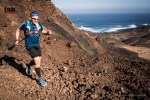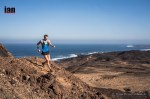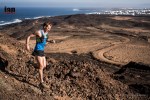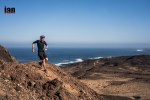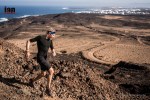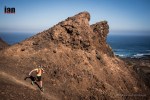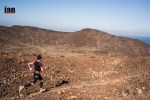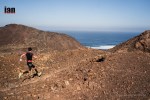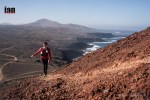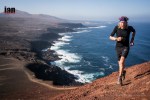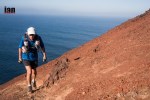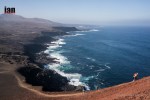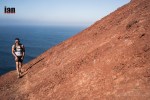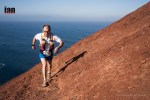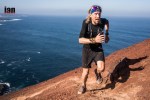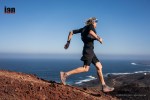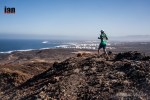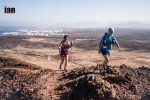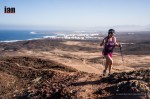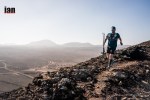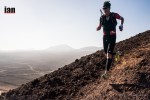
The last stage of MDS 120 Peru opened in darkness. Two waves, 0500 and 0600, slipped out of bivouac beneath a sky heavy with cloud and mist. It was a quiet start, almost private. Footsteps softened in the cool sand. Headlamps cut short beams through the haze. The whole scene carried a sombre tone, as if the desert itself was waiting to see who still had strength left to give.
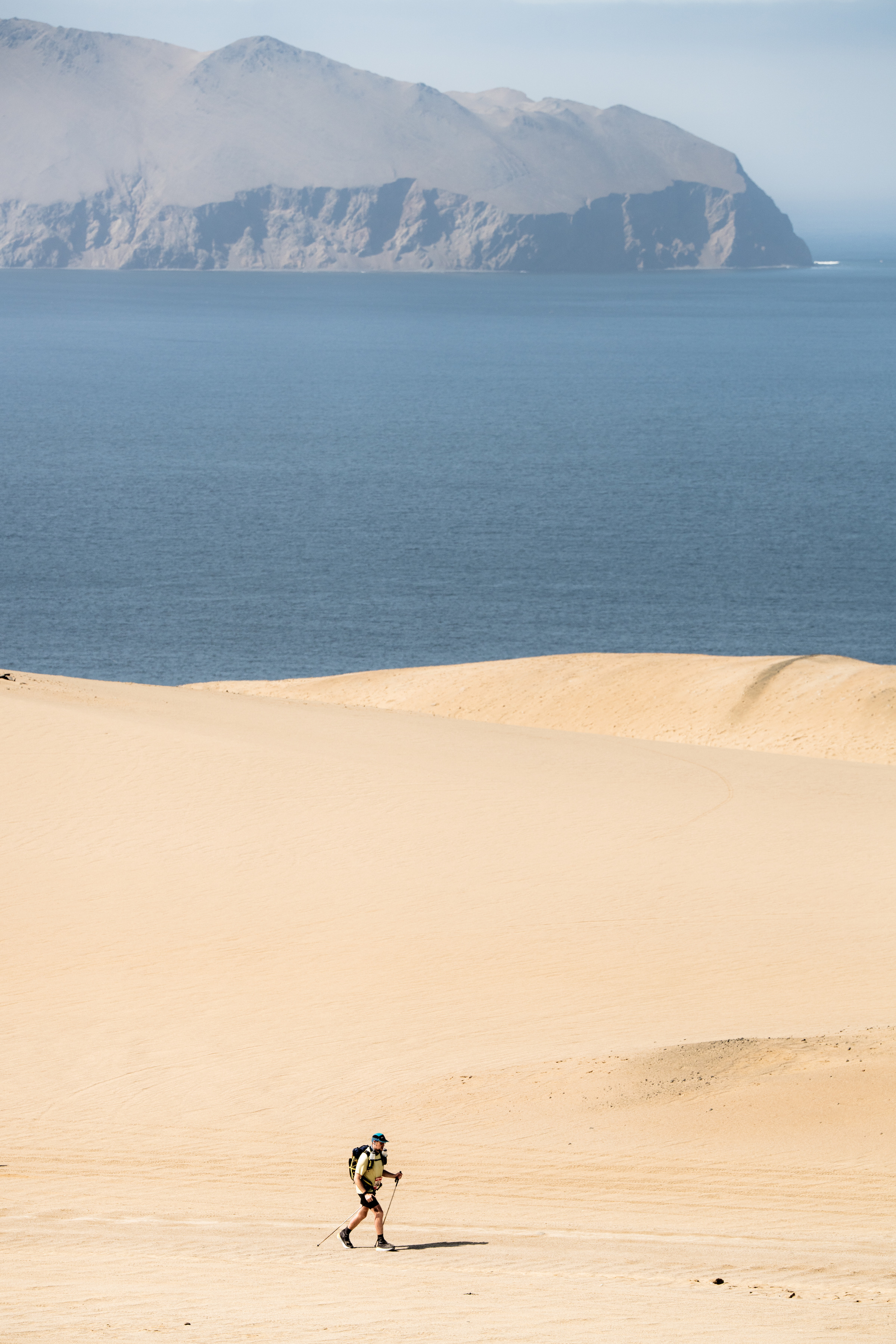
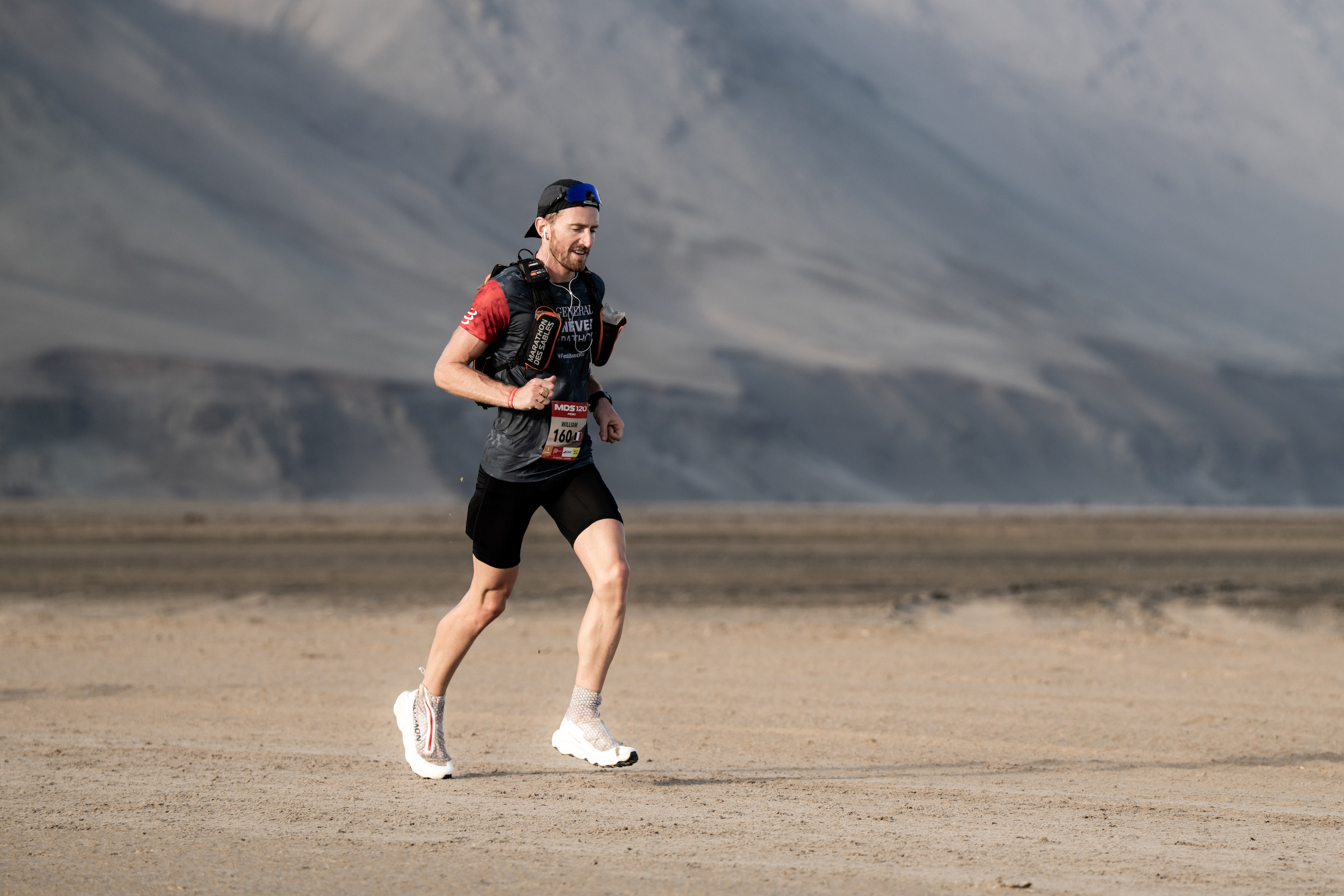
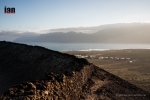
Runners set off knowing this was it, 27.3km’s stood between them and the finish close to Laguna Grande, with the South Pacific stretching out behind Isla Independencia.
A straight line on paper. A world of effort in reality. After days of navigating sand ridges, barren slopes, and the weight of self sufficiency, the final morning felt like a test wrapped in silence.
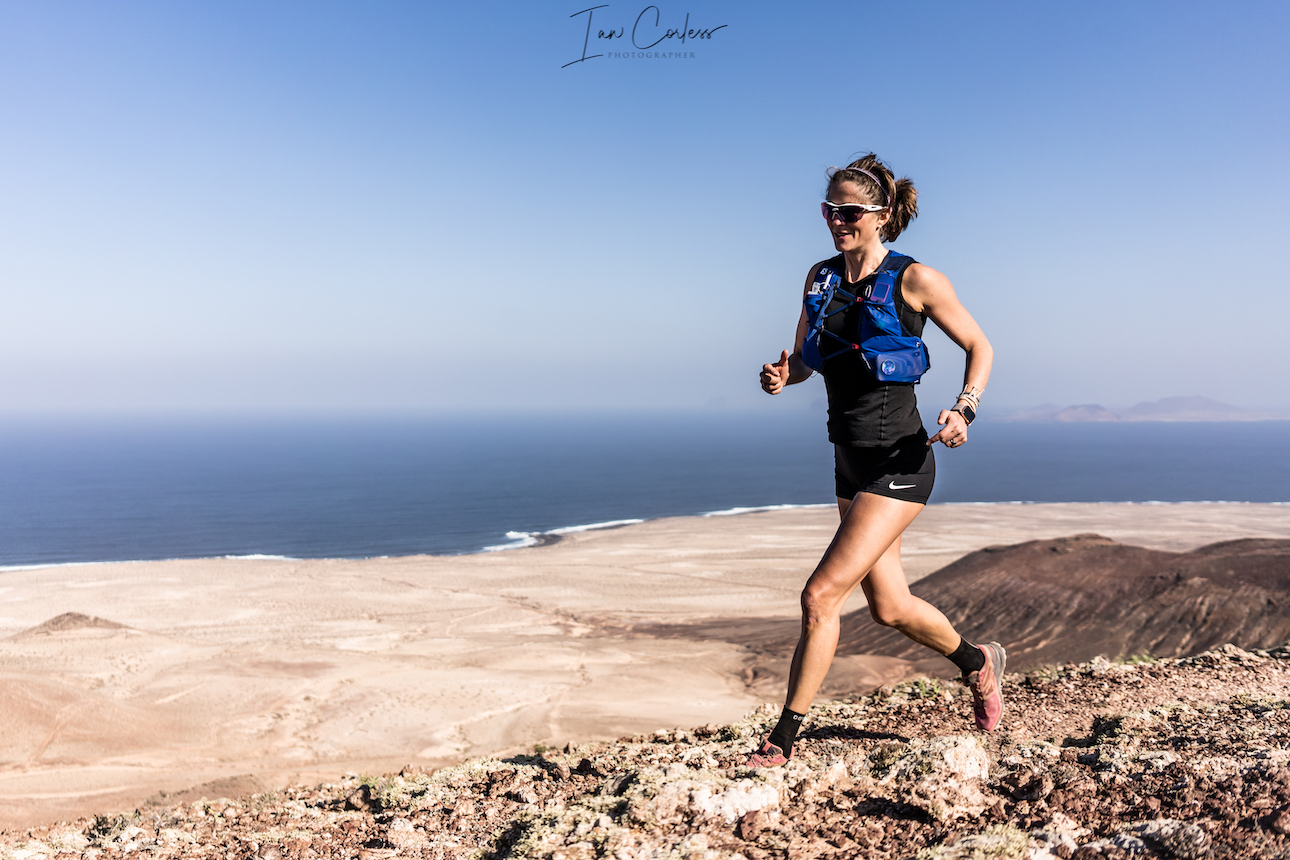
Then the sun rose. Not with drama, but with intention, as if it had been saving its entrance for the moment runners needed it most. Light broke through the mist and transformed the mood. What had been grey became gold. What felt eerie turned warm. Shapes that were hidden came alive in full color. The desert opened up, and the coastline showed its depth. The day shifted from hard to hopeful in minutes.
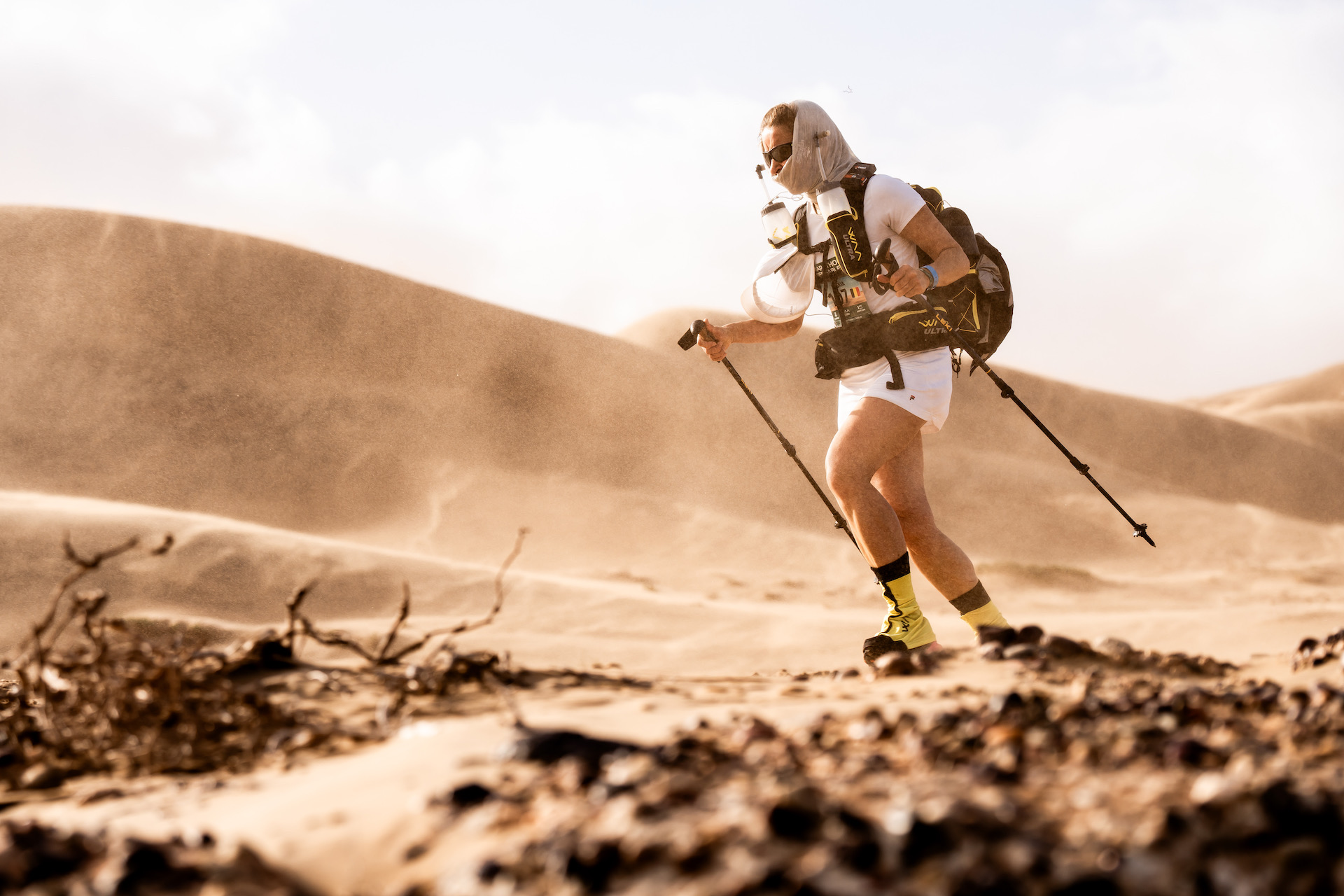
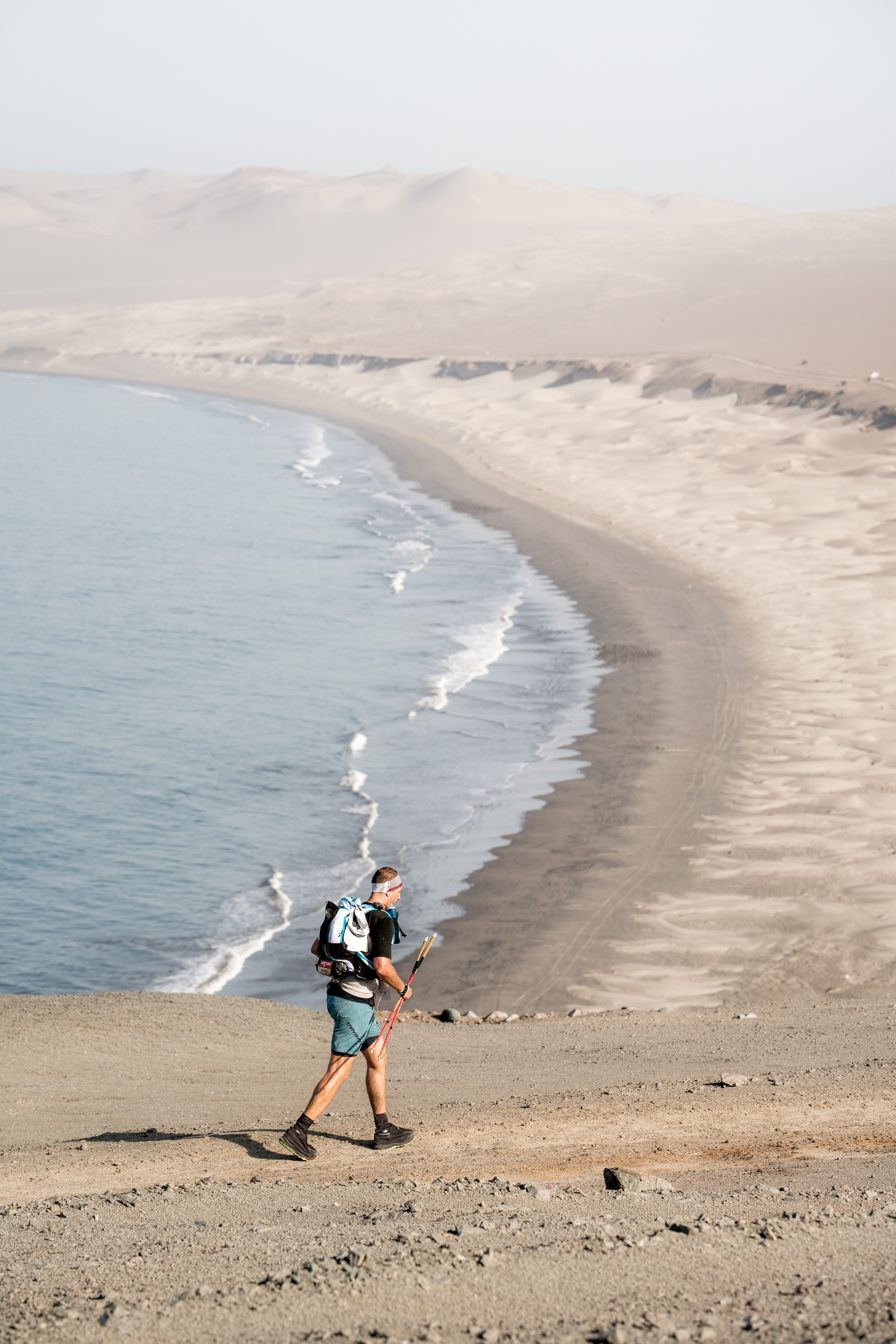
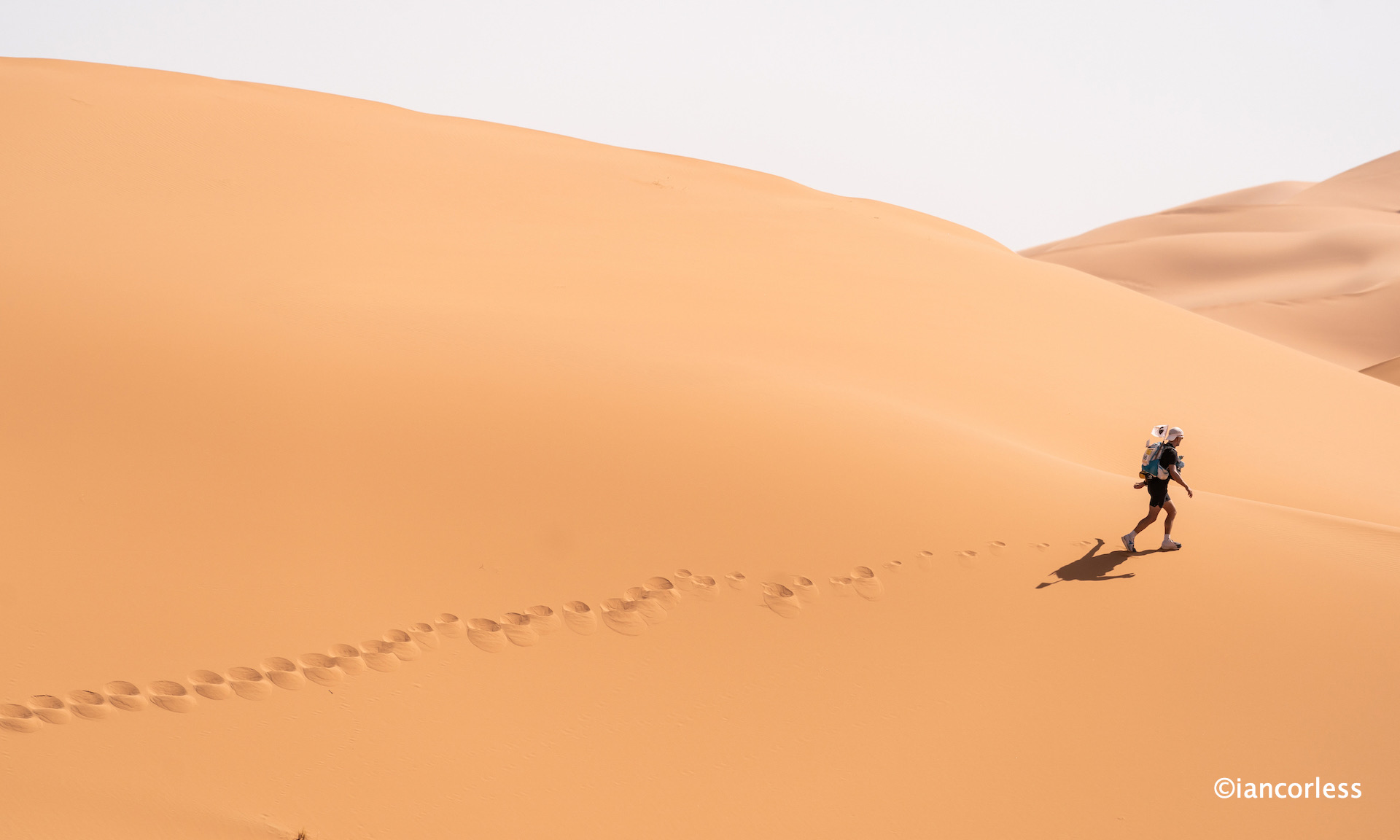
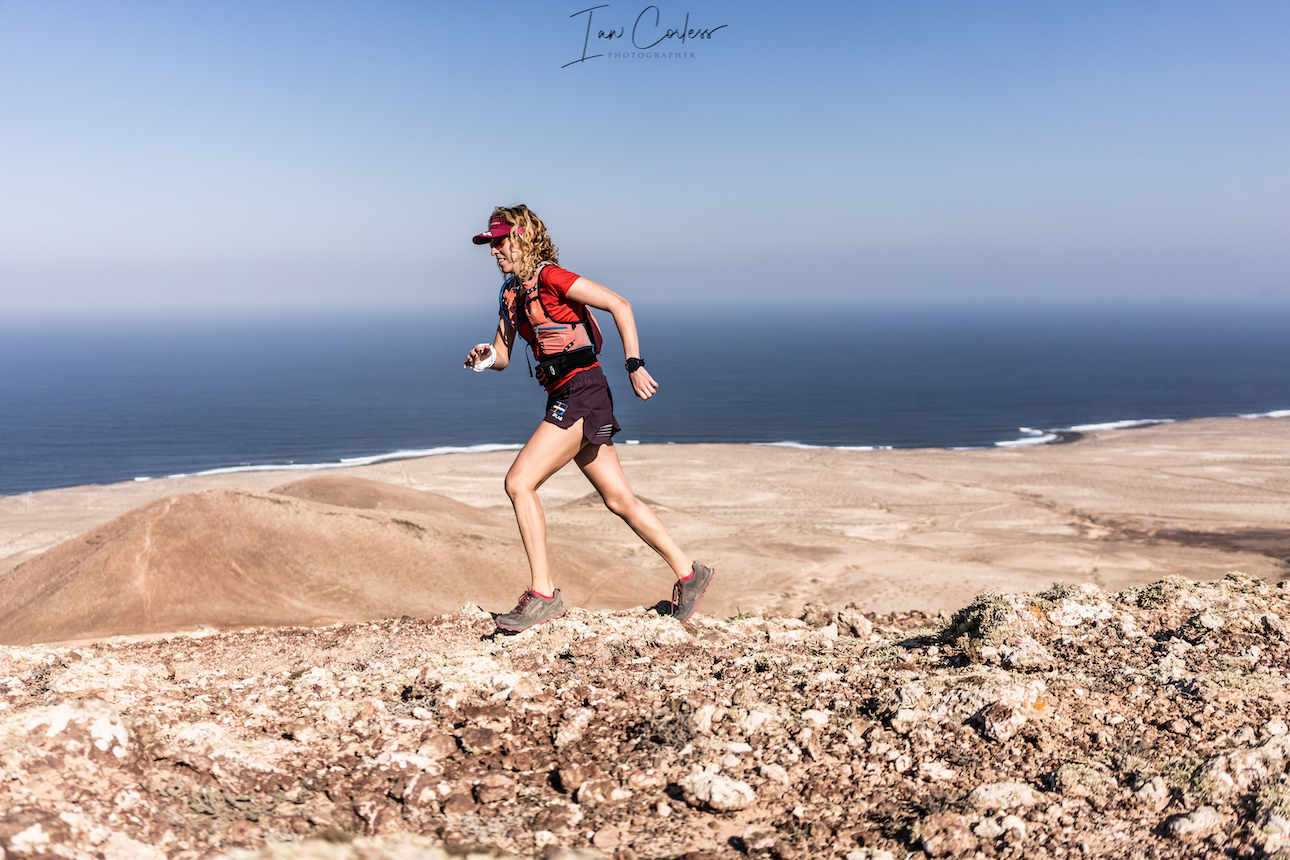
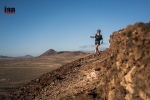
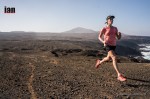
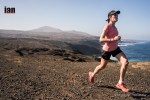
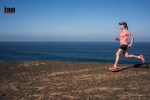
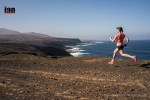
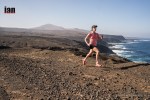
The course unfolded in long stretches where the runners sat between sand and sea. To the left, dunes rising and falling with perfect curves. To the right, the ocean pulling at the shoreline with steady rhythm. The contrast was sharp. The calm blue of the Pacific. The pale heat of the desert.
The line of runners threading through it all. It was a route that looked simple but felt huge. Every kilometre carried its own personality. Hard packed sand, soft patches, wind-carved paths, open flats. The landscape changed often enough to keep minds awake, and beautiful enough to pull them forward.
The heat arrived just as the field settled into its stride. It wasn’t the fierce blowtorch heat of earlier days, but it was real. A reminder of where they stood. Yet the ocean breeze stepped in like a quiet ally. It never erased the challenge, but it kept it honest. It made the effort manageable, even enjoyable, for those who still had enough in the tank to look around and absorb the moment. The contrast between struggle and beauty gave the stage its edge. You work for every step, but you are rewarded at every turn.
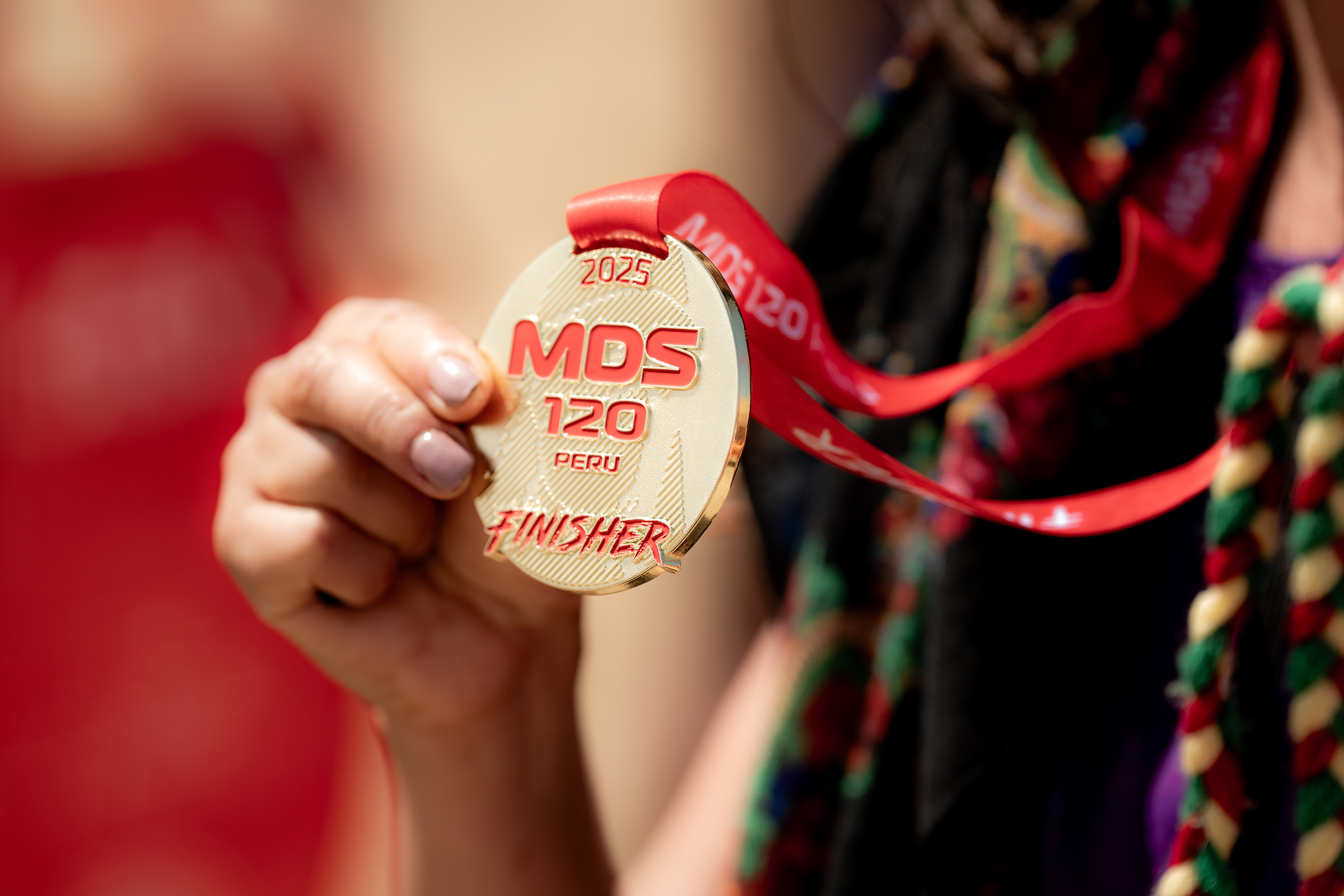
Ahead waited the final finish line. The one everyone had imagined since the first briefing. Flags. A strip of sand. A medal that represents far more than distance. For some, it marked the end of 70km’s, for others, 100 or 120km.
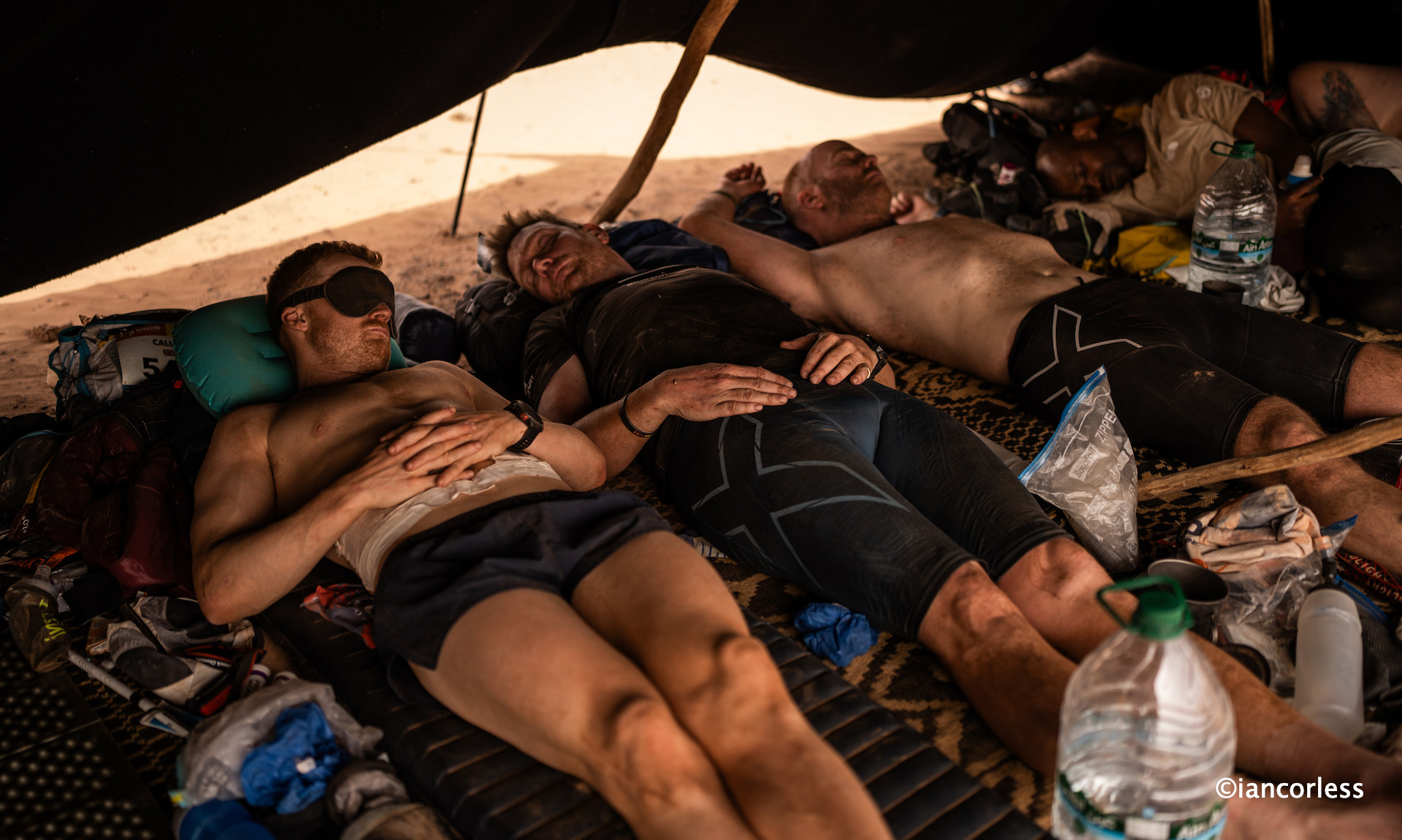
The numbers matter less than what they represent. Hours of carrying everything you need. Days of managing effort, discomfort, nutrition, and doubt. Nights spent in bivouac with sand in their shoes and a story building in their mind. Every runner arrived with their own reason for standing on that line. Every runner left with their own version of pride.
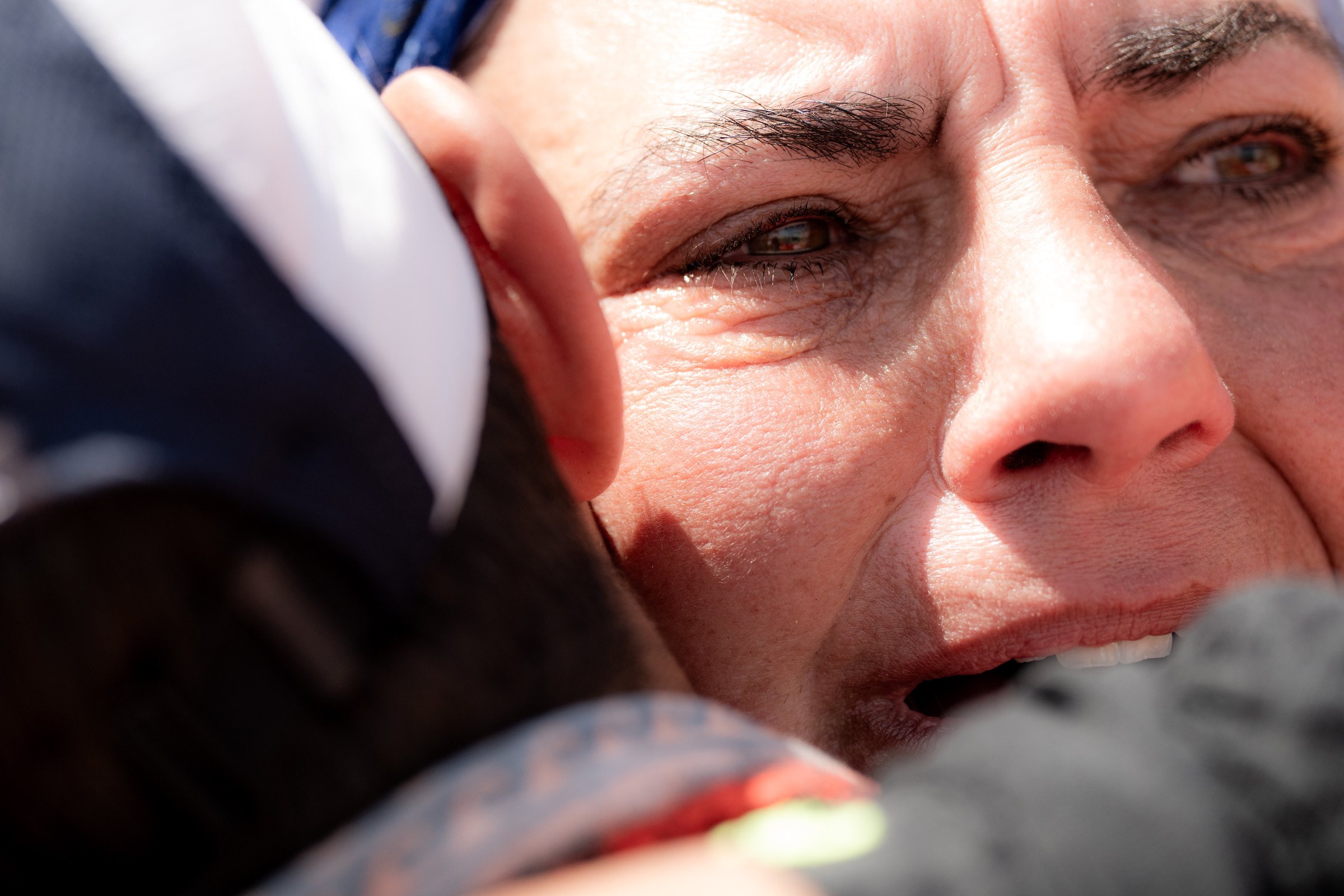
Ocean, desert, island, sky. A backdrop that looked unreal even with tired eyes. The final meters felt both endless and too fast. Some ran strong. Some walked with purpose. Some cried.
Some smiled because crying would have taken too much energy. But when they crossed, the moment hit all the same. Relief, release, accomplishment. A medal placed on a dusty, sunburned chest always carries more weight than its metal. It is a statement: you finished what you started.
Peru helped deliver that feeling. This place is varied and magical in a way words only capture from the surface. Participants have now experienced it from within. They have lived at the pace of the terrain. They have watched light move across dunes and cliffs. They have felt the temperature swing, the sand shift, the silence settle. They have stared at landscapes that looked untouched and walked through areas shaped by wind, water, and time. The magic isn’t something you observe. It is something that gets into you until the experience becomes part of your memory, and part of your identity.
Self sufficiency sharpened that magic. Carrying your world on your back changes how you see everything. Meals taste different. Rest hits harder. Small wins grow bigger. Each person learned to handle the course with their own decisions. When to push. When to save. When to stop and fix something. That independence builds a kind of confidence that no one can hand you. You earn it step by step. You also earn the hardship that comes with it. Fatigue. Friction. Heat. Moments when your thoughts wander into the wrong corners. Yet that is where the race shifts from physical to personal. You leave with a stronger sense of who you are and what you can do.
Stage three completed that story. It tied the effort of previous days into one clean line toward Laguna Grande. A route that looked almost gentle from above but carried the full emotion of the journey. Those final twenty seven kilometers gave runners space to reflect. Not in a soft poetic way, but in the grounded, honest way that comes when you are tired but not broken. Many thought about why they came. Many thought about who helped them get here. Many thought about how they had changed over the past days. The finish line didn’t give those answers. It confirmed them.
What stands out from this stage is the sense of balance. Mist, then sun. Heat, then breeze. Hardship, then reward. Desert, then ocean. A final effort that closed the race exactly as it should have: with clarity. Runners saw Peru in wide angles and fine detail. They felt the country’s scale and its intimacy. They moved through places you cannot appreciate from a screen or a road. They earned every view and every step.
MDS 120 Peru is built on challenge, but it thrives on discovery. Participants discovered what the desert holds, what the coastline gives, and what they themselves can carry through heat, sand, and self doubt. They discovered that Peru is not only beautiful. It is alive, shifting, layered, and surprising in ways that stay with you.
Stage three delivered the finish, but more importantly, it delivered perspective. The medal is the symbol. The journey is the reward, the magic of Peru is something they will keep long after the sand is washed from their shoes.
Stage 2 of MDS 120 Peru asked for grit, not the kind you feel in your teeth after miles of soft sand, but the kind that keeps you moving when your legs and head start to argue with each other.
The day opened under a blanket of cloud and a bite of early chill. Soon enough the sky broke open, the sun pushed through, and the landscape shifted again.
Runners climbed hard from the start, working through rolling terrain that rose and fell like waves before the coastline even appeared. The sand stayed soft and stubborn, forcing every step to count.
What the course took in effort, it paid back in views. Wide open desert. Long lines of dunes. Light bouncing off ridges and carving shadows that stretched for kilometres.
Each distance had its battles, but they shared one reward.
The final approach dropped into Paracas National Reserve, where the South Pacific came into full view.
The coastline set the stage for the last push, a reminder of why runners sign up for days like this.
Stage 2 was tough. It was also unforgettable. The kind of day that reminds you you’re capable of more than you think when the terrain and the moment rise together. Tomorrow, a rest day…
The MARATHON DES SABLES is a unique adventure of 250km’s spread over 6-stages of self-sufficiency, shared by thousands of enthusiasts, in 2026 it celebrates 40-years. In 2017, another format, HMDS was born with 70 to 120km distances, spread over 3-stages and 4-days.
Since 2024 there has been a significant changes for the MDS brand. The ‘HMDS’ format while still following the same protocols and format has now dropped the ‘half’ title and moving forward, events will be called MDS 120 Jordan, MDS 120 Morocco, MDS 120 Cappadocia and so on.
To differentiate the full distance race of 250km’s, Marathon des Sables will now be known at MDS Legendary, reflecting the legendary status of this iconic event and its long history as a pioneer of the stage racing and multi-day format.
All the races are now owned by the same team and while many may be familiar with the format and protocols for the shorter distance races, MDS Legendary since 2024 has had some significant changes.
Since 2024, MDS has expanded beyond its roots with MDS 120, the exploratory MDS TREK, the demanding MDS RAID, the mind-bending MDS Crazy Loops. and MDS ULTRA – Morocco. And the inspiring, MDS HANDI. Each one a new take on the same promise, to push the limits of what a runner can handle.
MDS EVENTS
MDS The Legendary
MDS 120 Atlantic Coast Morocco
MDS RAID Namibia
MDS 120 Cappadocia
MDS Crazy Loops – currently 2 locations in France.
MDS 120 Fuerteventura
MDS 120 Morocco
MDS Trek Morocco
MDS Handi Morocco
MDS 120 Jordan
MDS 120 Peru*
MDS ULTRA – Morocco
* Every 3-years.
WHAT IS MDS?
MDS is a self-sufficient race taking place over 3 to 6-stages.
Bivouac life.
MDS Legendary is the iconic 6-stage race (over 7-days) with a distance of 250km (+/-) based on the route, terrain and difficulty. There are no options available on distance and participants are self-sufficient for the entire race, the only exception is the provision of water and a shared tent (bivouac) with 7 other participants. An example of 2024 distances:
Stage 1 : 31.1 km
Stage 2 : 40.8 km
Stage 3 : 85.3 km (over 2 days)
Stage 4 : 43.1 km
Stage 5 : 31.4 km
Stage 6 : 21.1 km
MDS120 events start at 70, 100 and 120km for the shorter race format, depending on the race destination, there are 2 or 3 distances available. To clarify, this is not 2 or 3 different races, but the same race with the option to choose what distance you run or walk. As an example, the route is divided into 3 stages (4-days), to be completed at your own pace: walking or running.
– 70 km
– 100 km
– 120 km
Here is a breakdown of each stage:
– Stage 1: 25km – 30km
– Stage 2: 20, 40 or 60km
– Stage 3: 25km – 30km
The choice of the format is made at the registration. However, you can adjust it until the time of MDS.
MDS RAID follows a similar format to MDS 120.
MDS TREK is not self-sufficient and while similar to other MDS events, the format is much more a holiday experience, ideal for first timers or those who are looking for an active travel/ relax experience. Read more HERE.
THE MDS FORMAT
MDS The Legendary and MDS 120 events follow a similar format, however, there are key differences:
MDS The Legendary is a 10-day experience
MDS 120 a 7-day experience
In both scenarios you arrange travel to the relevant destination, arriving with adequate time to meet the MDS team at a designated meeting point and time. This may mean you need to arrive one day in advance to ensure you are able to meet the schedule as stipulated. From here, the MDS team then transport you to the start of the race.
For MDS Legendary this will be a flight to Marrakech and free transport is offered to Ouarzazate.
For MDS120 / TREK / RAID and ULTRA events, the meeting point will be a specific airport for transfer to hotel.
MDS The Legendary use classic Nomad tents that hold 8-participants. By contrast, MDS120 events use individual tents organised in cells of 6. TREK has upgraded tents, RAID combines solo tents and a star night, MDS ULTRA will be hotels except when racing.
Post-race you will be transported to a hotel and an awards ceremony and gala dinner will take place.
EVENTS
MDSLEGENDARY the iconic 6-stage, 250km race celebrating 40-years in 2026.
MDS 120 (used to be HMDS) this is 3-stages over 4-days with distance options of 70/ 100 or 120km.
MDS TREK this is similar to the MDS 120 format, however, there is no self-sufficiency, more comfortable accommodation and additional facilities, an excellent introduction to the MDS.
MDS RAID an event for more experienced athletes that is undertaken in teams of two, over approximately 90-120km’s, typically, two distance options are provided. The format is similar to MDS 120 with 3-stages over 4-days. One night will be undertaken under the stars with no bivouac.
MDS ULTRA new for 2025, a 100-mile or 100km single stage race with a 40-hour cut off.
MDS CRAZY LOOPS three new events for 2025 undertaken in ski resorts, the format is to run as many loops as possible in 24-hours. The loops will be typically, 3-5km’s in length.
MDS HANDI an inspiring inclusive event to provide wheel chair athletes an opportunity to participate with team members.
Both race formats, MDS Legendary, MDS120, MDS RAID and MDS ULTRA require participants to be self-sufficient for the whole race.
What does this mean?
Quite simply, you must wear and carry all you need for your race experience with the exception of the tent / bivouac. MDS ULTRA will not require a bivouac or same kit requirements as MDS Legendary, Raid or 120.
It may sound daunting but it is not, it’s actually quite simple. You need to address the following points:
What you wear.
Equipment you need to participate.
Sleeping.
Food.
Cooking equipment. (You can purchase fuel blocks in bivouac)
Water.
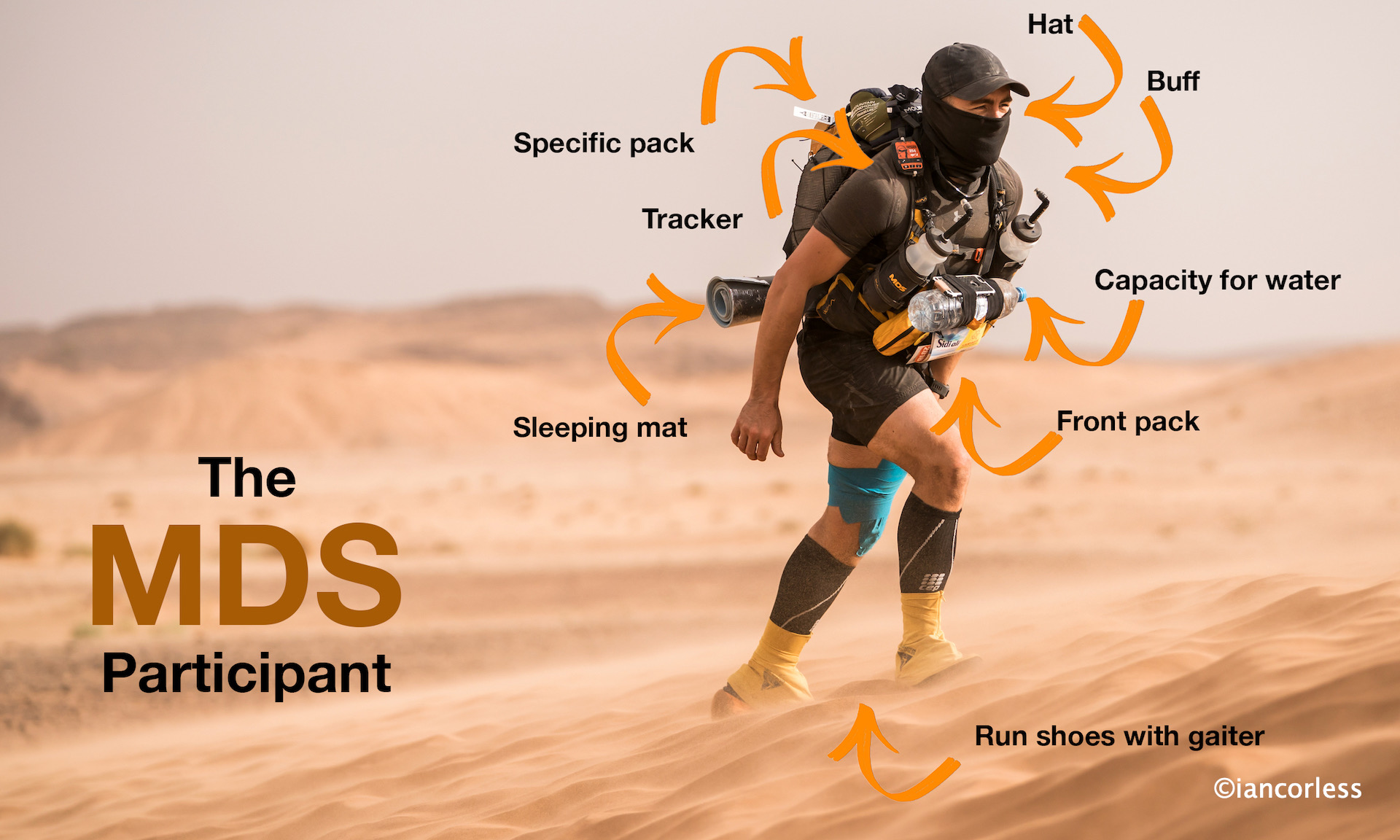
WHAT TO WEAR
Hat to protect from the sun with optional neck protection.
Shirt (short or long sleeve) with adequate protection from the sun.
Shorts, skort or similar.
Socks.
Shoes with appropriate protection and durability for a desert environment with a gaiter (typically sewn on) to keep sand out of the shoe.
WAA is a partner for MDS have specific equipment for desert/ stage-racing.
Because you have entered a MDS event, there is no need to buy new apparel and shoes. Quite simply, if you have items that work, are comfortable, cause no problems or irritation, there is no need to change them. If it aint broke, don’t break it. Shoes always create a huge debate and please find what works for you. If you ask on any forum, you will get countless recommendations but none of those recommendations are specific to you and your needs. Read an article HERE and HERE.
Always remember that with MDS events you are either wearing or carrying everything you need for the race duration. Therefore, it is imperative that you purchase the lightest options available (based on budget) and you keep luxuries to a minimum.
Keep it simple!
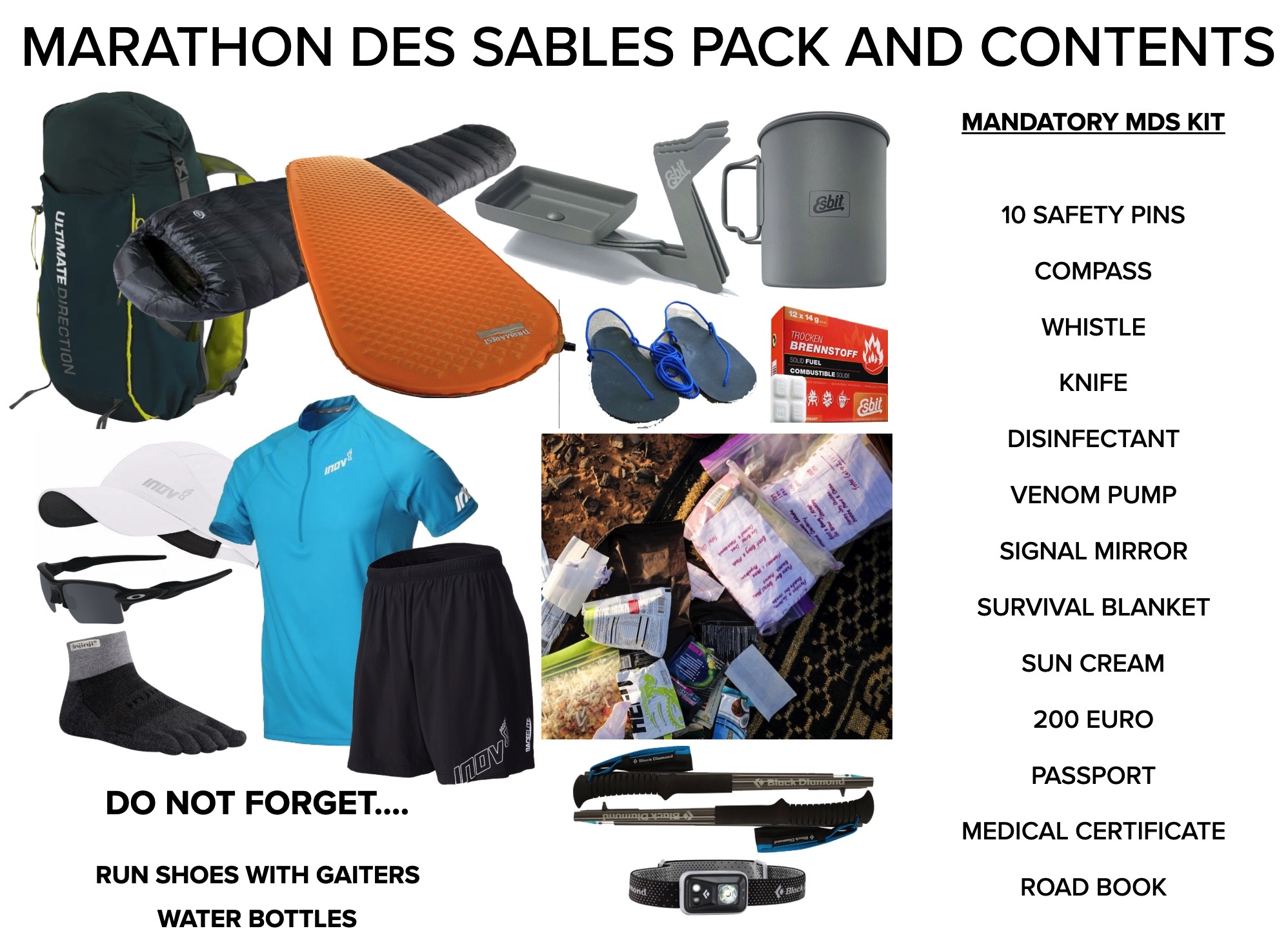
MDS specify ‘mandatory’ equipment for participation as specified below:
A sleeping mat is highly recommended to protect from the ground, insulate and provide comfort.
A jacket is highly recommended (lightweight down) for cold morning and chilly nights. Many products exist. An excellent combination item is offered by PHD but it does come at a price – HERE.
Poles are for many 4-wheel drive in stage races, Leki are highly recommended.
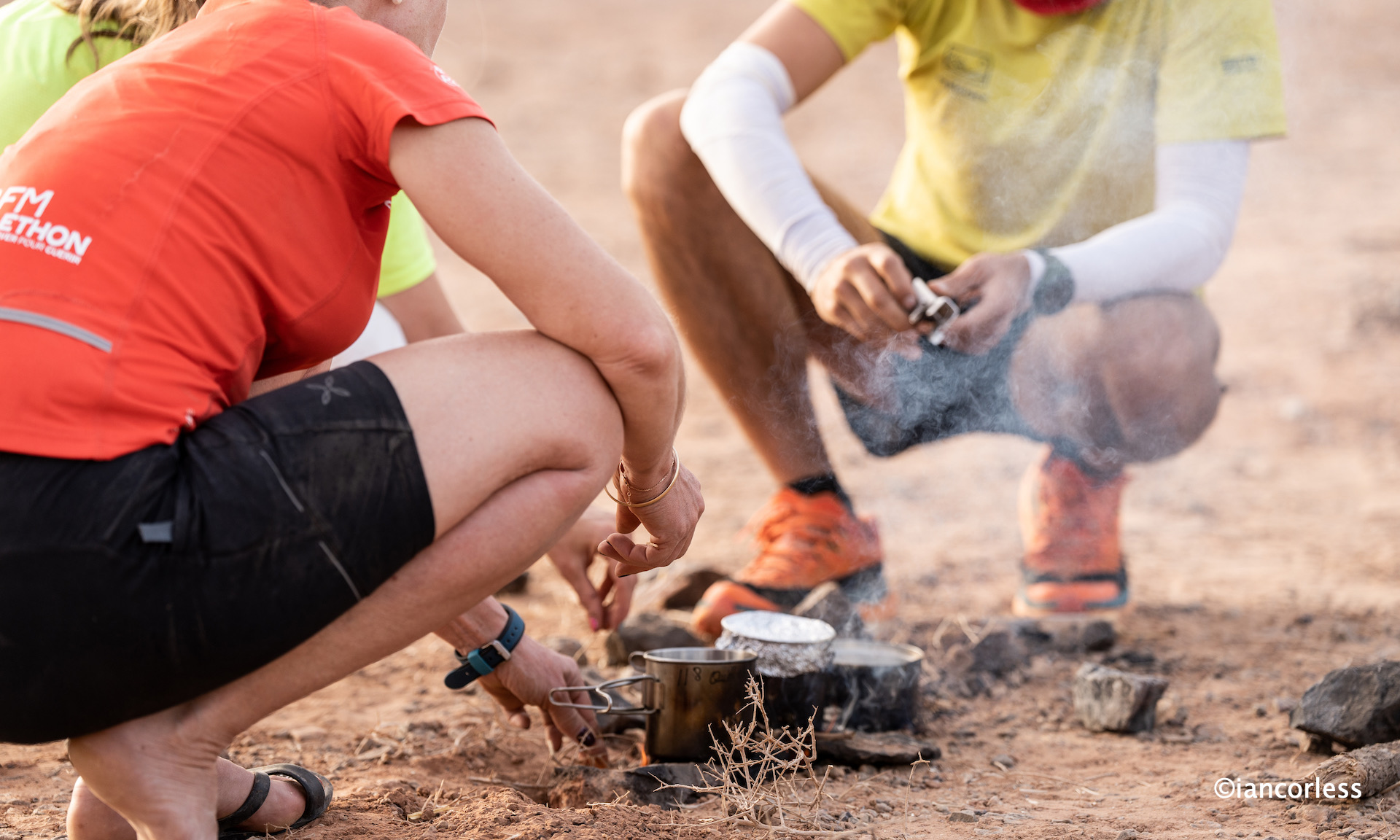
Stove – if you plan to have hot water, you will need a cooking system like those provided by Esbit. Please note, you cannot use any gas stoves in the desert, you must use fire bricks which you can purchase at bivouac.
Pot – if you are using a stove, you will need a pot/ mug.
Spoon with long handle for eating. Such as a Spork.
Buff or neck roll.
Sunglasses are essential and think about protection in sand storms, goggles may be required.
Flip flops or similar. Many use the weight free slippers from hotels, however, they rarely withstand the desert.
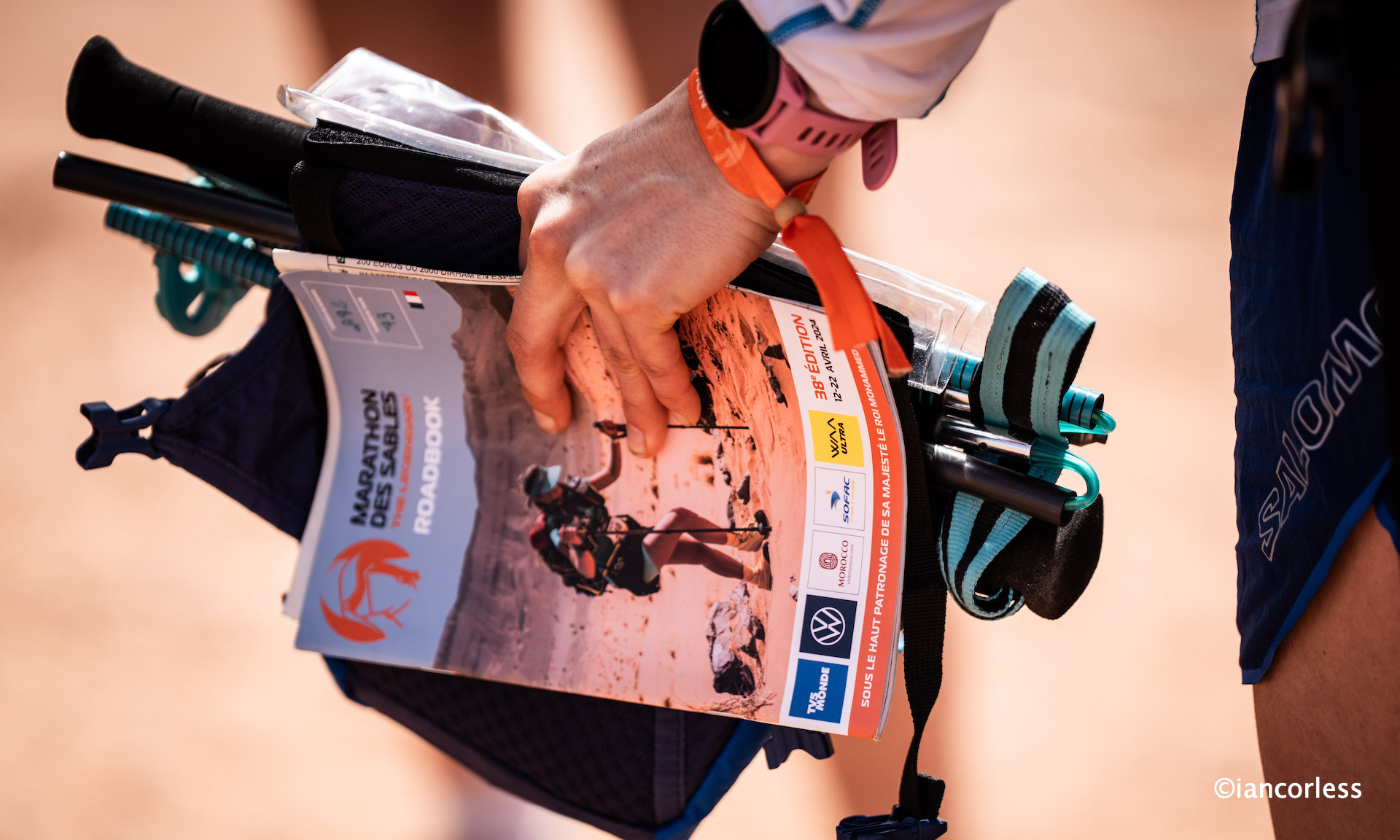
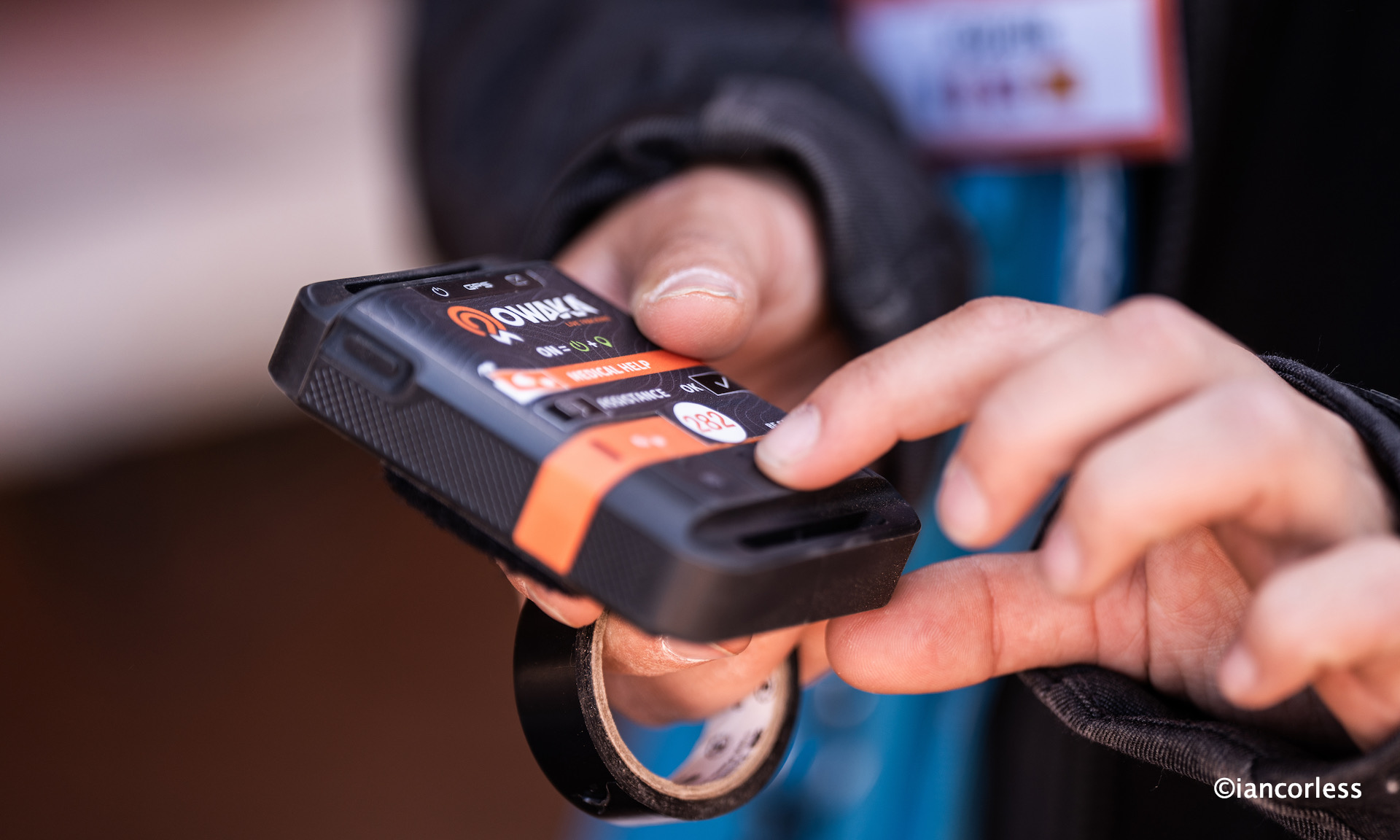
Watch / GPX
Personal items: Tooth brush, toothpaste, hand gel, wipes, toilet paper, ear plugs, blind fold etc.
Emergency – Things can happen during a race, so, be prepared with some essential items such as needle and thread, superglue, zip ties, monkey tape etc. If something rips or breaks, you need to repair it.
Luxuries
MDS is and should be simple in format. Remember, you must carry everything, so, keep luxuries to a minimum. Many consider a small MP3 player, look for something small, light and with great battery.
Phones are an essential part of our daily lives, do yourself a favour and leave it at home. The liberation is extremely rewarding. Please note, phones are allowed, however, it is prohibited to telephone on the bivouac or on the course. If you want to make a phone call, you will have to move away from these places so as not to disturb anyone.
SLEEPING
A sleeping bag is mandatory, so, there is no discussion here. The combined weight of your food is the heaviest and bulkiest item, however, a sleeping bag is next. These days there are many options available and quite simply you want the lightest possible, with the smallest packing size with required warmth at a price that you can afford. Not all sleeping bags are the same, so, consider this. Down is the best filling as it is the lightest, warmest and packs small. However, ‘fill power’ is a key element of down, fill power tells you how much volume a 30-gram, or one-ounce, sample of down will take up. So, the higher the fill power, the warmer the bag will be for less weight, because that one ounce of down has larger down clusters that provide more loft and have the ability to trap more heat. These bags will be more expensive.
Brands to look at: Nordisk, Seat to Summit, Rab, PHD, Western Mountaineering, Wilsa, Lightwave and so on.
Note here, that you will also probably be taking a down jacket for warmth. This can be used as extra warmth and insulation in a sleeping bag. So, it is possible to think about getting a lighter, less warm bag and supplementing warmth with a jacket.
UK brand PHD has come up with the perfect solution with an Ultra Jacket and Desert Race Half Bag but is does come at a price. However, it is comparable with the costs of jacket and bag by Nordisk.
Sleeping mat is highly recommended. When you are not running or walking, you are sitting or lying down, comfort is key. Two options exist, inflatable or not. Inflatable provides the greatest comfort but with poor admin does have the risk of puncture. Sea to Summit provide excellent inflatable options with low weight and pack size. Exped have excellent closed-cell foam.
The MDS 120 events (TREK not included) are self-sufficient adventures. You need to bring your own food and carry it in your bag for the duration of the race.There is a requirement that you must have 2000 calories minimum per day. Please remember that from 2024, catering is not provided at MDS The Legendary and therefore you must have enough food and calories before the race starts.
Food is the heaviest item you will carry and is essential. Don’t skimp on food. Lay food out per day addressing key items:
Breakfast (be careful they are not too sweet)
Snacks while running (bars, nuts, dried meat etc)
Post-run recovery (usually liquid form is ideal)
Lunch if applicable (this could be another meal such as cous cous)
Dinner (dehydrated meal)
Evening snack (a bar)
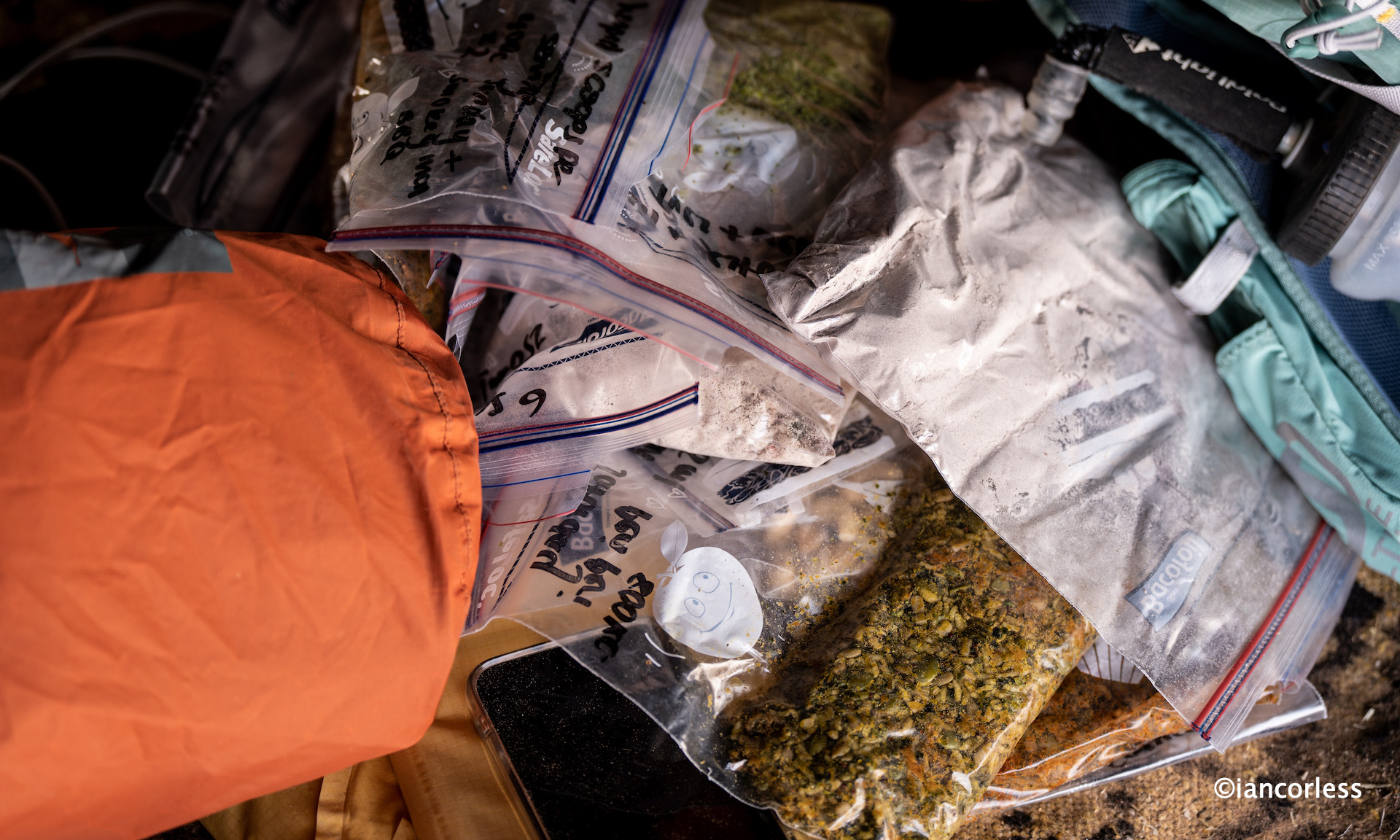
Where possible, repackage food to make them smaller and lighter. However, make sure you keep nutritional information for the admin day. Pack food in day bags, that way it is easy to know what you have and importantly, you don’t take food you need for the next days. Keep doing this and you will be short of food at the end of the week.
Food is personal and you must find out what works for you. Remember taste chances when fatigued and in hot environments, often, sweet becomes less palatable with a preference for savoury. Dehydrated meals will often be used for key meals such as breakfast and dinner, some hydrate well with just warm water, others need hot water. So, if you are not taking a stove, test this. Basecamp food is a good website that shows what options exist. After many tests, highly recommended products are Firepot, Lyo, Tentmeals and Adventure Menu. Personally speaking, Firepot produce the tastiest meals I have tried.
Make sure you add some treats to spice up your palette.
A food list for MDS The Legendary could look like this:
Water provision, particularly at MDS The Legendary and MDS 120 has changed. In past editions, water was rationed and provided at key checkpoints in bottles, typically, 10km’s apart.
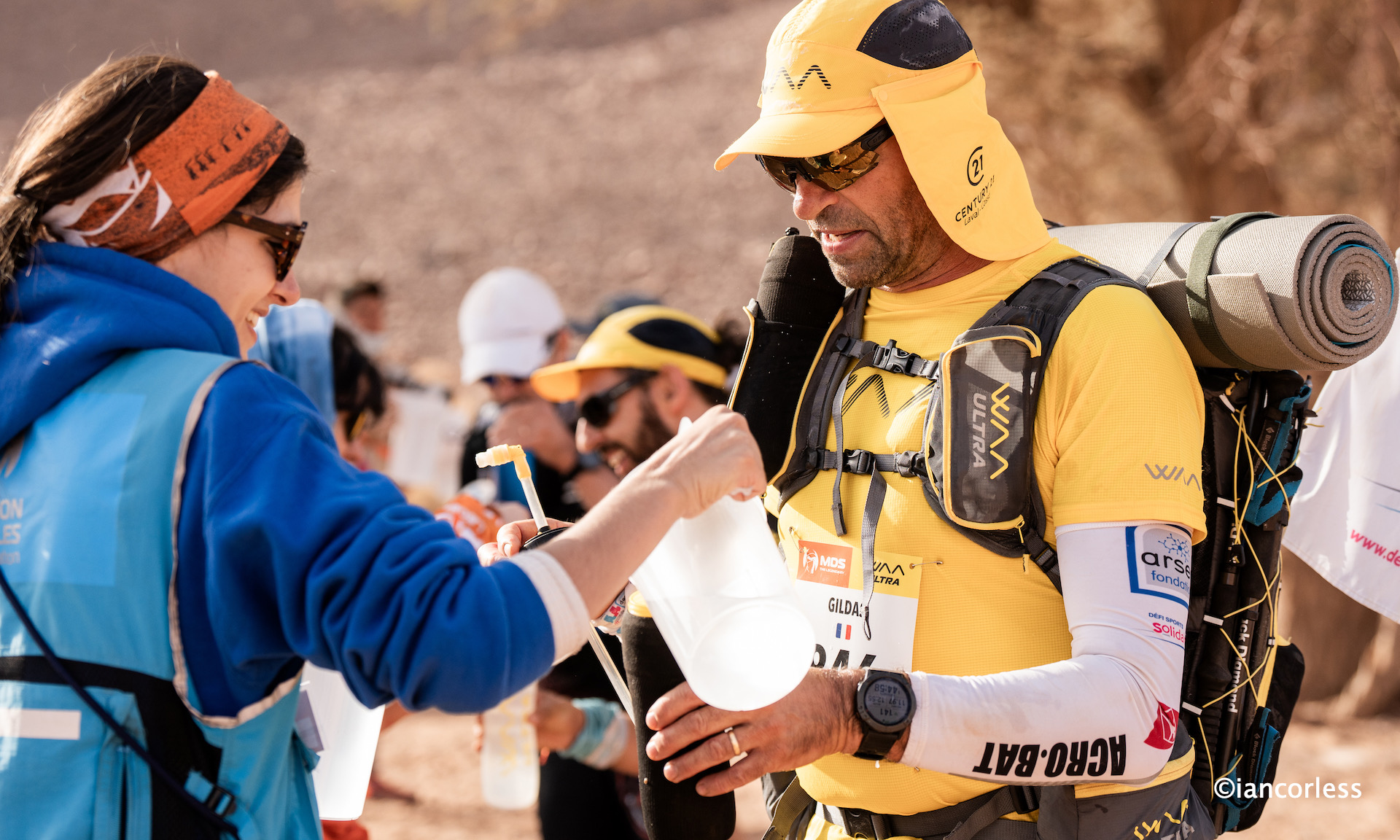
In 2024, the new organisation changed this and arguably, water is now available, as required whilst racing. It is poured from jugs by MDS staff.
In addition, intermediate water stations are added when deemed necessary to ensure competitor safety.
At key checkpoints, iced water is supplied and poured by MDS staff on the heads and neck to aid cooling.
Post-race, each runner is provided with a 5L bottle of water, this is used for evening cooking, breakfast and up to CP1 the next day. If you wish to wash or freshen up, this comes from the same water ration. So, prioritise food and drinking before washing.
THOUGHTS AND CONSIDERATION
MDS is available for all, be that racing snake or someone who is looking for the adventure of a lifetime. So, keep that in mind. A top runner will have his or her pack at the absolute minimum weight and will look to survive the week racing as fast as possible. They will spend the week hungry. You, for example, may wish to carry a little more weight and have some comfort during the week. Just don’t carry to much extra weight!
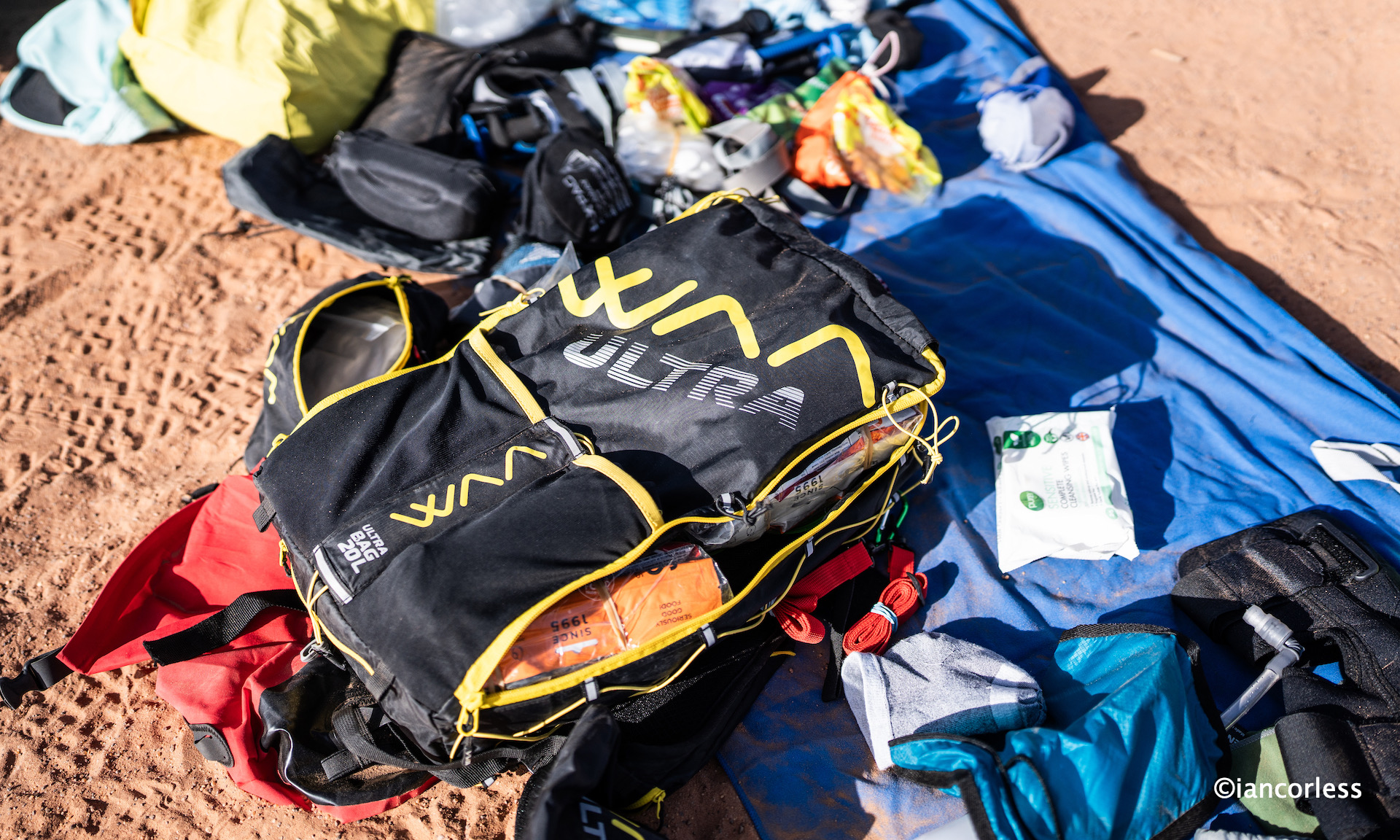
The pack you wear is a crucial item that not only must fit everything you need, but it must also be comfortable and allow easy access to drink. There is no one-stop solution here. We are all different sizes and have different body shapes, so, make sure you try options.Also remember, at the beginning of the race, your pack can be around 8kg, this adds extra pressure on the shoulders, so, make sure you have enough padding and comfort. Many packs now come with waist belts and this, for many, is a great solution not only for extra storage but weight distribution. WAA have the ultra bag which has been specifically designed for the job. Osprey have recently released the Talon Velocity 20 which in testing has been superb. Don’t be tempted to get a bag that is too large, remember, the more space you have, the more you may take.
Bottles are the obvious way to carry water, typically 2x 750ml on the chest straps. I personally really dislike this format, I find it uncomfortable and unpleasant. So, find your own solution. Bladders have always been considered a NO for MDS but I personally find the solution ideal for my multi-day adventures. If you are a ‘racer’ this is not the best solution, but for most, it is ideal. As always, bladders can puncture, so, think about this.
Shoes will always be a debate and point of discussion. Shoes are personal and must be suited to you, the individual. Consider your gait (neutral, supinate or pronate), consider time on feet, consider your weight, consider how much you will walk (and then double it) also consider shoe drop and how much cushioning you need. It’s impossible to recommend any one shoe because of these variables. You will see top runners using a lighter shoe, remember, these shoes only need to last 20-30 hours. However, you may well need a shoe for 40, 50 or 60-hours. Do you need a trail shoe? No, you don’t need a trail shoe but I would say that many trail shoes are more durable as they are designed for the rough and tumble of variable terrain. Do you need an aggressive outsole? No, you don’t, but I do think some grip is better than none and therefore I would use a trail shoe over road. Protection? Toe box protection is a good idea as deserts include lots or rocks, far more than you may think. Do I need a size bigger? Shoe sizing does depend on what is ‘normal’ for you. I always recommend a thumb nail of space above the big toe, you don’t need any more than this. Recommendations of going a size is bigger is bad advice in my opinion. A shoe that is too large allows your foot to move, a moving foot causes friction, friction causes blisters and the rest is the same old story that I see at desert races all over the world. However, I would recommend a shoe with a little more width in the toe box, this will allow for some comfort as the days progress. If you are prone to feet swelling, discomfort, blisters and so on, get a strategy sorted before you head out to your chosen race. You will need a gaiter and while not always the case, sewing velcro on a shoe can change its shape, so, consider this. There are specific desert racing shoes now available by Salomon and Raidlight.
Poles are a godsend, buy some and learn how to use them. They are 4-wheel drive.
Food is essential, make sure it works. Hot or cold water is a consideration and make sure if using meals that need rehydrating that they work with water at desert temperature. Never assume that water will always be warm because you are in the desert, just as we get hot years, we also get cool years.
Salt is needed to keep you in balance. Many foods contain salt so look to supplement that with the mandatory food cubes. Be careful here, for example, OXO works considerably better than Knorr. Do you need alt tablets? Do your research,, find out what you personally need and come up with a plan. Listen to a podcast HERE.
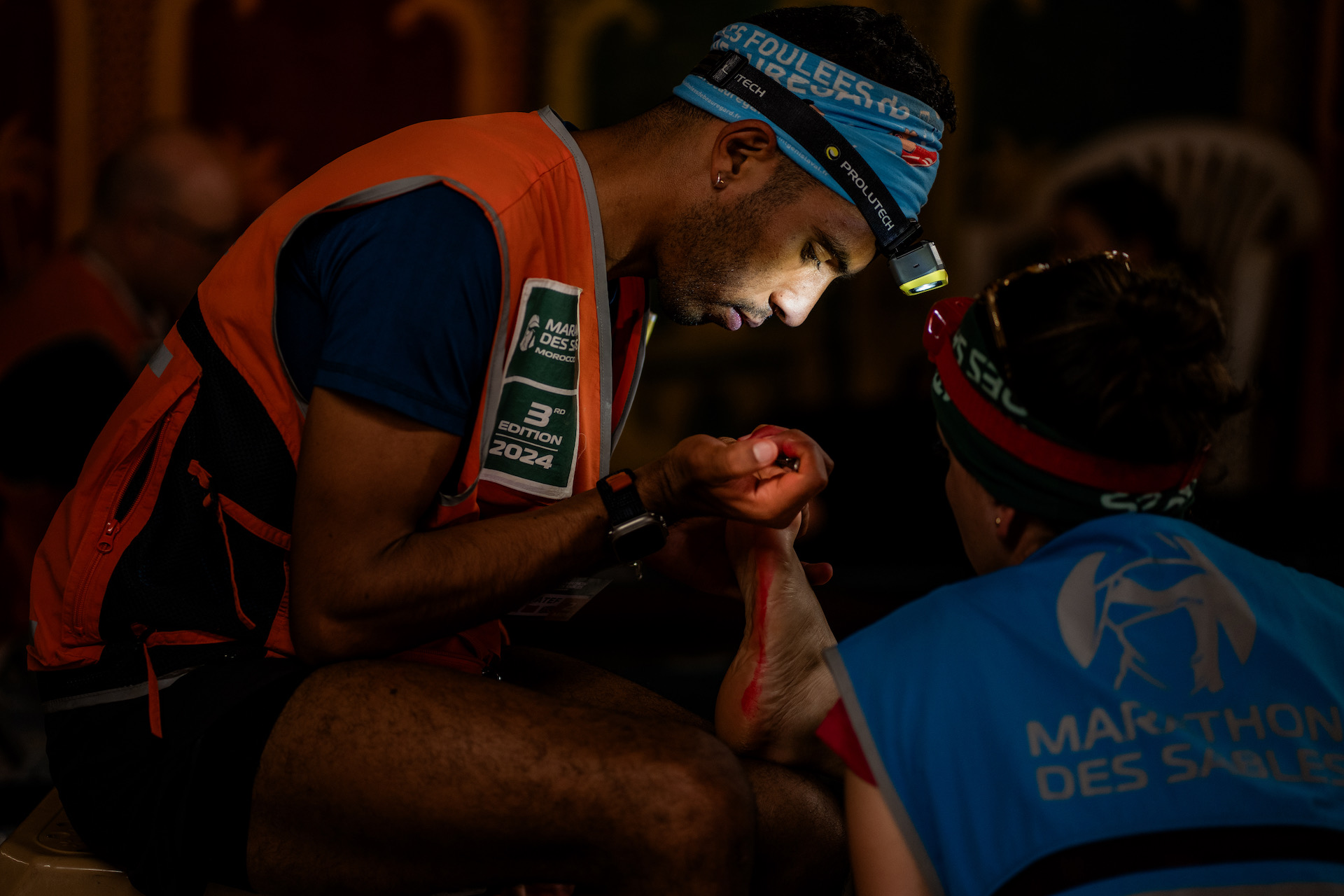
Feet – make sure you look after them. With the correct socks and correct shoes, there is no reason to get blisters and despite what some people say, the majority of people do not get blisters. Read Healthy for Running and Walking.
Heat is difficult and without doubt, it’s better to adapt to heat before the race. Read about Heat Acclimation by Dr Jodie Moss.
Hygiene is crucial and difficult when self-sufficient. But set up a protocol not only for your benefit but for those around you.
Luxuries keep them to a minimum.
Toilet paper is essential, make sure you have enough and compressed towels are brilliant to freshen up when you add a little water.
Take essentials on the plane and wear your run apparel and shoes. That way, should a baggage disaster happen your chances of racing improves.
Have additional items such as a base layer, sleeping bag liner and other items that may be on a ‘question’ list for the race. On night 1 and before you go to admin, you can make final decisions of what to and what not to take. Particularly important if you think you may be cold at night.
You signed up for the challenge, you wanted to be on the start line and therefore you are responsible for the outcome. Believe me, the ‘you’ that leaves the Sahara is not the same you that entered. Arguably, you change the moment you pay the deposit, the transformation process begins. Embrace the journey and apply yourself. Keep perspective, the MDS journey is an enhancement of you as a person. It’s easy to become obsessed, ultimately the majority of runners at MDS are enthusiasts, if you keep that in mind the journey will be a complete one.
Plan ahead, formulate a long term plan and don’t rush. The sooner you start this process, the greater your chance of success and the less chance of injury. Plan stepping stone races and don’t be fooled into thinking that you need to run marathons day-in and day-out. You don’t! Training is about ALL the training you do and not about anyone run.
If we exclude the top 50-100 runners (who will also walk sometimes) the majority of the MDS field spend a huge amount of time walking. Learn to walk! Believe me, it’s a huge tick in the MDS box and rest assured that if you are able to walk at a good consistent pace (barring injury or dehydration) you will finish MDS.
You are going to share bivouac with other people and you are going to have some serious highs and lows. These tent mates will pull you through and motivate you. They will become friends for life.
Legs, lungs, heart and feet will only get you so far. The mind is what will get you to the finish. Despite the hardships and pain, embrace the journey and mentally prepare for the challenge.
MDS is a magical and life changing journey, it really is a true challenge of mind and body to race over many days, irrespective if you complete or compete. It’s a hark back to a more primitive time, a time without clutter and modern technology. Embrace this. Embrace the silence of the surroundings and the simplicity of placing one foot in front of the other, eating, resting and sleeping and then doing it all again.
You can read a SUMMARY of the 2024 MDS The Legendary HERE
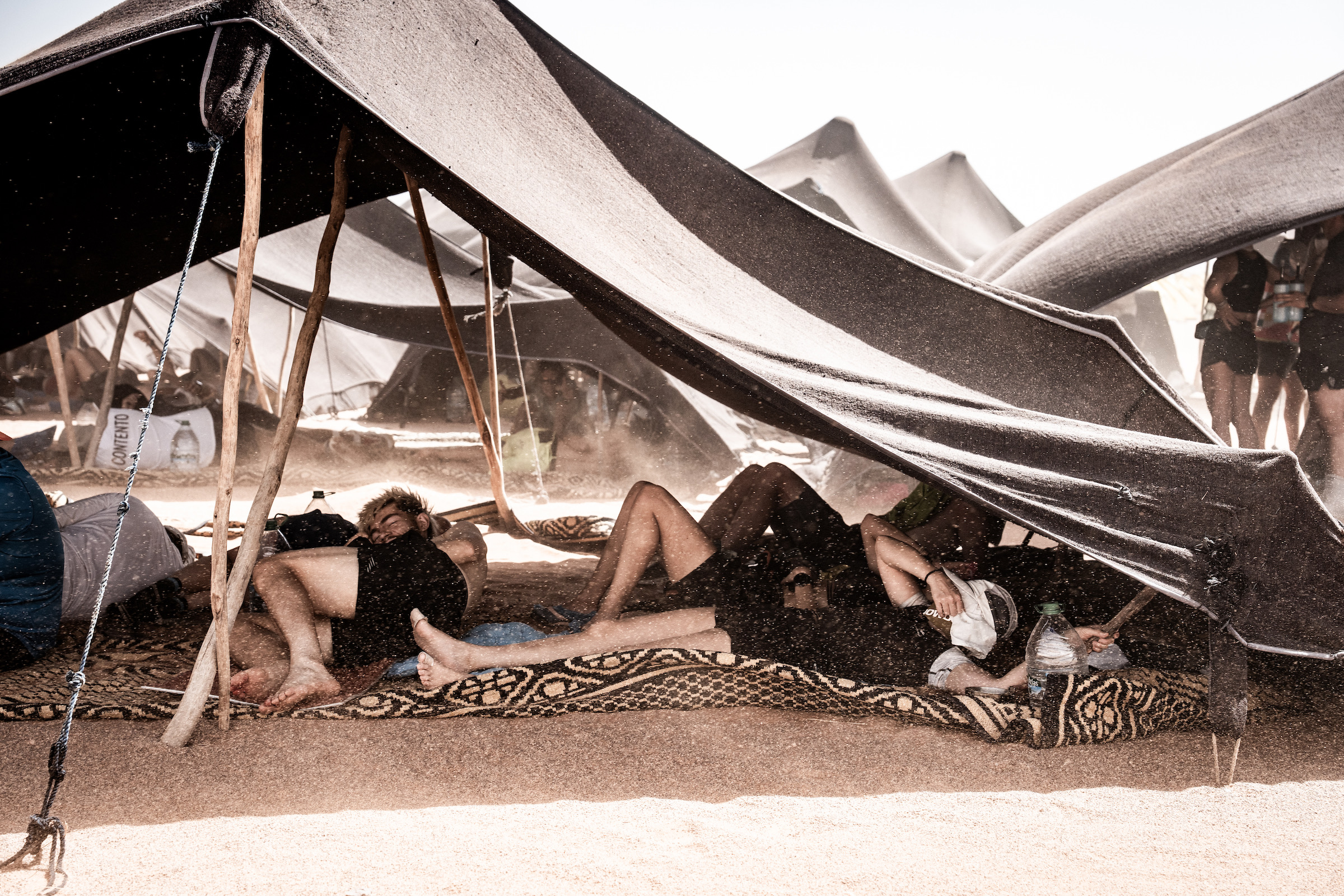
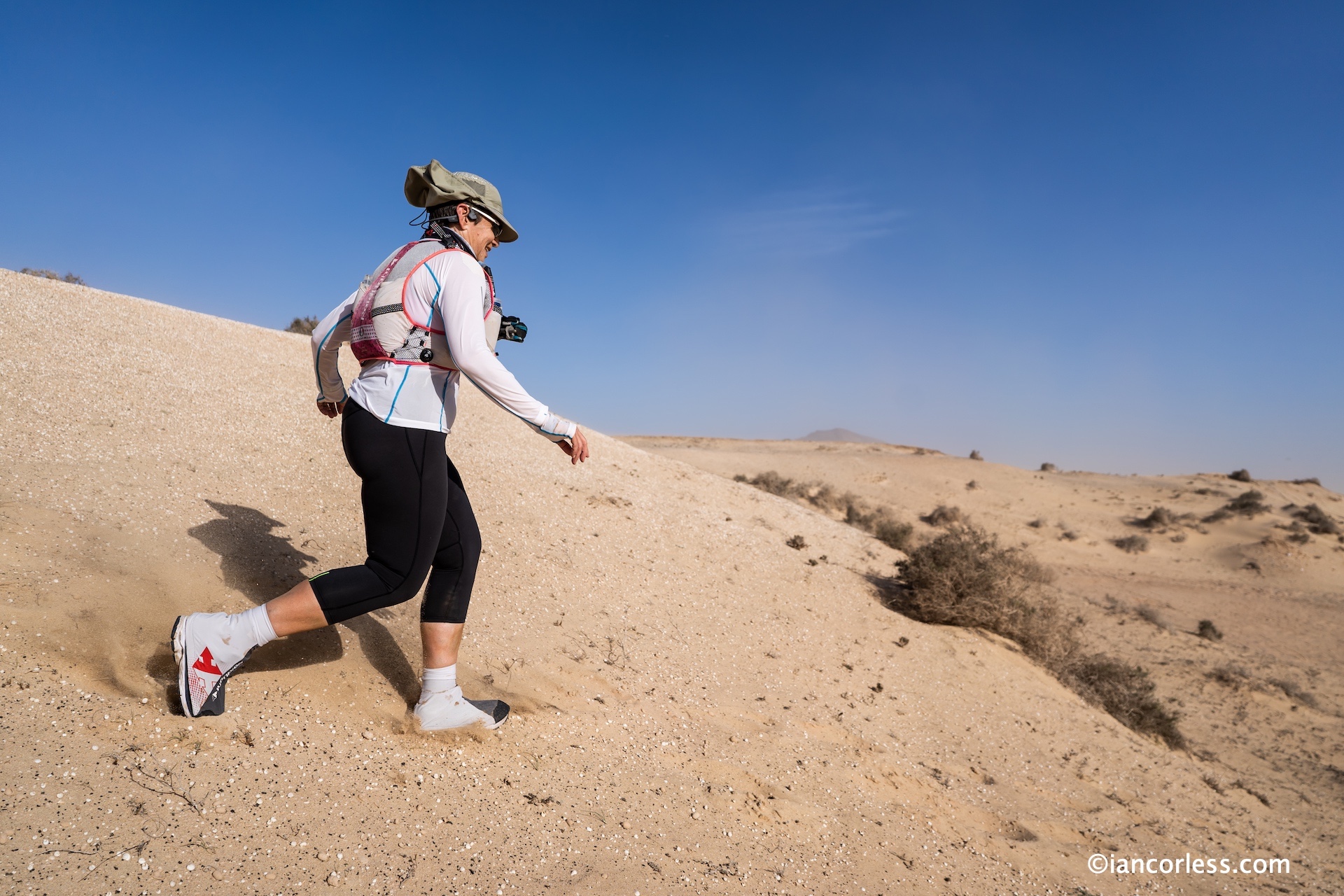
Day 3 of the Lanzarote Multi-Day Training Camp and a long run that included soft sand practice. It was a perfect day… Clear skies, hot temperatures and an opportunity to understand how to run up , down and across soft sand.
After a break, the afternoon session on ‘Fast and Light’ provided an insight on Fastpacking by Ian Corless and Abelone Lyng. While an emphasis was placed on Marathon des Sables, other races and environments were considered, such as rainforest, mountain and snow/ ice.
MDS Kit
Once again a short recovery run concluded the day.
Tomorrow, participants will spend a night under the stars, in bivouac, fine-tuning their self-sufficient skills in a real environemnt, with rationed water and just a tent provided.
Interested in joining us? 2024 is open for booking HERE
12th January to 19th January, 2023. Club La Santa, Lanzarote
Missing the 2021 camp due to the pandemic made the ’22’ camp even sweeter. Some may say it was the best camp yet…? To be fair, we think they are all great.
We have so many attendees returning year-after-year and this keeps me on my toes always looking for something new. In the last two editions we have added a ‘Long Day’ that is a point-to-point run offering an opportunity to see and experience new trails. In 2022 we added some new routes that offered a little more technicality and vertical meters.
2023 WILL BE THE BEST YET
Rachid at the 2021 MDS on stage 1.
First and foremost, we will have some new coaches and special guests. The big news is that 8x Marathon des Sables champion, ‘King of the Desert,’ Rachid El Morabity will join us, arriving Friday 13th and departing Monday 16th. He will join us for two runs, provide a 2-hour Talk & Worskshop and yes, I am pretty sure you will all get an opportunity to have a photo taken with him.
The amazing and inspirational, ‘Dead Man Running,’ Kevin Webber will join us for the whole week. He will look to inspire each and every attendee by quite literally, leading by example. As Kevin says, “Got told my prostate cancer may kill me in 2yrs but here I am, nearly 5 years later running ultra marathons, raising awareness and funds for Prostate Cancer UK!”
With some new routes, new talks and workshops, new guests, the 2023 Multi-Day Training Camp will take what is already a special and unique formula and take it up several notches.
Day 4 of the Lanzarote Multi-Day Training Camp was after a sleepless night in bivouac. The wind started at midnight and built through the night making for a ‘perfect’ test scenario for a multi-day race, particularly one in a desert.
Tents were broken, clothing items were lost, tents (those that survived) were full of sand and all the participants had a great learning curve that ultimately was a priceless experience.
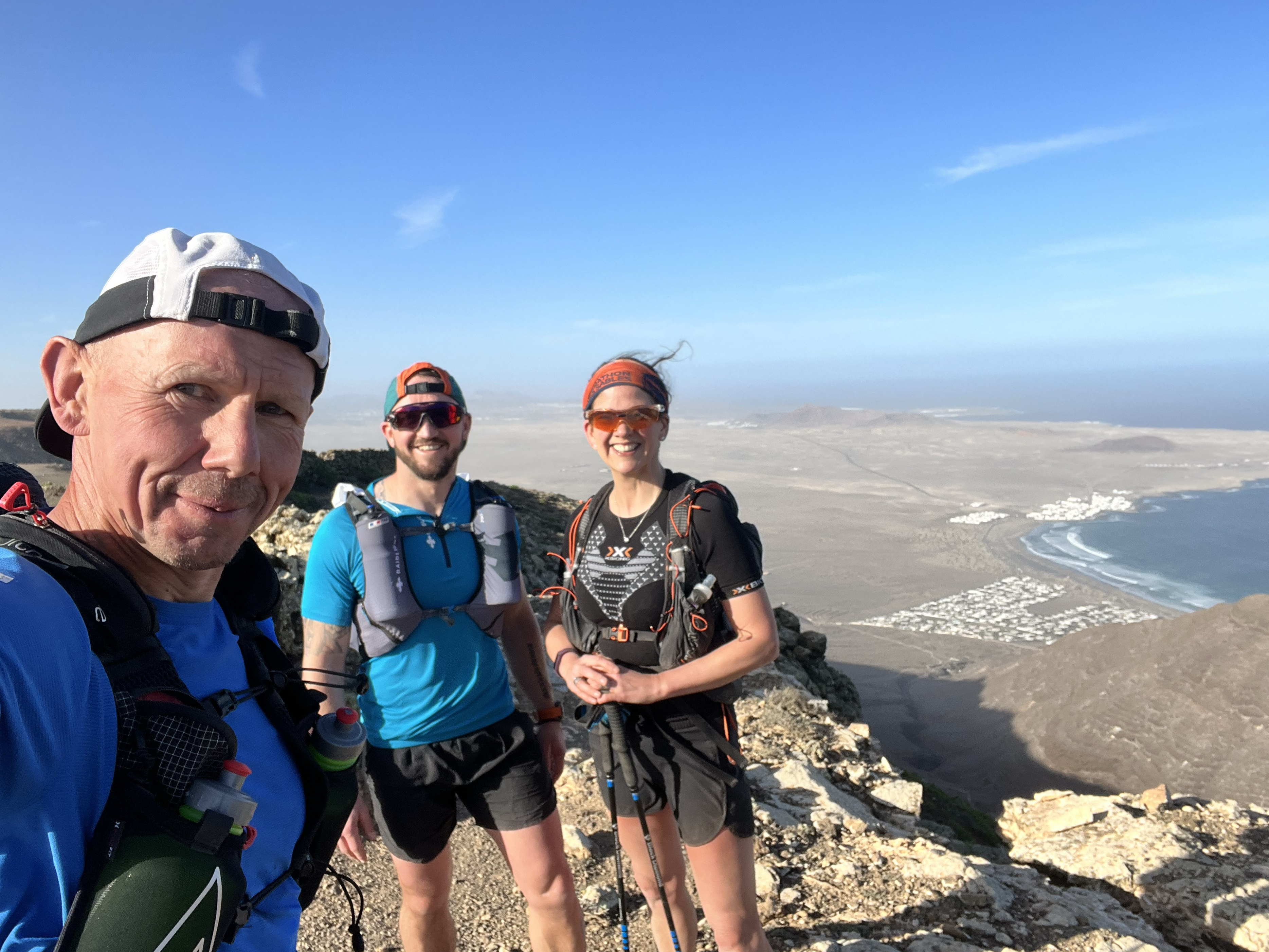
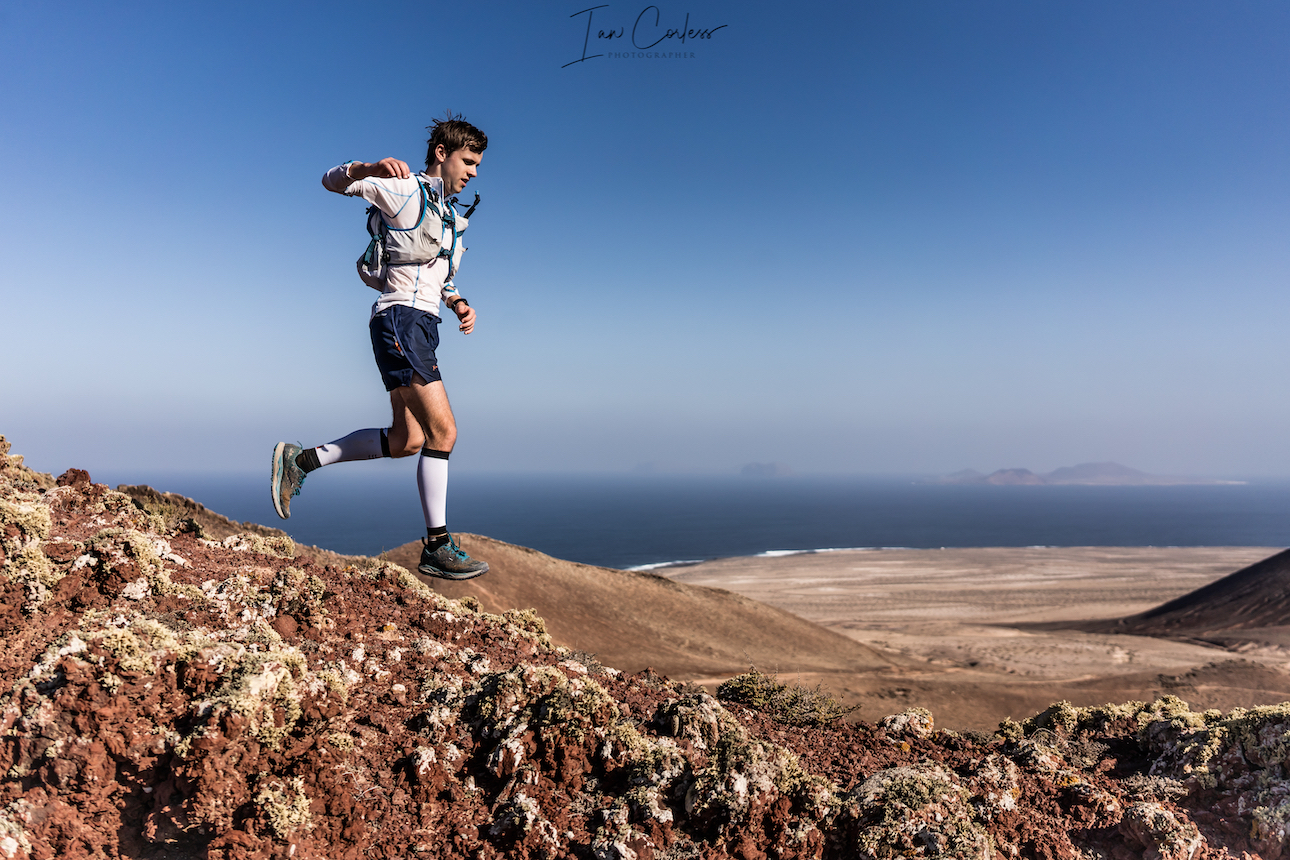
After a dehydrated breakfast, we split in to four groups, Inge taking a walking group, Sondre taking a run/walk group and Ian and Pierre taking run groups. Distances varied for the groups but Ian and Pierre took on a new route for the Lanzarote camp which totalled 18/ 20-miles and over 1000m vert with El Castillejo (615m) and Peñas del Chache (673m) the two high points. The wind made the challenge all the harder.
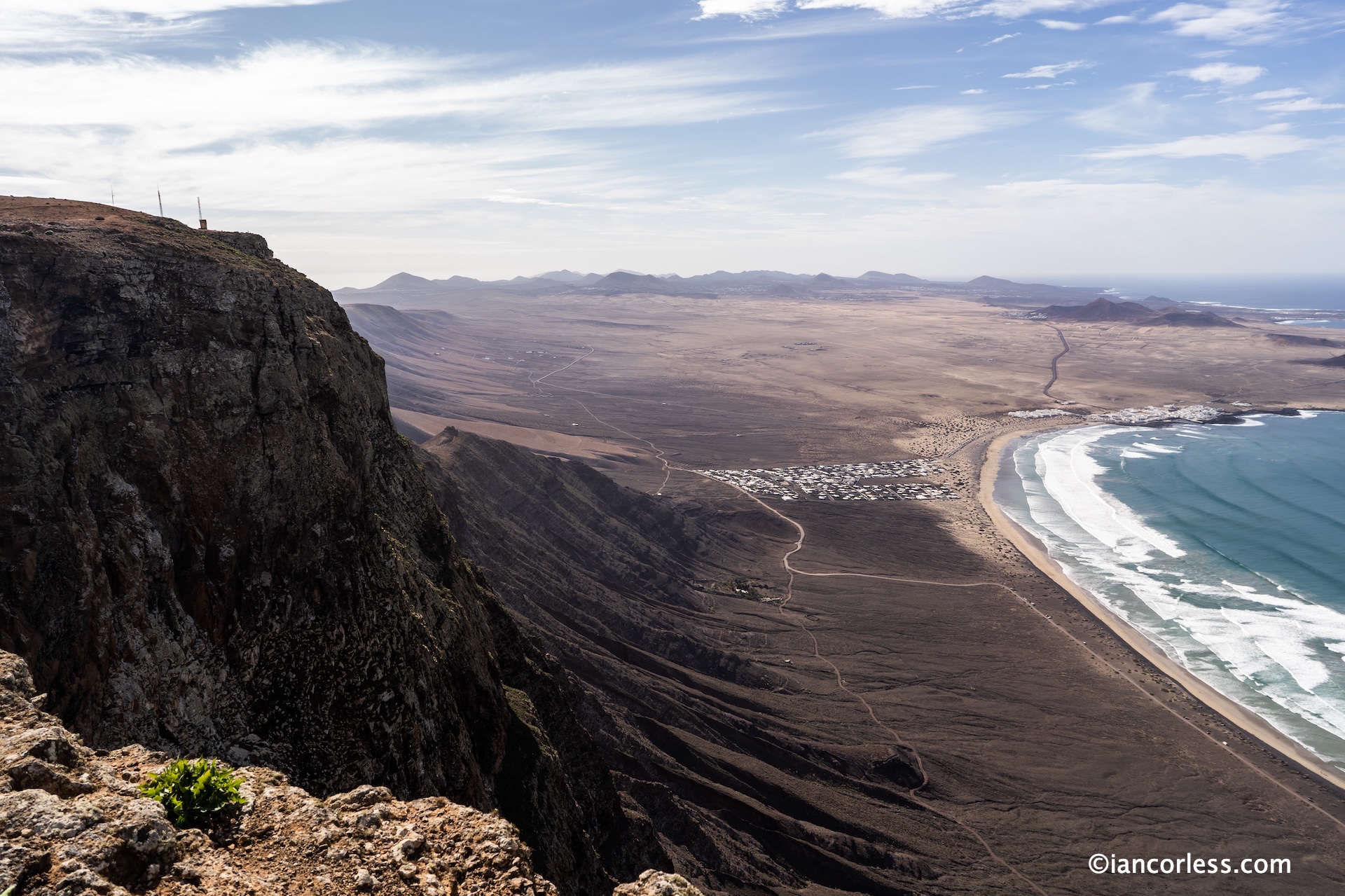
From the summit, you have great views of the ocean, Famara, and off in the distance, La Santa.
Back in Club La Santa, Elisabet and Pierre hosted a talk, Elisabet addressing foot care/ taping and Pierre bringing his physio skills to great use with a talk and practical on how to look after your body.
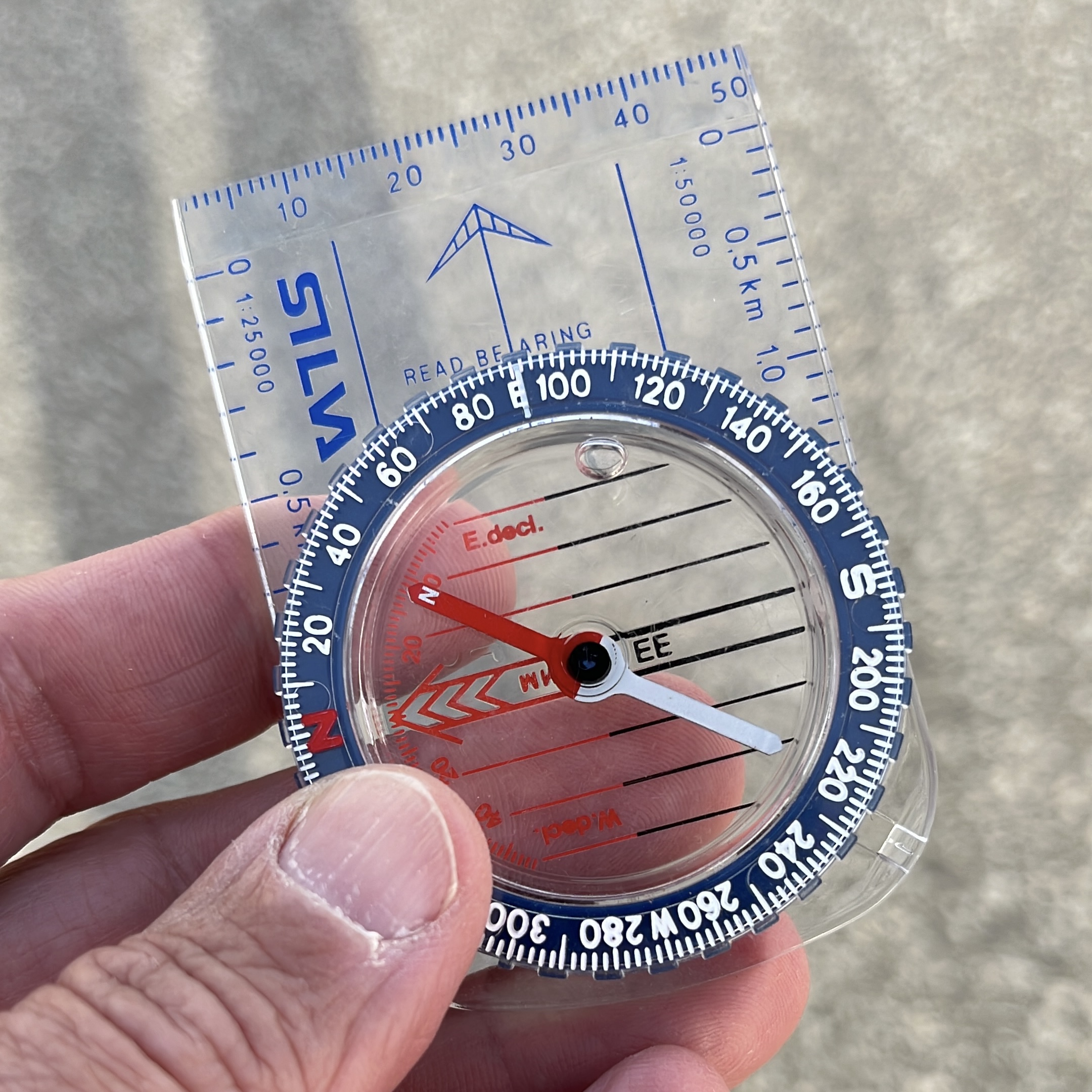
At 1730, Ian did a practical demonstration on compass and how to follow a bearing. An often neglected but required skill for races such as Marathon des Sables.
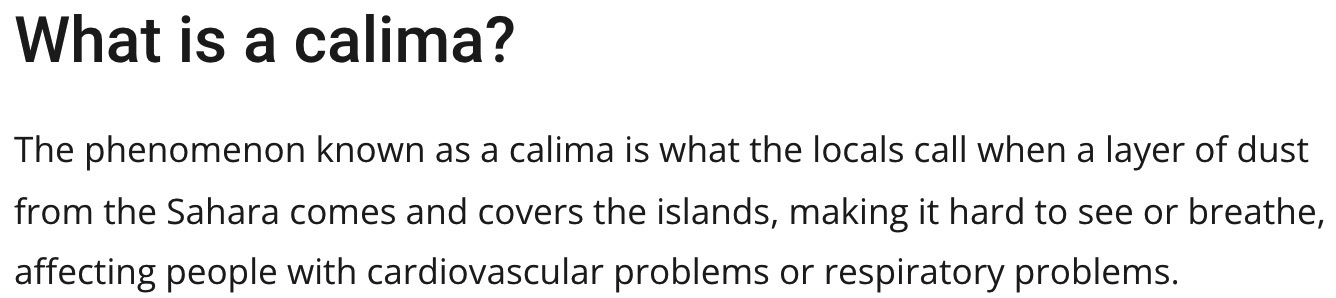
As day 4 concluded, the winds and ‘*Calima’ raged on. While the winds and sand bring a challenge, they are perfect for a training camp providing the clients with a great opportunity to really experience and learn.
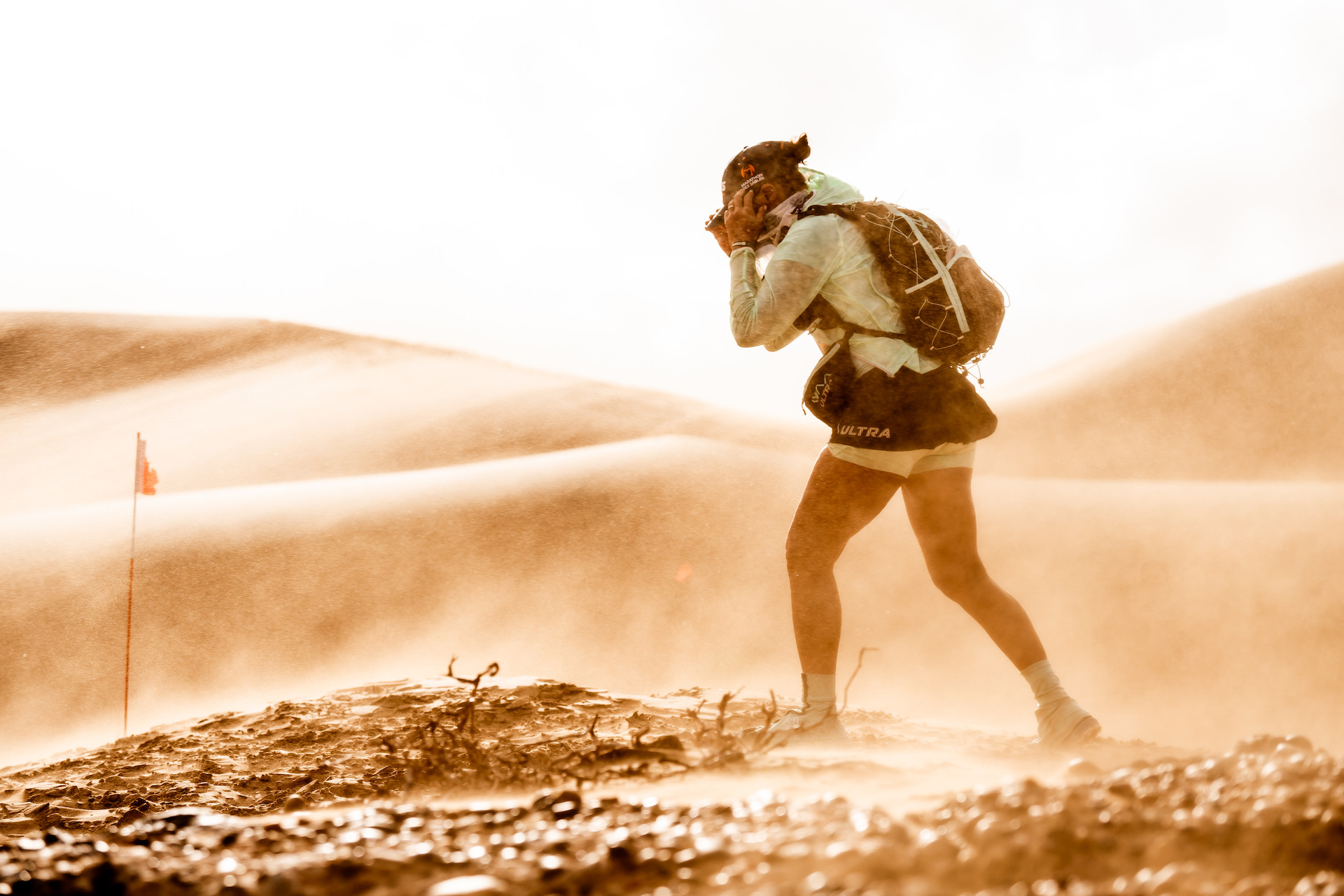
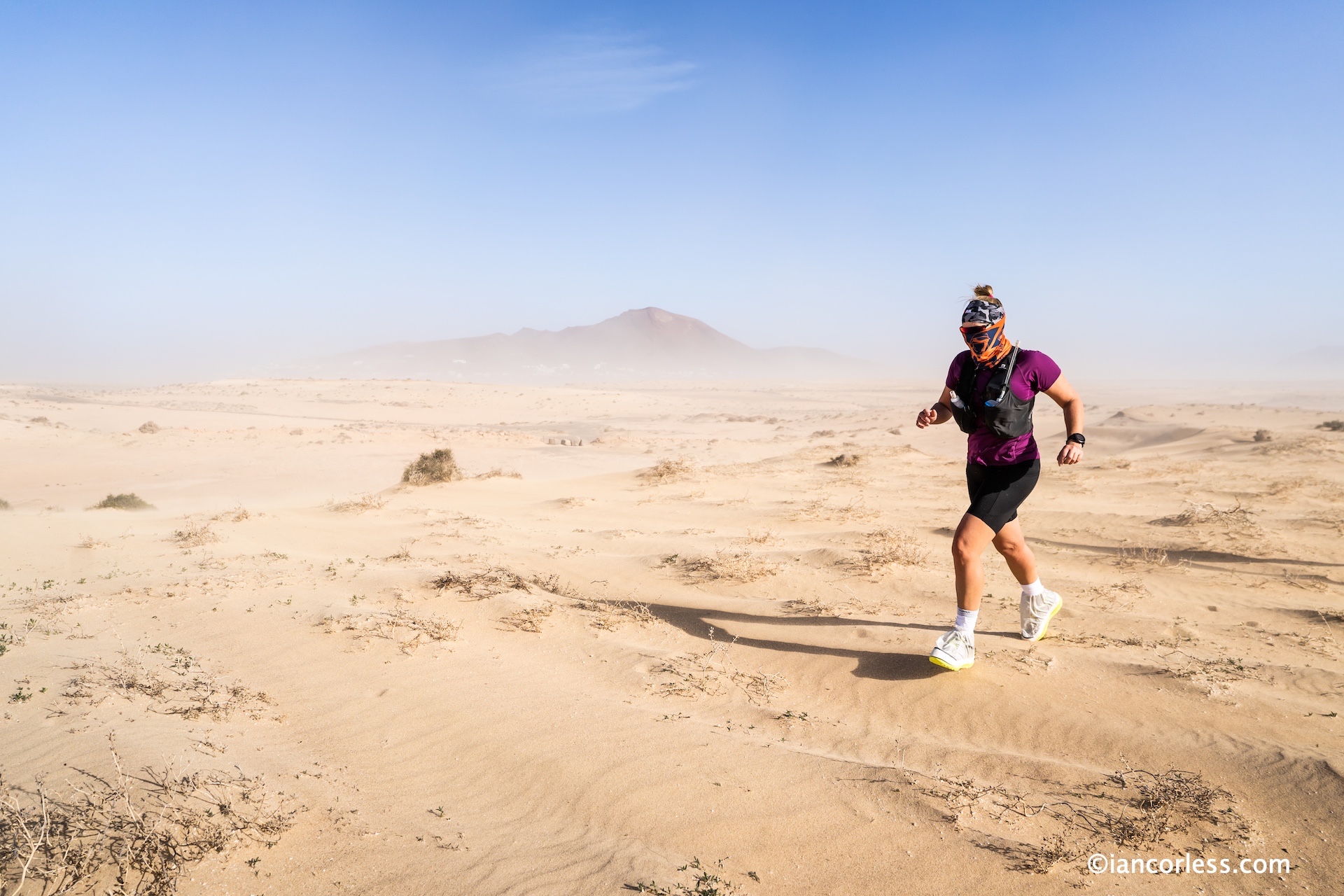
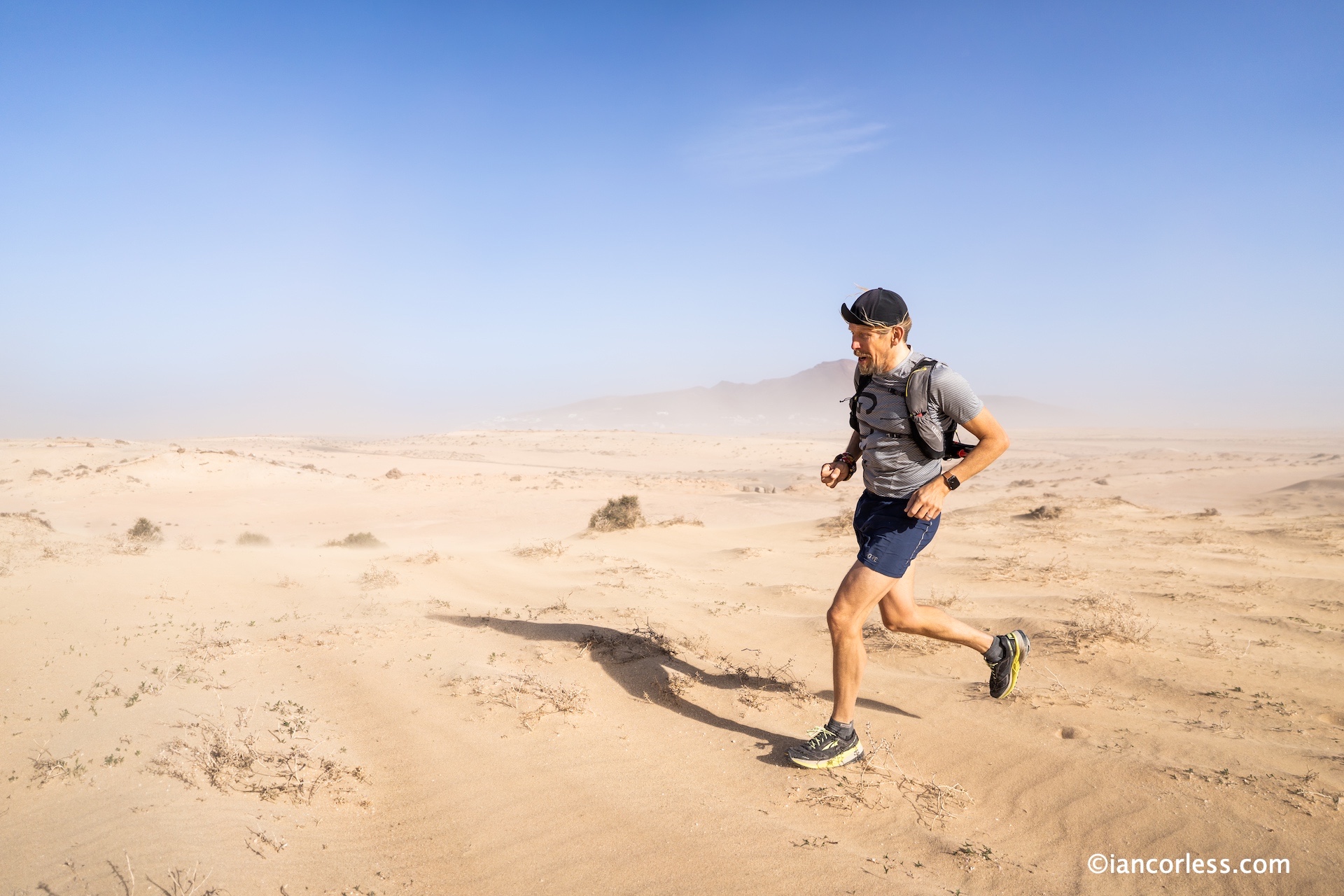
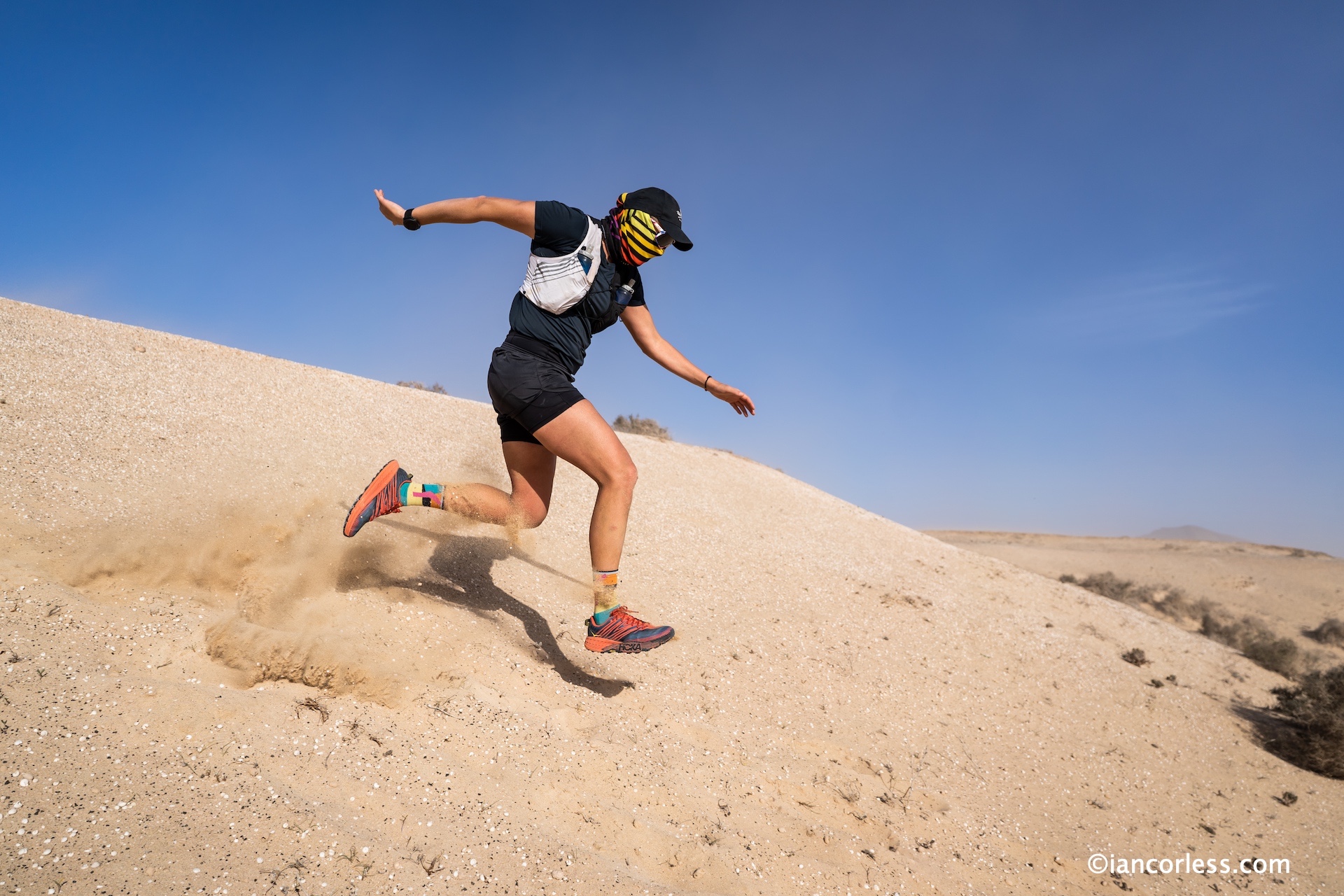
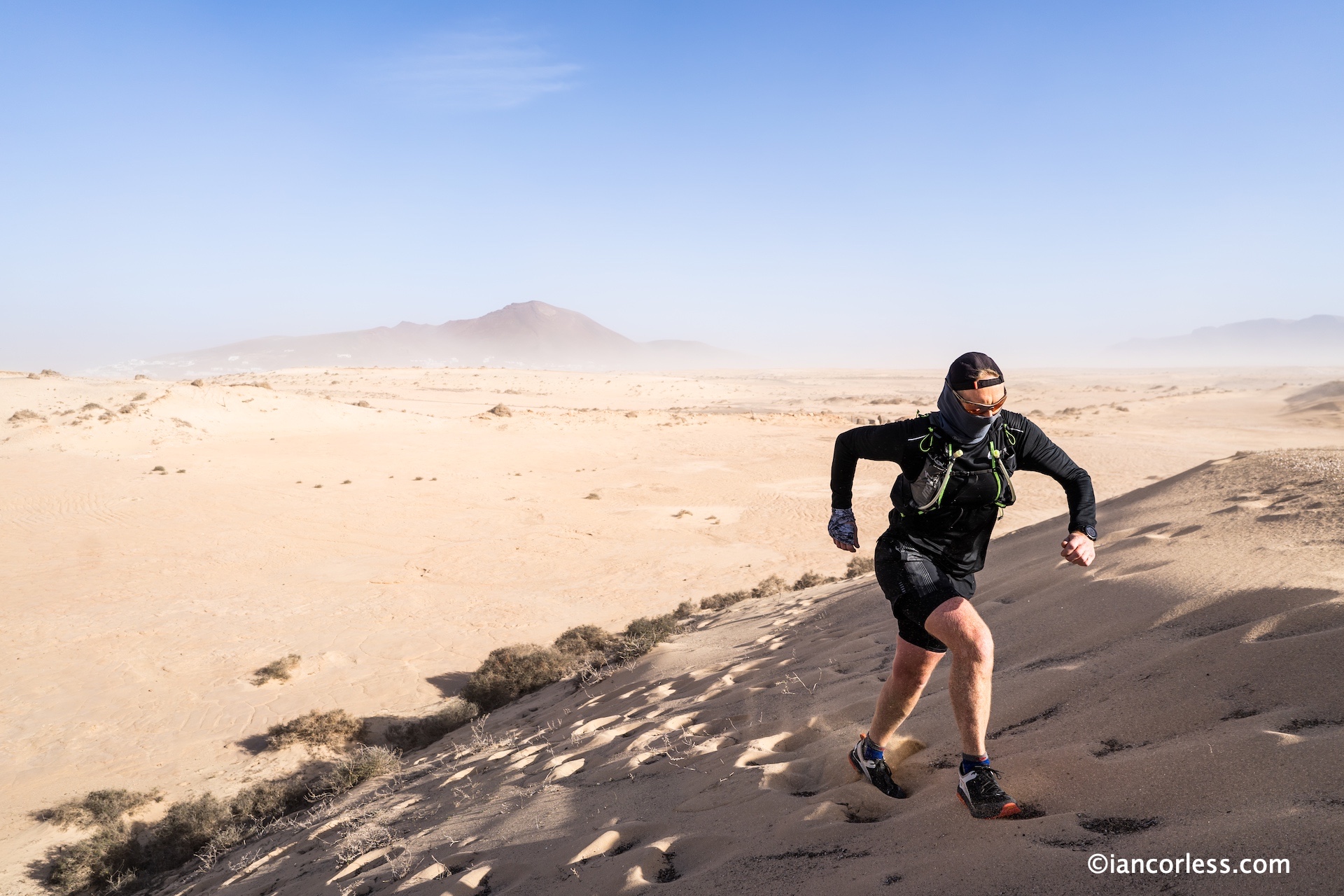
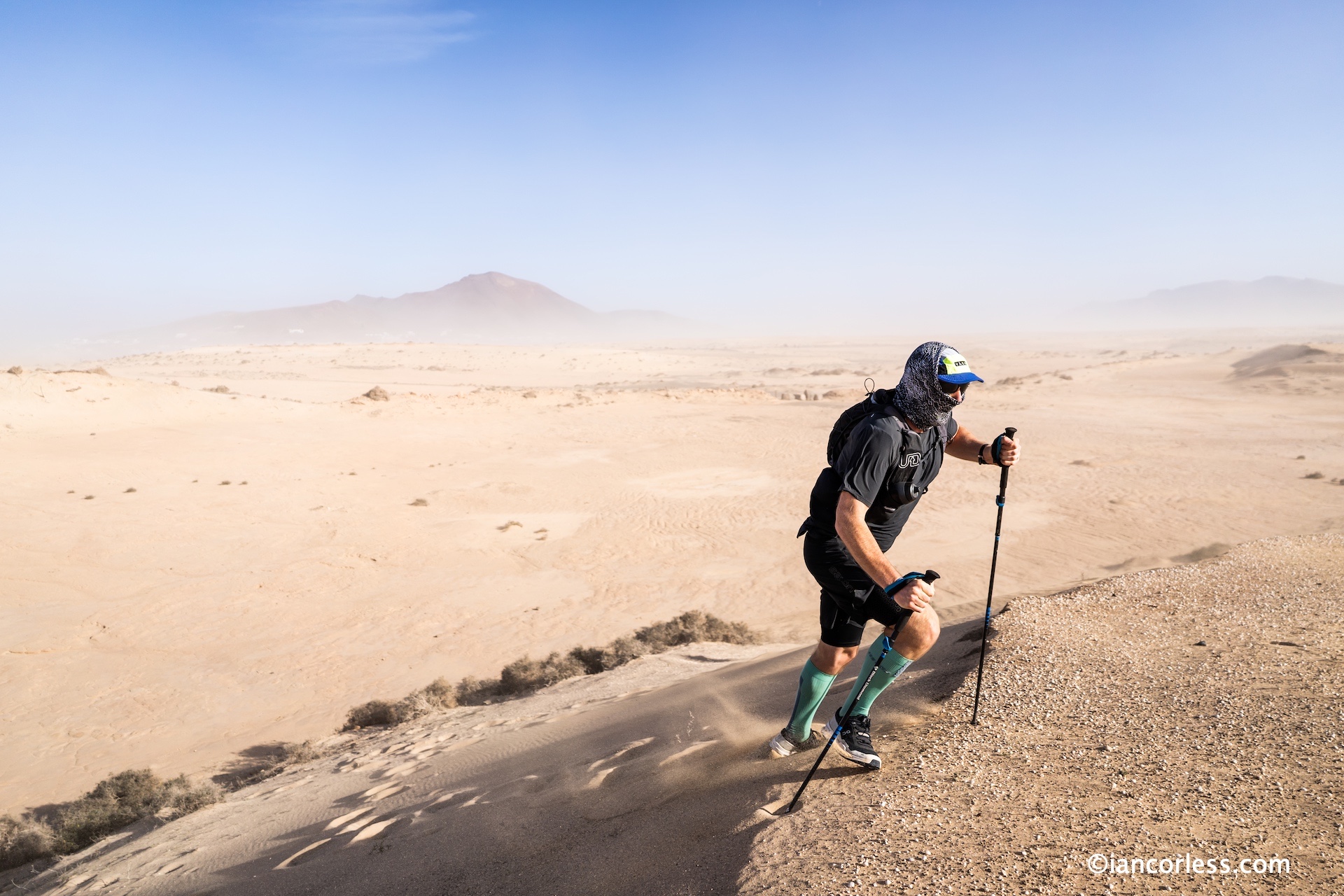
The winds raged on and the Calima intensified. Day 5 started with a soft sand/ dune run and we warned all participants to be mindful of the Calima and suggested wearing Buff (or similar) to protect nose and mouth. The reality was we had perfect sand storm conditions to run in.
After 10km of running in a strong headwind, battered by sand, we eventually settled in a soft-sand and small dune area to practice skills.
While many may consider strong winds and sand make for miserable running, we were all thankful of the opportunity that these conditions brought. Running in a sand storm takes skill, patience and a required mental approach.
With 20km done, it was a great morning of running and learning.
The afternoon talk by Elisabet and Sondre was about equipment, packing and how to ensure you choose the correct equipment for your desired race and how to get as light as possible without compromising what you need to race safely and effectively.
At 1730, the final session of the day was done by Ian who discussed poles and how to use them.
Day 6 tomorrow is a big day… A marathon over a point-to-point route starting in Uga and concluding at Club La Santa.
Please support this website. I believe everyone deserves to read quality, independent and factual articles – that’s why this website is open to all. Free press has never been so vital. I hope I can keep providing independent articles with your help. Any contribution, however big or small, is so valuable to help finance regular content. Please support me on Patreon HERE.
The penultimate day of our training camp was a cracker and one that many of the camp attendees have called a highlight.
Our first run was between 8-10 miles and included a climb, traverse and descent of the Montana Soo. It’s a great route and one that pushes many out of their comfort zone as the terrain is often steep, technical and challenging with loose stones.
At the summit it provides a great photo opportunity with Club La Santa off to the right in the distance.
For the more experienced runners, they move fast over the terrain embracing the challenge that it brings. Others move slower, more deliberate and thoughtful. We include it in the camp as it closely replicates the feeling and exposure that one can get at the large Djebel at Marathon des Sables.
After the mountain loop, we all returned back to CLS for a 3 hour break before a self-sufficient run. This is our mini multi-day experience that allows all our clients to run to a bivouac location in ability based groups with packs carrying sleeping bag, essential, dehydrated food for dinner and breakfast and a minimum of 1.5ltr of water. Most packs weigh around the 5kg mark.
We transport tents to the bivouac, rationed water and two gas burners to provide hot water for cooking. Once the runners leave CLS, they are self sufficient.
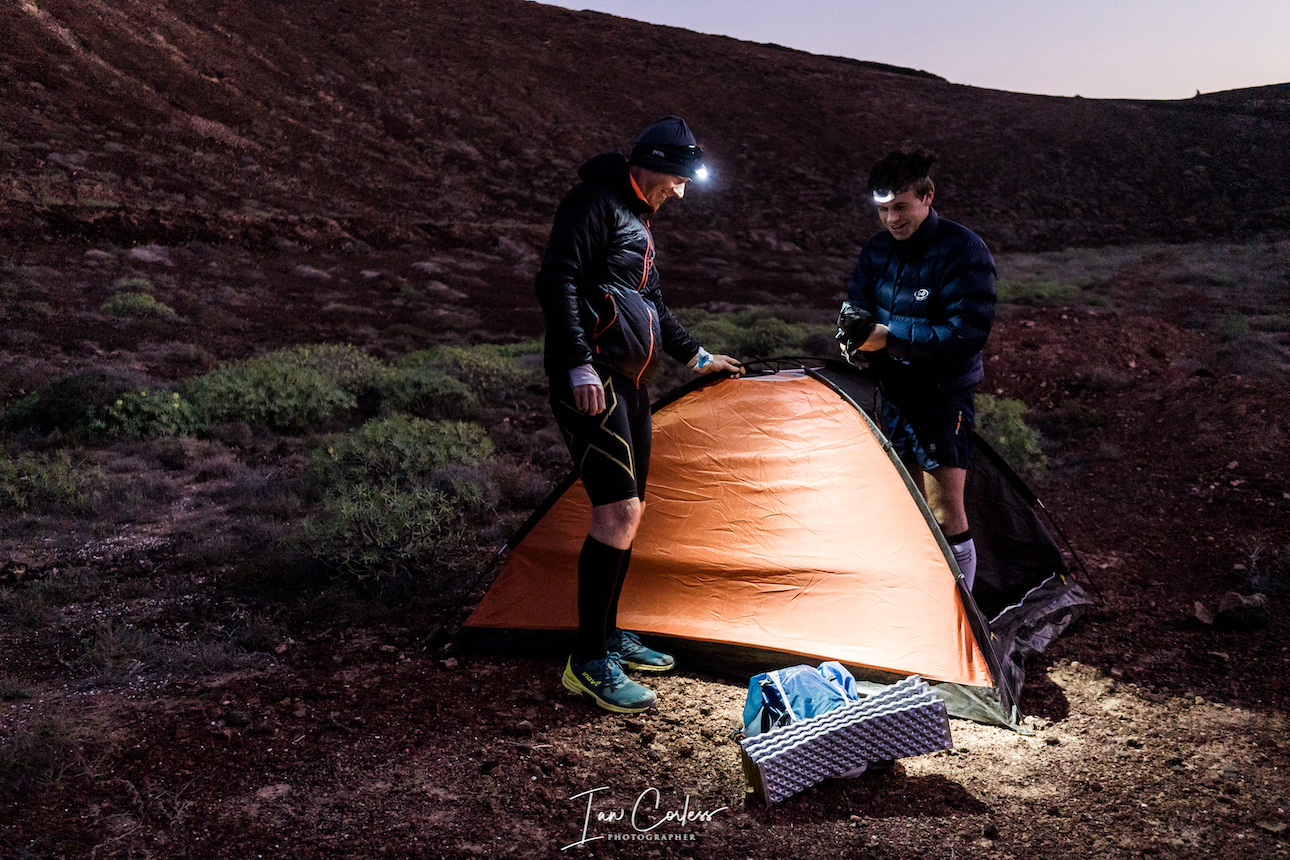
At the bivouac, they put up tents.
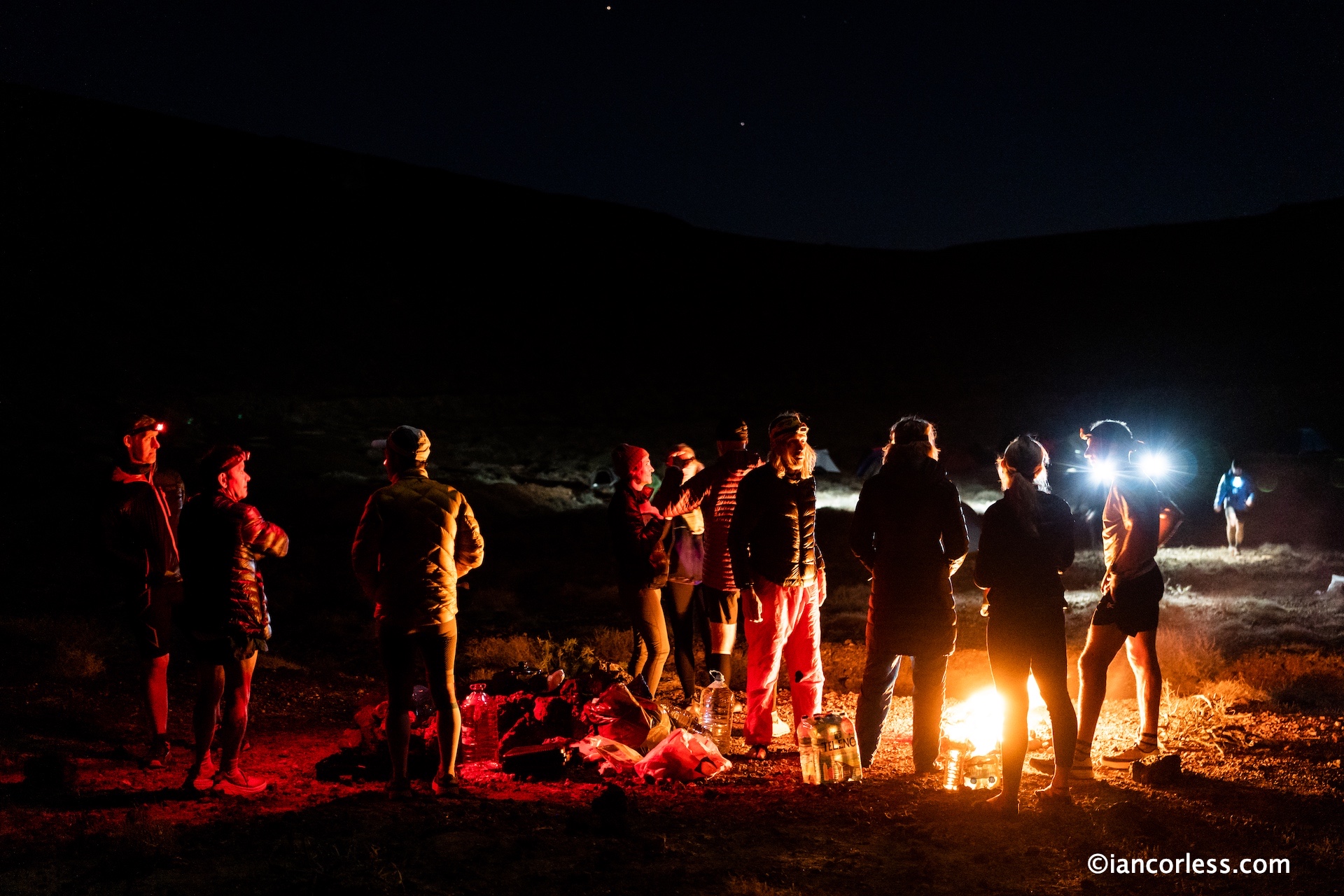
As the sun disappears they test out dehydrated food and simulate a bivouac experience. They understand the weather, the need for warmth and then they sleep under the stars.
Our night started perfectly with beautiful clear skies. Amazing star views and warm temperatures. As the night progressed, the wind increased and very much simulated a stormy night in the Sahara. For many, it was a sleepless night with shaking tents and sand being blown everywhere.
An early breakfast call, self-sufficient breakfast, water rations given and they were then off for another 13-miles of soft-sand and dune training before returning back to CLS.
Our final day has one final talk by Elisabet Barnes and Sondre Amdahl and then a group dinner to say farewell…
The next time we will all meet will be in Morocco for the 35th Marathon des Sables.
Our 2021 Training Camp will be announced soon HERE
Day 5 is bivouac day! Arguably, it is the day of the Lanzarote Training Camp that the runners dread but learn the most.
It’s quite simple – we simulate many of the feelings and experiences that you will encounter in your chosen multi-day self-sufficient race.
Runners leave with their race packs including sleeping bag, sleeping mat, food for the dinner, snacks, food for breakfast, a minimum 1.5ltr of water and clothes such as down jacket!
The attendees run or walk in guided groups to the bivouac taking a minimum of 2.5 hours. They then pitch a tent (transported for them) and then they are rationed water. Our bivouac is extra special – it is inside a volcano!
We provide hot water but many runners test and try their own cooking skills using Esbit and then they eat a dehydrated meal. It happens every year… “Oh wow, I love this meal!” to the opposite, “Oh my word, that is disgusting!”
It’s invaluable what can be learnt with a simulation night.
We get a roaring fire going and chat into the night – it is special!
The following morning, our camp attendees are welcomed to ‘rise’ with crow of a cockerel around 0630/ 0645. They then must prepare their own breakfast and prepare for another run; again, a minimum 2-hours.
A night under the stars and an opportunity to test sleeping bag, sleeping mat and all other aspects of self-sufficiency makes everyone realise what is good and what is bad.
Back at Club La Santa we have a 2-hour debrief talk and discussion, from here, all our attendees go away armed with the knowledge that will help them achieve the finish line of their next multi-day race.
No pain, no gain – well, that is what they say! Today, was ‘pain’ morning at the Lanzarote Training Camp when all the participants did at least 6 reps of a volcano.
It’s a challenging morning and the vertical gain is designed to replicate the largest jebel that has appeared in all the latest editions of Marathon des Sables.
Steep with lose gravel for the climb and the descent is a mixture of stone, lose rocks and sharp lava – a gravel road section allows some recovery before a repeating.
It was a hot day and although the session was tough – everyone loved it!
A break for lunch and then Elisabet Barnes did a practical workshop of foot care. It’s an essential session that prepares everyone with all the relevant skills to allow them the flexibility to be self-sufficient when racing. Elisabet also showed and demonstrated foot taping as a preventive measure against blisters.
At 6pm, the day concluded with an easy 5 or 10km shake-outrun to loosen the legs!
British humour, it’s a wonderful thing! Dry, witty and at times it can be difficult to tell if a joke is really being told… David Loxton personifies this and in all honesty, it’s this humour that got him and his tent mates through the 31st edition of the Marathon des Sables. Niandi Carmont picks up the story from within the bivouac.
*****
Nothing like a touch of humour to help your tent mates get through a challenging event like the MDS. Humour is a natural pain-killer …
David Loxton has just finished the marathon stage and joined the ranks of finishers over the 31 editions of the MARATHON DES SABLES. He is relaxed in his tent, a bit grubby as can be expected but grinning from ear to ear. His tent mates look happy too. And no surprise as they are in good company – David is a laugh and a gaffer too.
So how did it go I ask?
“I’ve got no blisters, I’ve got very tough feet and I’ve been very quick most days, apart from the long day where I wasn’t quite as quick. What else? I hate sand, I hate sunshine …”
His tent mates crack up laughing.
Seriously, I ask if he feels he’s got in enough preparation or was the event tougher than he expected?
“Nobody told me about preparation so I thought I’d just pitch up and do it.” More laughter. “Well I did do a training camp in Lanzarote to train for this in January.”
I ask him if he had any moments of doubt during the event.
“On day 1 actually I did. I thought I can’t do this for the next 5 days. It hurts. Beyond that it was OK. Apart from day 2 and a few moments of day 3 and most of day 4. Day 5 was good apart from the bad bits.”
I ask him if he would do anything differently if he had to do it again.
“I would probably search online for some tent mates. Probably do some more work on the fitness and definitely pack before the Thursday night. We flew to Morocco on Friday.”
I know he’s not serious but he’s funny anyway and his mates seem to be enjoying his self-depracating humour.
“I’d also bring some business cards for the ladies.”
I ask him if he met some interesting people.
“I met some of the people from the training camp in January. I made myself unpopular with the Helpful Heroes tent by accidently stealing some of their water flavours, the French guys have been good and the Japanese guys too. I’ve loved every moment of it but once is maybe enough for me.”
Is he looking forward to getting back to wet, windy and cold UK?”
“No I’m married.”
And has he learnt anything from his experience? Suddenly David takes on a more serious air, this time he’s not joking, he’s more philosophical.
“In terms of fitness it is surprising what you can do, how far you can push yourself. Sometimes your mind can overrule your body. The guys here have got some pretty horrific blisters and they’ve worked through it and they found more within themselves than they expected.”
When you are back in Ouarzazate and back in civilisation, what is the first thing you will treat yourself to?
“Apart from beer? The first thing will be beer, the second thing will be beer, the third thing will be beer …and after that I will phone home.”
And I lift my glass to David who deserves that long-awaited beer after keeping his mates going with his very special priceless sense of humour!
Read Niandi’s interview with ladies 2016 MDS champion HERE
Read a summary and view images of the 31st edition HERE